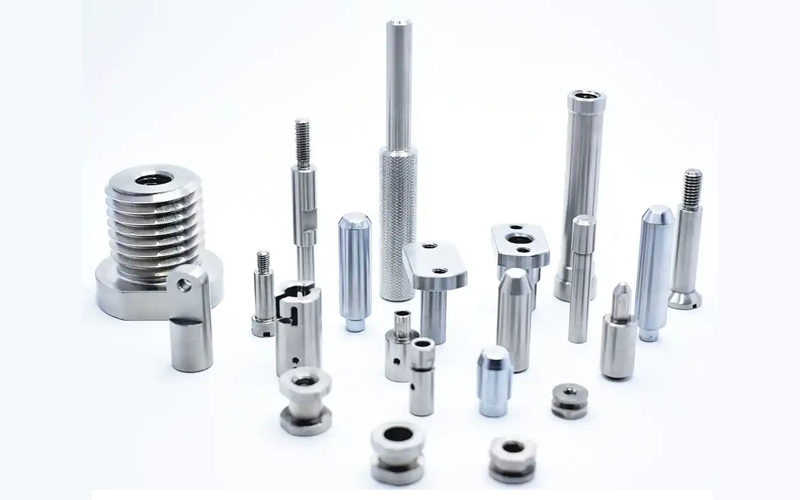
When it comes to manufacturing custom carbon steel pipe fittings, many buyers assume that free machining steel (such as 12L14, 1215, Y15, or 11SMn30) is universally easy to form. After all, these materials are prized for their excellent machinability, particularly in CNC turning operations.
However, in practice, using free machining steel for cold heading or cold forming can be disastrous. At Yuhuan Hongqian Machinery Co., Ltd., a professional CNC turning factory based in Zhejiang, China, we have consulted with numerous cold heading suppliers and verified that these materials are prone to cracking under cold forming conditions. For critical components such as threaded pipe fittings and hydraulic connectors, any cracks are unacceptable.
Instead, we have adopted hot forging (red forging) as the primary forming method for free machining steel pipe fittings. While slightly more expensive than cold heading, this method ensures structural integrity and meets European quality expectations.
In this article, we will explain why free machining steel cracks under cold heading, compare material options, and demonstrate our optimized solution for pipe fitting production.
Understanding Free Machining Steel
Free machining steels are engineered to improve cutting performance. Common grades include:
-
12L14 (ASTM A108) – Leaded steel widely used in CNC turning for its exceptional machinability.
-
1215 / Y15 – European and Chinese variants with sulfur or lead additives.
-
11SMn30 (EN standard) – European free cutting steel, popular in pipe and thread fittings.
Characteristics
| Material | Lead (Pb) | Sulfur (S) | Machinability | Cold Heading Suitability |
|---|---|---|---|---|
| 12L14 | 0.3–0.35% | ~0.15% | Excellent | Poor |
| 1215 | 0.3–0.35% | ~0.15% | Excellent | Poor |
| Y15 | 0 | 0.12–0.15% | Very Good | Poor |
| 11SMn30 | 0 | 0.28% | Very Good | Poor |
Why are they “free machining”?
-
Sulfur forms MnS inclusions, which act as natural chip breakers.
-
Lead is dispersed in small particles, reducing friction during cutting.
-
The steel exhibits excellent machinability on CNC lathes, automatic machines, and threading operations.
Why Free Machining Steel Cracks During Cold Heading
Although these steels are easy to machine, they do not perform well under large plastic deformation. Cold heading relies on compressing and reshaping the material at room temperature. The mechanisms behind cracking include:
-
Non-metallic inclusions (MnS) as stress concentrators
-
During cold forming, these inclusions create weak points.
-
Cracks initiate at inclusion boundaries.
-
-
Lead particles reduce ductility
-
Lead does not contribute to structural strength.
-
During compression, lead particles cannot deform with the surrounding steel, forming micro-voids that become crack nuclei.
-
-
High internal stress in cold deformation
-
Cold heading generates stress throughout the material.
-
Free machining steel cannot absorb this stress effectively.
-
| Process Type | Free Machining Steel | Low Carbon Steel | Medium Carbon Steel |
|---|---|---|---|
| CNC Turning | Excellent | Good | Good |
| Threading | Excellent | Good | Fair |
| Cold Heading | Poor (cracks) | Good | Good |
| Hot Forging | Excellent | Excellent | Excellent |
Conclusion: Free machining steel is excellent for CNC turning, threading, and machining, but not suitable for cold heading, especially for critical pipe fittings or threaded hydraulic parts.
Our Solution: Hot Forging for Free Machining Steel Pipe Fittings
At Yuhuan Hongqian Machinery Co., Ltd., we manufacture custom pipe fittings from free machining steel using hot forging instead of cold heading.
Why Hot Forging?
-
Improved ductility at high temperatures
-
Steel softens, reducing stress concentration.
-
-
Eliminates cold cracks
-
Reduces the risk of internal fissures.
-
-
Better material utilization
-
Complex shapes can be formed with minimal waste.
-
-
Compliance with European quality expectations
-
European buyers specifically request 12L14, 1215, or 11SMn30 materials.
-
Hot forging ensures a crack-free final product.
-
Cost Consideration
-
Hot forging is slightly more expensive than cold heading.
-
The cost is justified by eliminating scrap and ensuring integrity.
Material Comparison for Pipe Fittings
For pipe fitting applications, particularly threaded fittings and hydraulic connectors, selecting the right material is essential:
| Material | Typical Use in Pipe Fittings | CNC Machining | Cold Heading | Hot Forging |
|---|---|---|---|---|
| 12L14 | Threaded pipe fittings | Excellent | Not suitable | Excellent |
| 1215 | Threaded connectors | Excellent | Not suitable | Excellent |
| Y15 | Small diameter fittings | Very Good | Not suitable | Excellent |
| 11SMn30 | European standard fittings | Very Good | Not suitable | Excellent |
| 1045 | Medium carbon fittings | Good | Suitable | Excellent |
Key Takeaway: For free machining steel, hot forging is the safest forming method for high-quality pipe fittings.
How We Apply This in Custom CNC Pipe Fittings Production
At our Zhejiang factory, we follow a structured workflow:
-
Material Analysis
-
Verify grade (12L14, 1215, 11SMn30)
-
Check availability in local or imported stock
-
-
Blank Form Selection
-
Hot forging for free machining steel
-
Bar stock for small batch machining
-
Pipe blanks for hollow fittings
-
-
Machining & Threading
-
CNC turning for dimensional accuracy
-
Threading and finishing per drawing
-
-
Quality Control
-
First article inspection
-
In-process inspection
-
Final inspection before shipment
-
Factory Capabilities:
-
60 CNC lathes
-
Monthly production capacity to meet MOQ 2000 pcs
-
Support for 2D and 3D drawings
-
Export experience to Europe
FAQ for Free Machining Steel Pipe Fittings
Q1: Can 12L14 be cold headed?
A1: No. It is prone to cracking. Hot forging or CNC turning is recommended.
Q2: Why do European clients prefer 12L14 or 11SMn30?
A2: These materials offer excellent machinability and surface finish for threaded and hydraulic fittings.
Q3: Is hot forging more expensive than cold heading?
A3: Slightly, but it eliminates scrap, rejects, and guarantees crack-free parts.
Q4: Can Y15 or 1215 steel be used for small fittings?
A4: Yes, especially for pipe fittings and threaded parts. Hot forging is recommended.
Q5: Can your factory produce custom sizes?
A5: Yes. We support 2D/3D drawings and small or medium batch production.
Q6: What is the MOQ for custom free machining steel pipe fittings?
A6: Generally 2000 pcs per design.
Conclusion
Free machining steel is excellent for CNC machining but cannot be cold headed without risking cracks.
For threaded pipe fittings, hydraulic connectors, and other precision components:
-
12L14, 1215, Y15, 11SMn30 → hot forging ensures integrity
-
CNC turning → ensures precise dimensions and threads
-
Selecting the right blank and forming method reduces scrap, lowers risk, and meets European standards
At Yuhuan Hongqian Machinery Co., Ltd., our engineering team optimizes material selection, forming method, and machining process to produce crack-free, high-quality pipe fittings for European buyers and other international customers.