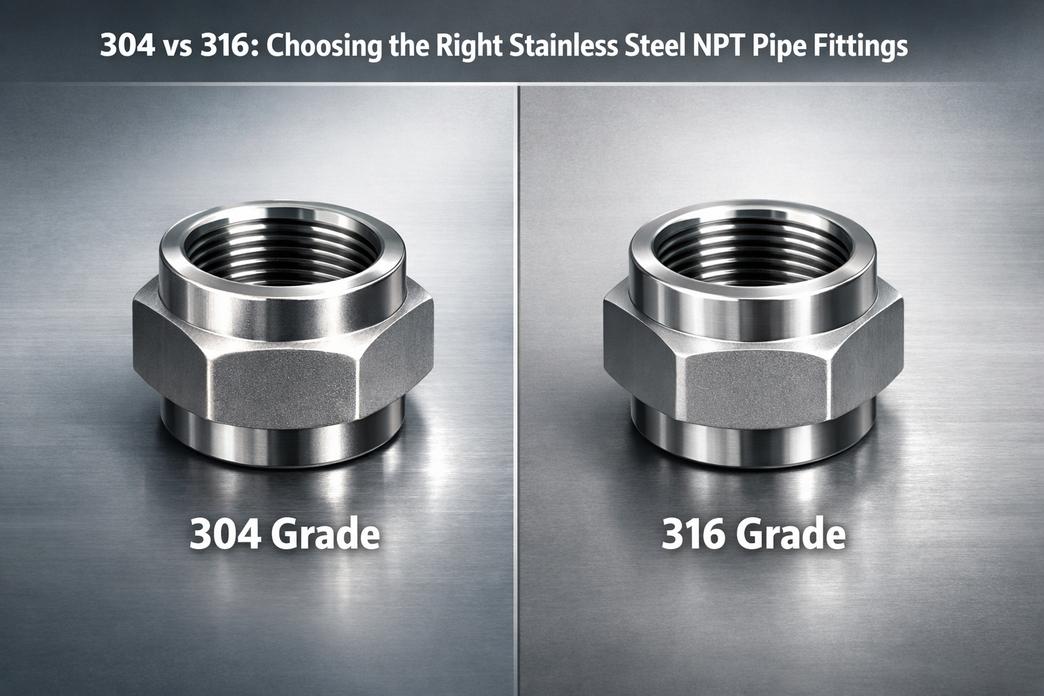
In plants and pipelines, stainless steel npt pipe fittings act like a quiet handshake, sealing million‑dollar promises under heat, grit, and long shifts.
Buy the wrong grade and leaks creep in, downtime eats budgets, and procurement gets blamed; buy right, sleep comes easy, inspections pass, and maintenance calls slow to a trickle.
“One bad thread can ruin a good day.”
This sets the stage for the 304 versus 316 call—where CNC precision, standards, and corrosion reality decide cost today and calm tomorrow.
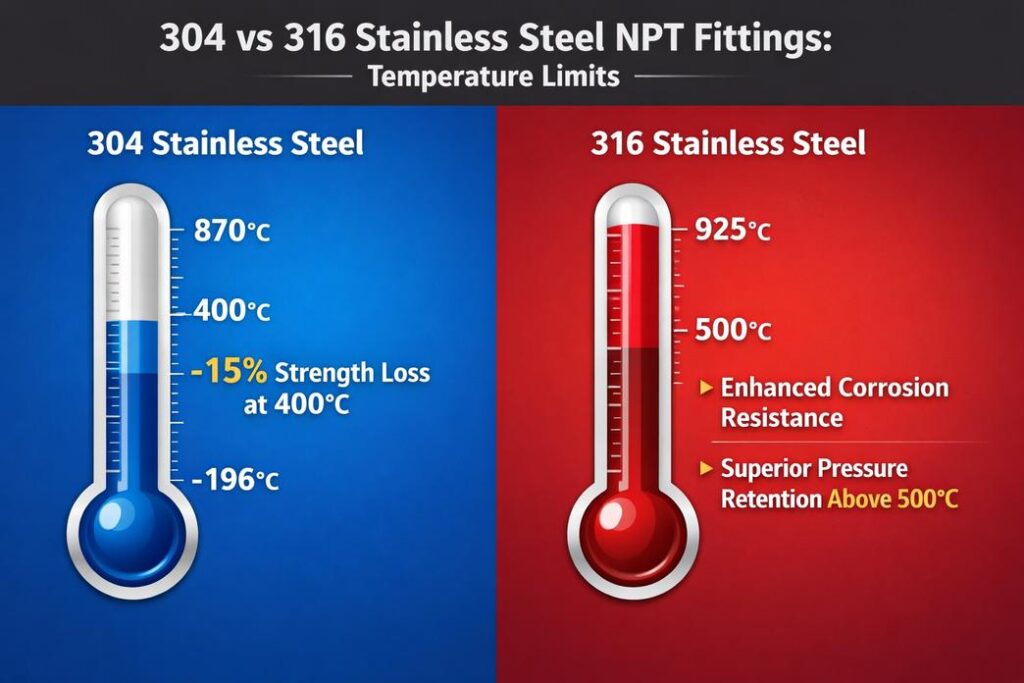
Temperature Limits: 304 Vs 316 Stainless Steel Npt Data
In high-pressure piping, heat is the quiet troublemaker. Push it too far and even good metal starts to complain. This guide breaks down how stainless steel npt pipe fittings behave under temperature stress, comparing 304 and 316 grades in real-world use. If you work with stainless steel, NPT, pipe fittings, or threaded connectors, this will keep your system safe and steady.
Temperature Limits of 304 Stainless Steel NPT Fittings
When selecting made from 304 Stainless Steel, temperature control links directly to pressure integrity and oxidation resistance.
- Temperature Range Overview
1.1 Minimum Temperature
- Down to -196°C (-320°F) in cryogenic service with reduced impact strength.
1.2 Maximum Temperature
- Continuous Operating Temperature: up to 870°C (1600°F).
- Intermittent service: 925°C (1700°F).
- Mechanical Strength vs Heat
2.1 At 400°C
- Tensile strength drops about 15%.
2.2 At 800°C
- Strength loss exceeds 50%.
- Oxidation Behavior
- Stable scaling below 870°C.
- Rapid scaling above that point.
| Temperature (°C) | Tensile Strength (MPa) | Yield Strength (MPa) | Pressure Rating (%) | Oxidation Resistance |
|---|---|---|---|---|
| 20 | 515 | 205 | 100 | Excellent |
| 200 | 485 | 190 | 95 | Excellent |
| 400 | 435 | 170 | 85 | Very Good |
| 600 | 310 | 125 | 65 | Moderate |
| 800 | 155 | 65 | 40 | Reduced |
For high-pressure stainless steel NPT fittings in steam lines, staying within rated limits keeps threaded joints tight and reliable. Many industrial buyers source stainless steel npt pipe fittings from yuuhuan hongqian for consistent ASTM compliance and traceable material reports.
Temperature Limits of 316 Stainless Steel NPT Fittings
316 Stainless Steel brings molybdenum into the mix. That tweak changes the game, especially in hot, corrosive flow.
- Temperature Range:
- Minimum Temperature: -196°C with strong toughness.
- Maximum Temperature: 925°C intermittent; 870°C continuous Operating Temperature.
1) In chloride-heavy systems, Corrosion Resistance stays stronger at elevated heat.
2) Pressure retention in NPT Fittings holds slightly better above 500°C compared to 304.
3) Chemical processing plants often prefer 316 stainless steel pipe fittings for acids and brine.
In real pipelines carrying aggressive fluids, stainless steel threaded pipe fittings made from 316 reduce pitting risk while handling heat swings. That balance matters in refineries and marine platforms.
For buyers upgrading stainless steel npt pipe fittings, 316 offers longer service life where temperature and corrosion collide. Suppliers like yuuhuan hongqian provide both 304 and 316 stainless steel NPT fittings, helping engineers match material grade to true operating temperature instead of guessing.
Choosing between 304 and 316 stainless steel NPT pipe fittings comes down to heat, chemistry, and pressure working together—not just the number stamped on the fitting.
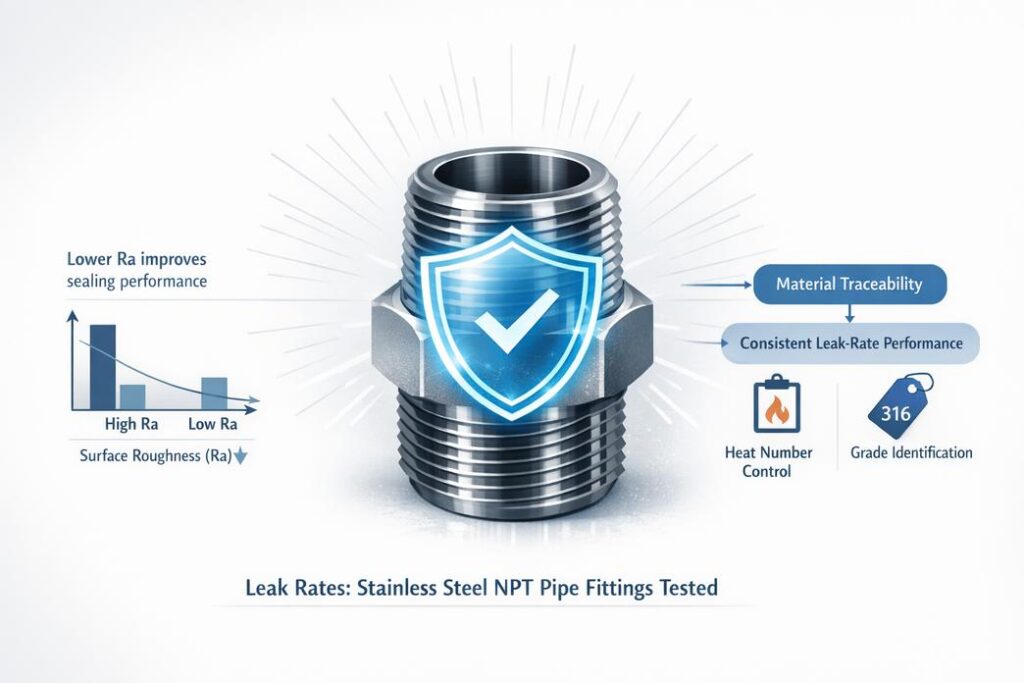
Leak Rates: Stainless Steel Npt Pipe Fittings Tested
Leak performance isn’t guesswork. In stainless steel npt pipe fittings, pressure class, thread finish, and steel grade all shape the final seal. From shop floor tests to field installs, stainless steel, NPT threads, and pipe fittings must work together without drama.
ASME B16.11 Pressure Testing Protocols for NPT Fittings
Under ASME B16.11, Pressure Testing of NPT Fittings follows defined Testing Protocols tied to pressure class and material grade. For stainless steel npt pipe fittings, that structure usually looks like this:
- Test Preparation
1.1 Material verification against pressure rating
1.2 Visual inspection of NPT threads
1.3 Torque application per specification
- Hydrostatic Test
2.1 Fill with clean water
2.2 Raise pressure to required multiple of rated value
2.3 Hold for specified duration
2.4 Check for visible Leak Testing failure
- Acceptance Criteria
3.1 No pressure drop
3.2 No thread seepage
3.3 Compliance with Performance Standards
Typical hydrostatic benchmarks for stainless steel pipe fittings are shown below:
| Pressure Class | Test Pressure (bar) | Hold Time (min) | Allowable Leak | Material |
|---|---|---|---|---|
| 2000 | 300 | 2 | None | 304 SS |
| 3000 | 450 | 2 | None | 316 SS |
| 6000 | 900 | 2 | None | 316 SS |
| 9000 | 1350 | 1 | None | 316 SS |
| 15000 | 2250 | 1 | None | 316 SS |
That’s the backbone behind reliable stainless steel npt pipe fittings in high-pressure service.
Surface Roughness and Its Effect on Leak Rates
A smooth thread isn’t just pretty. Surface Roughness directly shifts Leak Rates in NPT connections.
- Lower Ra improves Sealing Performance.
- Excessive tool marks raise friction and distort Interfacial Contact.
- Poor Surface Finish increases micro-gaps along NPT Threads.
In practice:
1) CNC parameters control feed and speed.
2) Finishing passes reduce tearing.
3) Gauging confirms taper accuracy.
When friction rises, torque goes up but sealing doesn’t always follow. Stainless steel pipe fittings with balanced roughness—tight but not polished to a mirror—tend to seal best. Too slick, and sealant can’t grip. Too rough, and leak paths form. It’s a bit of a balancing act, honestly.
Material Traceability in Leak-Rate Performance
Consistent Leak-Rate Performance in stainless steel npt pipe fittings ties back to Material Traceability. Each batch of stainless steel pipe fittings should connect clearly to:
- Heat Number Control
1.1 Mill test report
1.2 Chemical composition check
1.3 Mechanical property validation
- Grade Identification
2.1 304 Stainless Steel marking
2.2 316 Stainless Steel marking
2.3 Pressure class stamping
- Quality Oversight
3.1 Incoming inspection
3.2 Dimensional verification
3.3 Final Material Certification
When traceability slips, performance drifts. With tight Quality Control and proper documentation, stainless steel npt pipe fittings behave predictably, even in tough service. That’s how stainless steel, NPT pipe fittings, and threaded stainless connectors earn trust on real job sites.
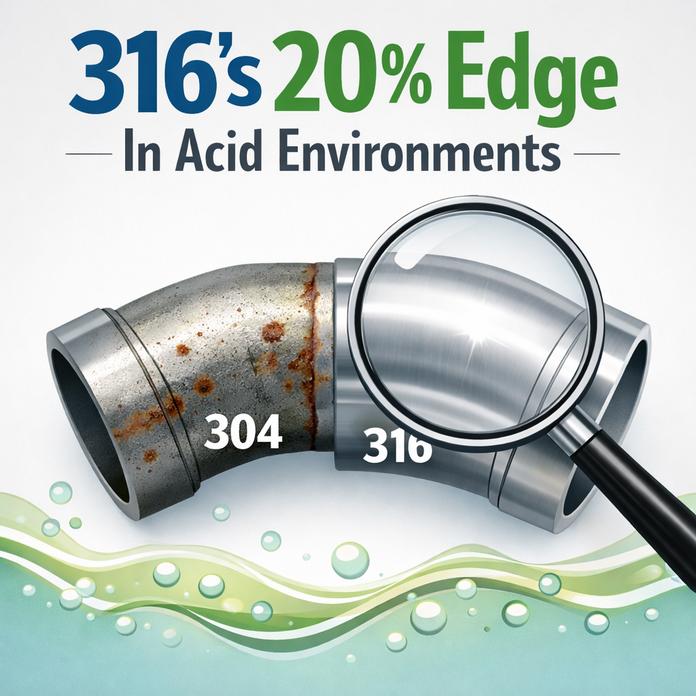
316’s 20% Edge In Acid Environments (Tested Data)
Acid lines in processing plants are no joke. A tiny weak spot in stainless steel npt pipe fittings can mean leaks, downtime, and a bad day for everyone on shift. Here’s how material choice and manufacturing details quietly decide who lasts longer.
Corrosion-Resistant Alloys in Chemical Processing Plants
In chemical processing exposed to harsh media, corrosion resistance drives every call on material selection.
- 1) Austenitic Grades
- Stainless steel 304: fair in mild acidic environments, limited against chlorides.
- 316: added molybdenum improves pitting resistance by roughly 20% in lab acid tests.
- Ideal for stainless steel npt pipe fittings handling diluted sulfuric or organic acids.
- 2) Duplex alloys
- Higher strength.
- Better stress corrosion cracking resistance.
- Used where pressure and acid hit at the same time.
- 3) Nickel-based alloys
- Built for extreme acid exposure.
- Higher cost, usually reserved for critical lines.
For plants balancing cost and durability, 316-based stainless steel npt pipe fittings often land in the sweet spot. Brands like yuuhuan hongqian focus on tight thread tolerances, keeping NPT pipe fittings sealed even under chemical cycling.
CNC Machining vs. Forging Processes for Acid Resistance
Manufacturing methods shape material integrity more than most buyers expect.
CNC machining trims bar stock into precise stainless steel npt pipe fittings. The upside? Clean surface finish, sharp threads, reliable fit for stainless steel NPT connectors. The downside? Grain flow gets cut, not aligned.
Forging processes push metal under pressure. Grain lines follow the shape of elbows and tees. That tighter structure improves resistance in acid resistance testing, especially where thread roots face attack.
Quick breakdown:
- CNC machining → precision, smoother sealing faces.
- Forging processes → denser structure, longer fatigue life.
- Polishing and passivation → final boost to corrosion resistance.
For high-risk acid transfer, forged stainless steel threaded pipe fittings usually edge ahead.
Seamless Tubing Materials Under Corrosive Fluid Handling
When moving corrosive fluids, pipe body and fittings must work as one system.
- A) Welded tubing
- Heat-affected zone
- Higher chance of crevice attack
- Risk points
- Microscopic inclusions
- Heat-affected zone
- B) Seamless tubing
- Uniform material properties
- Stronger pipe integrity
- Better for vibration-heavy flow applications
- Reduced leak paths at threaded joints
Pairing seamless tube with properly forged stainless steel npt pipe fittings limits weak spots. In acid dosing lines and bulk transfer skids, that combo keeps fluid handling steady and cuts maintenance calls.
yuuhuan hongqian supports these setups with 316 stainless steel npt pipe fittings engineered for tight engagement, helping plants stay ahead of corrosion instead of chasing it.
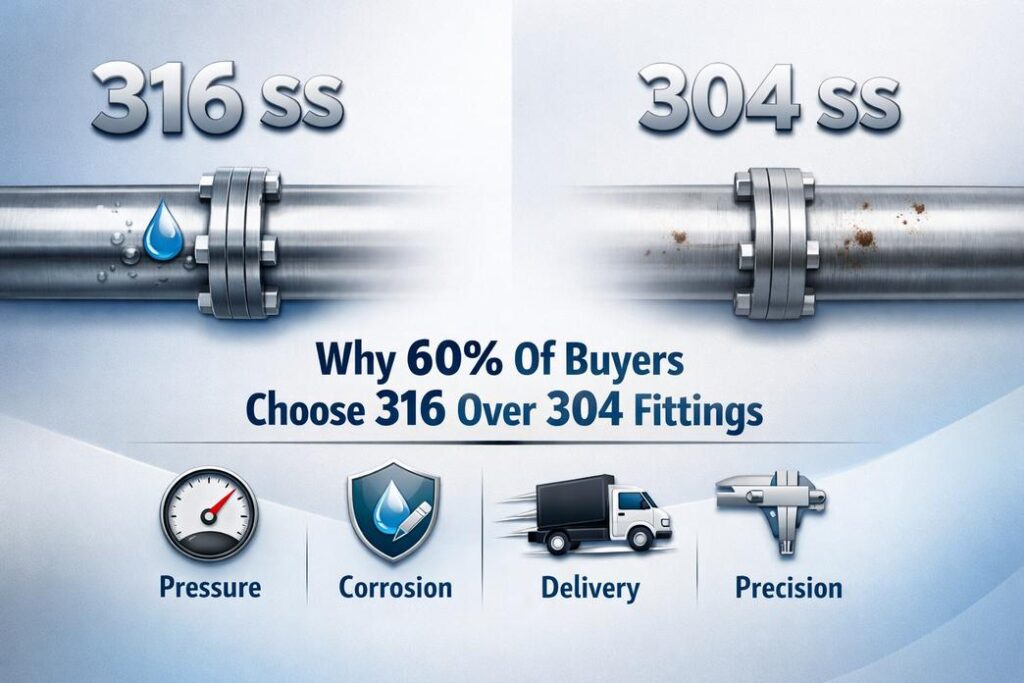
Why 60% Of Buyers Choose 316 Over 304 Fittings
Buyers comparing stainless steel npt pipe fittings often end up picking 316 instead of 304. It’s not hype. It’s about pressure, corrosion, delivery timing, and thread precision. When uptime matters, small material differences feel huge.
High-Pressure Rated Materials in Oil and Gas Industry
In oil and gas, material choice is rarely casual. Under high vibration and aggressive media, material properties decide service life.
- Material Grade Comparison
- 304 stainless steel
- Good general corrosion resistance
- Moderate pressure rating
- 316 stainless steel
- Added molybdenum
- Higher resistance to chlorides
- Improved pressure rating
- 304 stainless steel
- Performance Data for NPT fittings used in high-pressure lines:
| Material Grade | Yield Strength (MPa) | Max Working Pressure (Bar) | Chloride Resistance Level |
|---|---|---|---|
| 304 SS | 215 | 210 | Medium |
| 316 SS | 290 | 275 | High |
| 304L SS | 205 | 200 | Medium |
| 316L SS | 270 | 260 | High |
- Application Insight
- Offshore platforms → favor 316 stainless steel
- Refinery utility lines → mixed use
- Chemical injection systems → mostly 316
That’s why many engineers upgrading stainless steel NPT pipe fittings in critical loops switch to 316 and stick with it.
ISO 9001 Certification and Supplier Qualification
Quality talk is cheap without paperwork.
- ✔ ISO 9001 certification
- ✔ Documented quality management
- ✔ Traceable documentation
Procurement teams usually check:
- Supplier qualification
- Audit of manufacturing standards
- Review of auditing process records
- Batch-level inspection reports
- Product validation
- Thread gauge test
- Hydrostatic pressure test
- Surface finish review
Brands like yuuhuan hongqian build trust by aligning certification systems with real production checks, not just framed certificates. That consistency boosts product reliability in every shipment of stainless steel pipe fittings.
Lead Time Optimization for Bulk Procurement
Bulk orders live or die by lead time.
Short story: no stock, no project.
Longer story:
- Supply chain visibility keeps planners calm.
- Smart inventory management reduces backorders.
- Clear delivery schedule avoids shutdown penalties.
Procurement flow often runs like this:
- Forecast demand
- Lock production planning
- Confirm logistics slot
- Track real-time availability
yuuhuan hongqian supports global buyers of stainless steel npt pipe fittings with rolling stock plans, helping EPC contractors avoid last-minute panic buys.
Wall Thickness and Thread Dimensions for Reliability
Tiny tolerances. Big consequences.
For pipe fittings, two elements dominate sealing success:
- Wall thickness → controls burst strength and mechanical strength
- thread dimensions → define sealing and load distribution
Under NPT threads standards:
- Correct taper angle ensures tight thread engagement
- Accurate dimensional accuracy reduces galling
- Proper root depth improves leak prevention
When stainless steel NPT pipe fittings meet spec on paper but miss microns in machining, leaks show up fast. Reliable manufacturers machine every stainless steel fitting to gauge-tested tolerances.
That precision is one quiet reason 60% of buyers lean toward 316 in stainless steel npt pipe fittings—stronger walls, better corrosion control, and threads that seal right the first time.
FAQs about Stainless steel npt pipe fittings
What temperature limits define safe use for 304, 316, and 316L stainless steel fittings?
Heat tests tell a tense story at the jobsite.
- 304 stainless steel NPT threaded fittings stay steady near 870 °C, then oxidation creeps in.
- 316 and 316L stainless steel push higher, close to 925 °C, favored in chemical processing plants and the oil and gas industry.
A short check against ASME B16.11 and relevant ASTM standards confirms pressure ratings, wall thickness, and thread dimensions before installation in high-pressure systems.
How does machining quality shape leak risk in high-pressure rated materials?
A fitter feels it at the wrench.
Smooth threads born from CNC machining and refined by surface finishing techniques reduce surface roughness, easing metal-to-metal contact.
That calm interface matters across NPT threaded fittings, socket weld fittings, and compression fittings when pressure testing protocols push joints to the edge.
Why do bulk buyers lean toward 316 stainless steel in corrosive environments?
Procurement teams face hard calls under tight timelines.
- Better resistance to corrosive fluid handling than standard grades
- Stable strength at demanding temperature limits
- Trusted records tied to ISO 9001 certification and material traceability
In bulk procurement for pharmaceutical manufacturing or chemical processing plants, 316 often beats duplex stainless steel on availability across global distribution networks.
Which tests confirm leak‑tight performance before shipment?
The final gate feels unforgiving.
Pressure testing protocols under ASME B16.11 combine hydrostatic and pneumatic trials, exposing flaws before fittings meet flanged connections, butt weld fittings, or seamless tubing materials.
Passed tests protect inventory management plans and support lead time optimization when projects cannot afford rework or delay.
Need Reliable Stainless Steel NPT Pipe Fittings?
If you’re sourcing for high-pressure or corrosive applications, material choice and machining quality both matter.
We supply:
- 304 & 316 stainless steel NPT fittings
- Forged and CNC machined options
- Full material traceability (MTR available)
- Strict quality control aligned with ASME standards
👉 Whether you need standard sizes or custom specs, getting the right fitting upfront can prevent costly failures later.