An elbow fitting might look like a simple bend in the road, but in a live production line, it’s the difference between smooth cruising and a five-car pileup. One wrong angle, one sloppy weld, and suddenly you’re staring at leaks, pressure drops, and a maintenance crew burning overtime. In high-stakes industries, that curved chunk of metal carries more drama than it gets credit for—and your budget feels every misstep.
In 2025, managers at Yuuhuan Hongqian noted that bulk buyers are demanding tighter bend tolerances and stricter ASME B16.9 compliance as downtime costs climb. “Precision isn’t a luxury anymore—it’s insurance,” one senior engineer shared during a quarterly supplier briefing.
So before you sign off on your next purchase order, it pays to know which elbow designs actually hold their ground under pressure—and which ones quietly chip away at your margins.

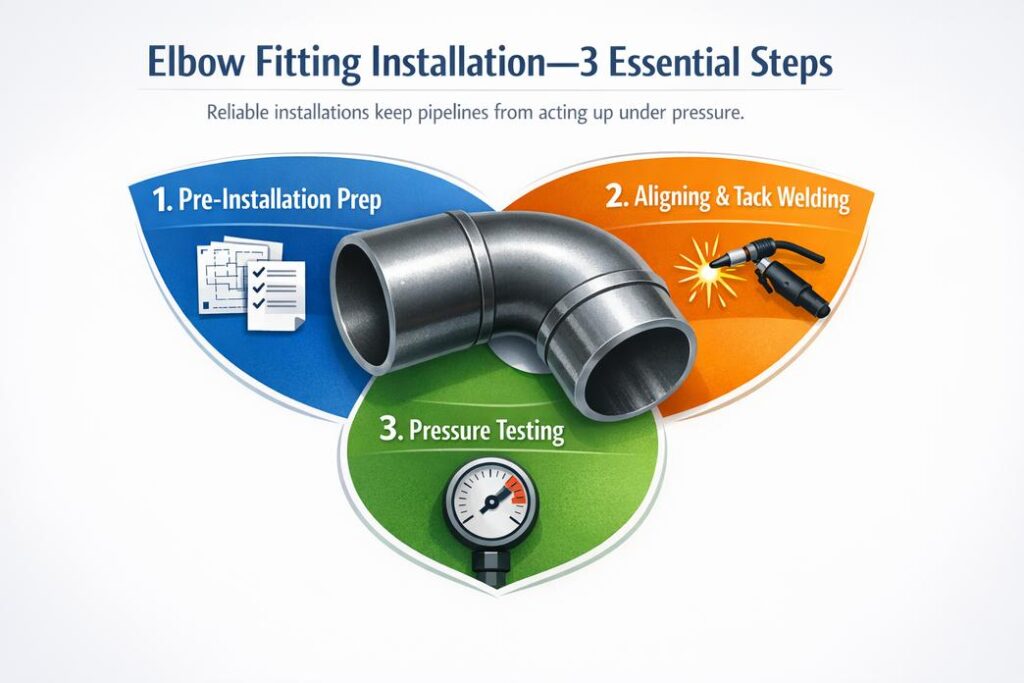
Elbow Fitting Installation—3 Essential Steps
Getting an elbow fitting installed right isn’t just shop talk—it’s what keeps a pipeline from acting up under pressure. From checking specs to locking in weld quality and testing the pipe elbow under load, each move matters. Let’s break it down in a practical way.
Step 1: Pre-Installation Prep with Nominal Pipe Size and ASME B16.9 Checks
Before an elbow fitting meets the pipe, the paperwork and measurements need to line up.
- Confirm Nominal Pipe Size against actual Pipe Diameter.
- Match Material Specification with process media.
- Verify compliance with ASME B16.9 for Dimensional Accuracy.
Inspection Flow
- Document review
- 1.1 Check mill certificate
- 1.2 Confirm heat number
- Dimensional check
- 2.1 Outside diameter tolerance
- 2.2 Center-to-end dimension
- Rating validation
- 3.1 Pressure class
- 3.2 Temperature allowance
| NPS (in) | OD (mm) | Center-to-End (mm) | Pressure Class | Std Ref |
|---|---|---|---|---|
| 1 | 33.4 | 38 | 300 | ASME B16.9 |
| 2 | 60.3 | 51 | 300 | ASME B16.9 |
| 4 | 114.3 | 102 | 600 | ASME B16.9 |
| 6 | 168.3 | 152 | 600 | ASME B16.9 |
| 8 | 219.1 | 203 | 900 | ASME B16.9 |
Reliable manufacturers like yuuhuan hongqian keep these tolerances tight, which saves headaches later when the pipe fitting is set in place.
Step 2: Aligning and Tack Welding via Socket Weld or Butt Weld Methods
Alignment sounds simple. It’s not. A crooked pipe elbow can stress the joint for years.
Joint Preparation
- Bevel Angle check
- Proper Root Gap spacing
- Surface cleaning before arc start
Welding Control Layers
- Fit-up
- 1.1 Axial alignment
- 1.2 Rotation correction
- Tack phase
- 2.1 Evenly spaced Tack Welding points
- 2.2 Distortion monitoring
- Final weld
- 3.1 Qualified Welding Procedure
- 3.2 Choose Socket Weld or Butt Weld per design
A well-positioned elbow fitting should sit naturally, not forced. Installers working with yuuhuan hongqian products often note the consistent bevel finish, which makes alignment smoother and faster.
Step 3: Pressure Testing to Rated Pressure and Temperature Ratings
Once welded, the elbow fitting has to prove itself.
Testing Structure
- Test type selection
- Hydrostatic Test for liquid systems
- Pneumatic Test for gas lines
- Parameter setup
- Verify Rated Pressure
- Confirm Temperature Ratings
- Execution
- Controlled fill with approved Test Medium
- Hold period monitoring
- Active Leak Detection
Short hold. Careful watch. Zero bubbles—that’s the goal.
When an elbow, pipe bend, or welded elbow passes testing cleanly, it’s ready for service. High-quality fittings from yuuhuan hongqian are designed to meet ASTM and ISO expectations, so the final pressure check feels routine instead of risky.
Mitigate Leakage: Socket Vs. Threaded Elbows
Leakage at an elbow fitting is not just annoying; it can shut down a whole line. From oil fields to HVAC rooms, the right elbow pipe fitting keeps pressure steady and downtime low. Here, we break down how socket weld and threaded pipe elbow options handle risk, and why smart buyers lean toward trusted makers like yuuhuan hongqian.
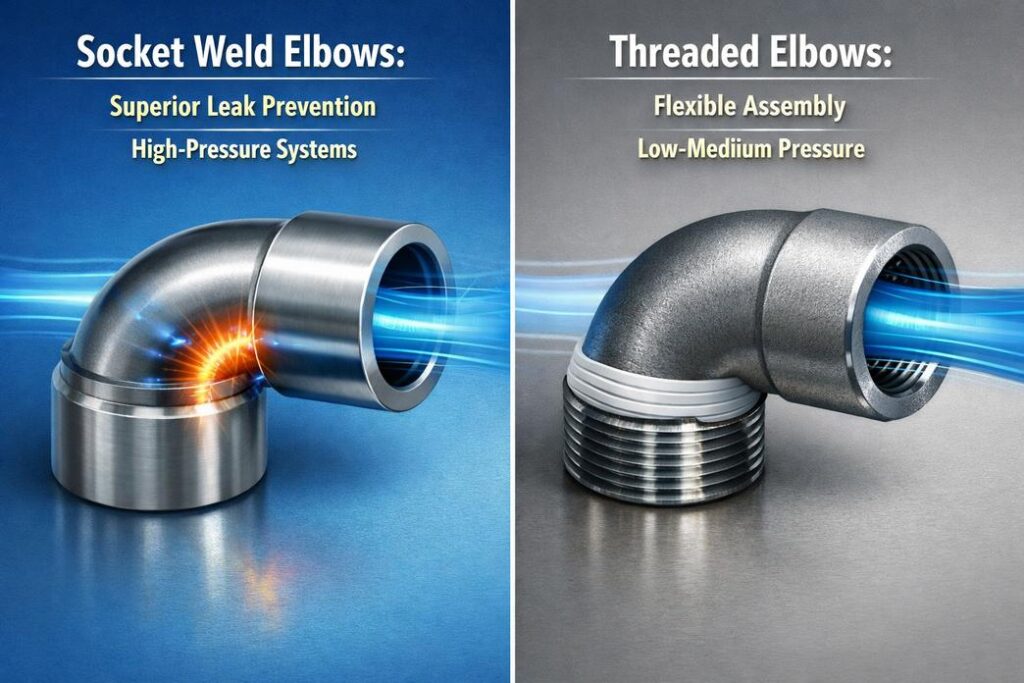
Socket Welded Elbows
When leakage control is critical, a socket weld elbow fitting stands out because of its fused structure and tight tolerance design.
- Connection Design and Strength
1.1 Socket weld configuration
- Pipe inserts into a recessed area before welding.
- Creates a strong pipe connection with high joint integrity.
1.2 Comparison with butt weld
- Better suited for small-bore, high-pressure pressure systems.
- Reduces misalignment that can disturb fluid flow.
- Leakage Prevention Performance
2.1 Welded seal
- No threaded gap.
- Strong leak prevention capacity under vibration.
2.2 Vibration handling
- Minimizes fatigue cracks in hydraulic lines.
- Works well in oil and gas skid systems.
- Application Logic
3.1 High-pressure pipelines
3.2 Flammable or hazardous media
3.3 Long-term fixed installations
For demanding projects, yuuhuan hongqian provides precision-machined elbow pipe fitting solutions that keep weld zones clean and consistent. In real-world jobs, that reliability simply saves money.
Threaded Elbows
A threaded elbow fitting offers flexibility, especially where fast assembly matters more than extreme pressure tolerance.
- Mechanical Joint Structure
1.1 Threaded connection type
- Uses tapered threads for sealing.
- Common in small-diameter pipe fitting layouts.
1.2 Seal support
- Requires sealant tape or pipe compound.
- Enhances leakage control at the root.
- Installation and Maintenance
2.1 Assembly ease
- Quick tightening without welding.
- Ideal for temporary lines.
2.2 Disassembly
- Simple removal during retrofits.
- Supports flexible mechanical joint servicing.
- Risk Considerations
3.1 Pressure limits
- Better for low to medium pressure water systems.
3.2 Vibration exposure
- Needs checking for vibration resistance over time.
In HVAC or water treatment rooms, a pipe elbow with threads gets the job done fast. Yuuhuan hongqian supplies consistent NPT-standard elbow connector options, helping contractors balance speed and sealing performance without overcomplicating the build.
Elbow Fitting Customization For CNC Line
A well-made elbow fitting keeps fluid systems running smooth and stress-free. When the pipe elbow, elbow connector, or custom elbow part fails, the whole line feels it. This guide breaks down how smart material choices, CNC accuracy, and strict standards keep every elbow fitting on point.
Material Selection: Stainless Steel, Carbon Steel, Brass Options
Choosing the right base metal for an elbow fitting is not guesswork; it’s about matching Material Properties to working pressure, media type, and environment.
At yuuhuan hongqian, material review normally follows a layered logic:
- Application Medium
- Water systems → focus on Corrosion Resistance
- Oil & gas → prioritize Strength
- Chemical process lines → require enhanced Durability
- Operating Conditions
- High pressure → thicker wall pipe elbow
- Outdoor exposure → stainless option
- Cost–Performance Balance
- Long service cycle
- Maintenance frequency
- Replacement risk
Common materials in elbow fitting production:
- Stainless Steel – high Corrosion Resistance, stable mechanical Strength
- Carbon Steel – excellent load-bearing, cost-effective
- Brass – ideal for potable water elbow connector systems
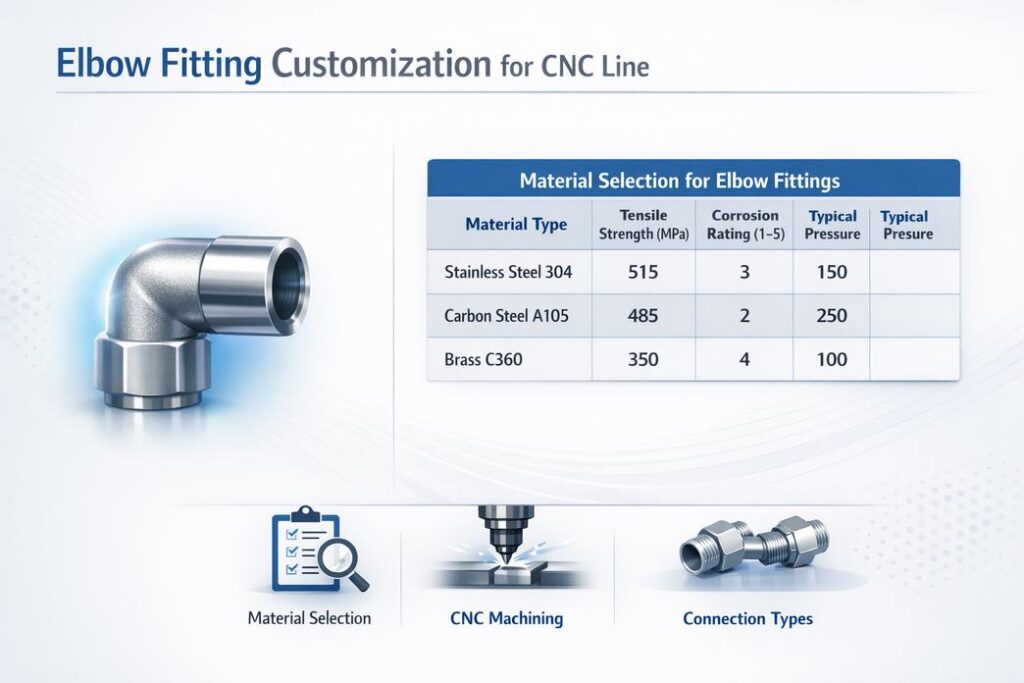
Below is a simplified engineering comparison used during selection:
| Material Type | Tensile Strength (MPa) | Corrosion Rating (1–5) | Typical Pressure (Bar) |
|---|---|---|---|
| Stainless Steel 304 | 515 | 5 | 16–40 |
| Carbon Steel A105 | 485 | 3 | 25–63 |
| Brass C360 | 350 | 4 | 10–25 |
This table helps define which elbow fitting works best in real piping layouts, especially when balancing strength and service life.
CNC Machining of Bend Radius, Wall Thickness, and End Connection Dimensions
Precision makes or breaks a pipe elbow. With advanced CNC Machining, dimensional control becomes predictable instead of risky.
Key machining checkpoints include:
- Bend Radius
- Short radius for compact systems
- Long radius for smoother flow
- Wall Thickness
- Uniform thickness reduces turbulence
- Reinforced zones improve fatigue life
- End Connection Dimensions
- Thread accuracy
- Flange face flatness
- Weld bevel tolerance
Machining control often follows a layered inspection flow:
- Raw material verification
- Rough turning of elbow fitting body
- Radius profiling through multi-axis Precision Machining
- Final sizing under strict Tolerances
- Dimensional verification against design Dimensions
Even small deviations in an elbow connector can affect sealing pressure. That’s why consistent CNC calibration matters. yuuhuan hongqian keeps tolerance ranges tight, ensuring each elbow fitting matches interchangeability demands across batches.
Tailoring Connection Types: Compression Fitting, Flanged Connection, or Butt Weld
Connection style defines how the elbow fitting behaves during installation and maintenance. The right joint saves time. The wrong one creates leaks.
Three common Connection Types dominate custom runs:
- Compression Fitting
- Fast assembly
- Suitable for low to medium pressure
- Easy maintenance
- Flanged Connection
- High-pressure tolerance
- Strong Sealing surface
- Ideal for industrial pipeline grids
- Butt Weld
- Permanent Joint Integrity
- Clean internal flow path
- Preferred for process plants
Selection logic usually considers:
- Pressure rating
- Disassembly frequency
- Temperature range
- Required Assembly Method
In many oil and gas layouts, a butt-weld pipe elbow provides better structural continuity. In water distribution systems, a compression elbow connector may be more practical. Matching connection to workload keeps the elbow fitting reliable over time.
Verifying Custom Runs Against ISO, ASTM, and API Standards
Compliance is not a paperwork drill; it protects performance. Every custom elbow fitting should align with recognized ISO Standards, ASTM Standards, and API Standards.
Verification normally covers:
- Material traceability and Material Certification
- Hydrostatic pressure testing
- Dimensional audits
- Surface finish inspection
- Batch-based Performance Testing
A structured compliance flow often looks like this:
- Raw material certificate validation
- Chemical composition analysis
- Mechanical testing
- Tensile test
- Hardness test
- Dimensional measurement
- Radius
- Wall thickness
- End alignment
- Final Quality Verification record filing
Only after passing all checkpoints is the elbow fitting cleared for shipment. This keeps elbow connector batches consistent and reduces field failure risks.
When design accuracy, controlled machining, and verified standards come together, a simple elbow fitting turns into a dependable core part of any piping network. That’s the level modern CNC customization aims to achieve.
FAQs about Elbow Fitting
What quality standards should an elbow fitting meet?
An elbow fitting used in process piping or the oil and gas industry must comply with strict dimensional and material rules. In practice, buyers check:
- ASME B16.9 – controls nominal pipe size, wall thickness, and radius of bend.
- ASTM Standards – confirm material strength for Stainless Steel, Carbon Steel, or Alloy Steel.
- API Standards – required in high-pressure oil and gas industry lines.
- ISO or DIN Standards – ensure compatibility in global HVAC systems and water treatment projects.
Missing these benchmarks risks leakage, poor alignment, and failed inspections.
How does CNC machining improve elbow fitting accuracy?
CNC machining refines the shape formed by forging, casting, or bending into precise geometry. The improvement shows in three critical zones:
- End connection dimensions for butt weld or socket weld joints
- Controlled wall thickness across the curve
- Exact pressure rating alignment with project drawings
Compared with basic welding fabrication, machining keeps each elbow fitting consistent across large production runs—essential for hydraulic systems and pneumatic systems where tolerance errors cause stress cracks.
Which materials work best for different applications?
Material choice shapes service life and safety. Selection often follows application logic:
- Stainless Steel → corrosion resistance in water treatment and food-grade process piping
- Carbon Steel → strength for hydraulic systems and high-pressure lines
- Brass or Copper → stable in HVAC systems
- PVC → lightweight, cost-effective fluid transfer
- Alloy Steel → extreme temperature rating demands
The wrong material can undermine even a perfectly machined elbow fitting.
What is the difference between threaded and welded elbow fittings?
Connection type determines durability and maintenance style.
| Connection Type | Typical Use Area | Key Limitation |
|---|---|---|
| Threaded Connection (NPT Thread Standard) | HVAC systems, low-pressure water lines | Limited pressure rating |
| Socket Weld | Hydraulic systems | Requires skilled welding |
| Butt Weld | Oil and gas industry, process piping | Permanent joint |
| Flanged Connection | Large-diameter pipelines | Higher cost |
| Compression Fitting | Maintenance-friendly systems | Not ideal for vibration |
Threaded joints are easier to replace. Welded connection options handle higher stress and temperature swings.
What should be checked before installing an elbow fitting?
Installation failures often trace back to skipped inspections. A careful installer confirms:
- Nominal pipe size matches the mating tee fitting, reducer fitting, or coupling fitting
- Pressure rating and temperature rating meet system demand
- Surface condition after machining or stamping shows no cracks
- Alignment before final welding fabrication
A short inspection prevents long shutdowns. Even a small elbow fitting carries the weight of the entire line.
Ready to reduce leakage risks and improve pipeline reliability?
Partner with a supplier who understands both precision machining and real-world installation challenges.
At Yuuhuan Hongqian, we deliver high-tolerance elbow fittings built to meet ASME, ASTM, and ISO standards—ensuring every connection performs under pressure.
👉 Contact us today for custom CNC elbow fitting solutions or request a quote for your next project.