Carbon steel fittings are the lifeblood of global hydraulic and industrial piping systems. In an era of intense global competition, the landscape of CNC machining has undergone a rapid evolution, shifting from traditional manual operations to high-efficiency, fully integrated automation. Today, the strategic focus for manufacturers has moved toward optimizing loading systems.
In this comprehensive guide, we will discuss the respective advantages and disadvantages of Truss Robots (Gantry Robots) and Vibratory Bowl Feeders, and how they impact the precision, surface integrity, and cost-efficiency of your carbon steel fittings and CNC turning projects.
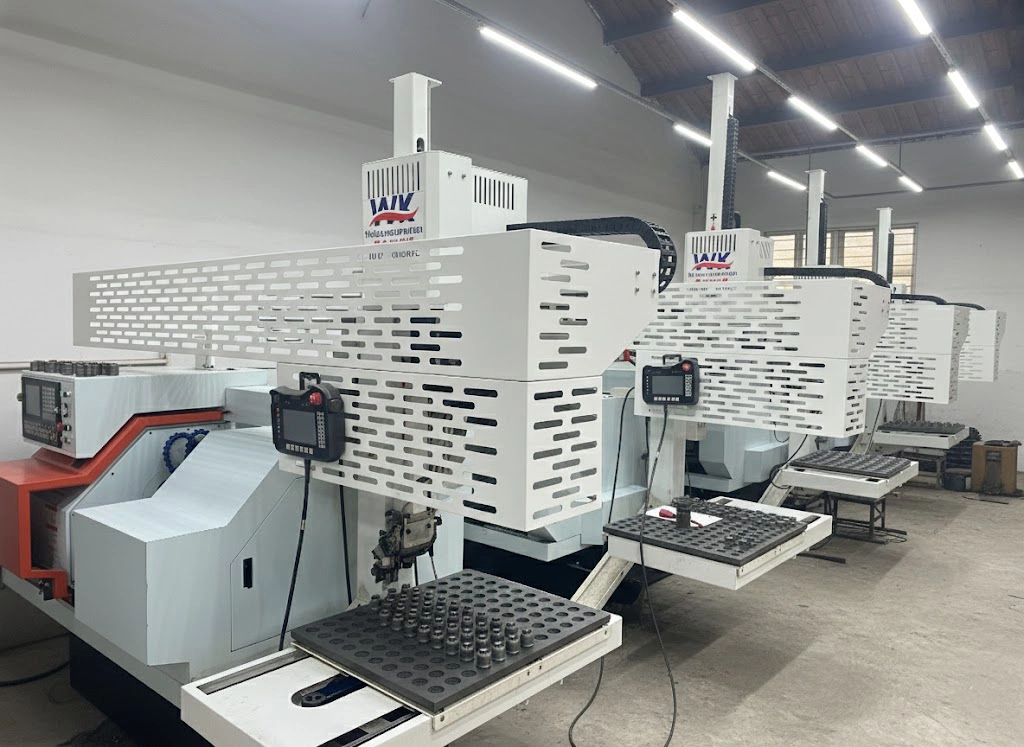
At Yuhuan Hongqian Machinery, we operate over 60 sets of CNC machines, integrating 15 advanced truss robots to deliver high-volume, high-precision carbon steel components to the global market.
1. The Automation Shift in Carbon Steel Fitting Production
The global push for “Zero-Defect” manufacturing has made manual loading obsolete. In the production of carbon steel fittings, consistency is the primary goal. Materials like AISI 1020, 1045, and 12L14 are the workhorses of the industry, but they require a stable processing environment to maintain tight tolerances.
Why Automation is Non-Negotiable?
The Geometric Growth in Labor Productivity
In traditional manual CNC machining, a single skilled operator is typically limited to managing 3 machines simultaneously. However, through the integration of advanced automation, that capacity expands to 7-10 machines per person.
For non-ferrous materials like Brass and Aluminum, which involve shorter cycle times and less tool wear, a single technician can effectively oversee up to 15 automated CNC centers. This leap in efficiency—increasing productivity by up to 400%—makes automation not just an upgrade, but an essential requirement for staying competitive in the global market.
2. Truss Robots: The Heavy-Duty Solution for High-Precision Fittings
A truss robot (or gantry robot) is an overhead automated system engineered for sophisticated “pick-and-place” maneuvers. At Yuhuan Hongqian Machinery, this is our flagship automation solution for high-end carbon steel fittings and stainless steel components that demand superior surface integrity.
2.1 High Flexibility and Surface Protection
The primary advantage of a truss robot in the production of carbon steel fittings is its non-contact loading mechanism.
-
Pick-and-Place Integrity: By picking each blank individually and placing it precisely into the CNC chuck, we eliminate the risk of parts colliding or scratching—a critical factor for fittings destined for high-quality Zinc Plating or Chrome Plating.
-
Intelligent Placement: Unlike bulk feeding, truss robots can be programmed for organized palletizing or sloped stacking. This ensures finished parts never impact one another, preserving the precision of every thread and surface.
2.2 Versatile Blank Handling: From Red Punching to Tubes
Truss robots offer unmatched versatility in the type of raw materials they can process:
-
Hot-Forged (Red Punching) Blanks: Ideal for complex hydraulic elbows and tees.
-
Cold-Heading Parts: Perfect for high-strength bolts and connectors.
-
Tube & Bar Stock: Efficient for long-sleeve couplings.
2.3 The “Chip Management” Crisis: Preventing Quality Accidents
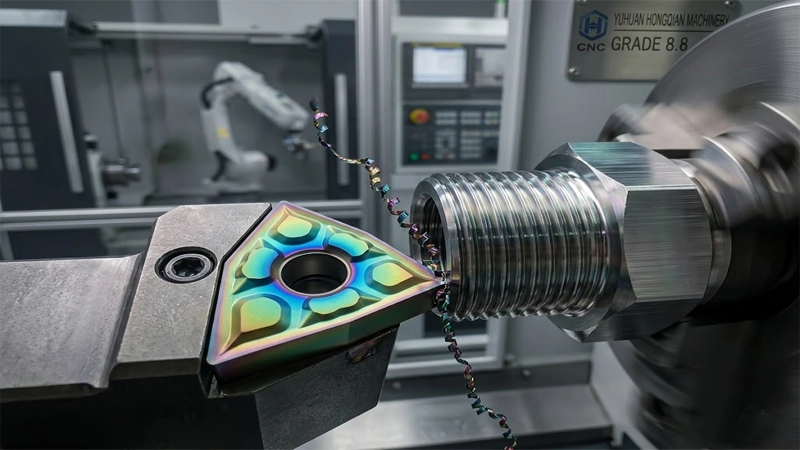
While truss robot technology is mature in the brass industry, applying it to carbon steel and stainless steel requires expert management of Chip Entanglement.
-
The Struggle with Steel: Carbon steel produces long, stringy “bird-nest” chips. If these chips wrap around the cutting tool or the robot gripper, it leads to catastrophic quality accidents and dimensional deviations.
-
The Solution: We mitigate this by using Slant-Bed CNCs (to assist gravity evacuation) and 70-Bar High-Pressure Coolant systems to force chips to break into small, manageable pieces.
2.4 Machine Tool Requirements: The “Hidden” Engineering
-
Rigidity Matters: Because the robot is mounted atop the machine, a heavy-duty machine base is required to absorb kinetic energy. Without this mass, micro-vibrations can ruin the h6 or h7 tolerances of the carbon steel fittings.
-
Unattended Intelligence: Our systems automatically halt the moment a tool wears down or a dimension deviates, preventing “batch errors” in a fully automated line.

3. Vibratory Feeders: The Speed King for Small Standard Parts
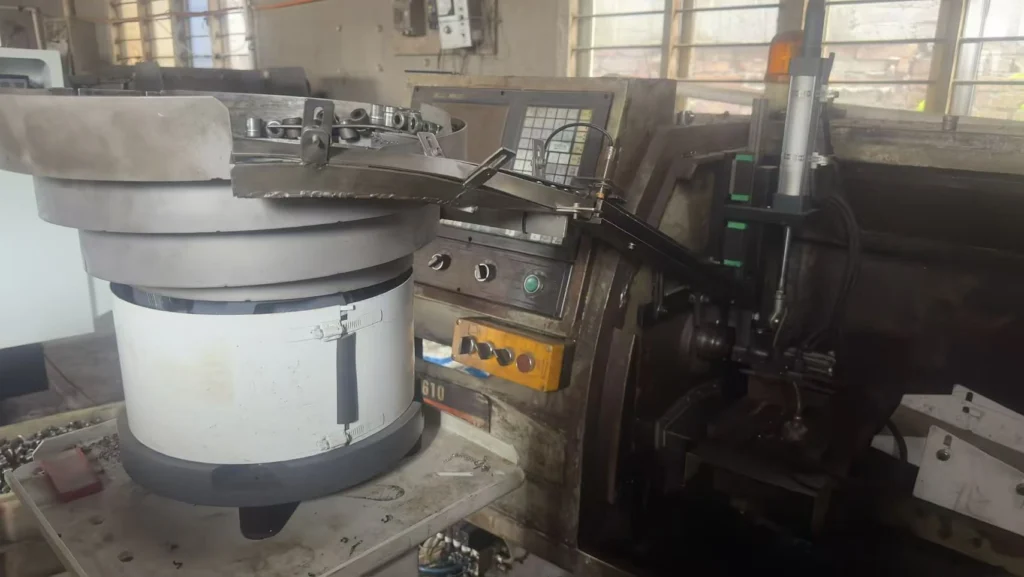
Vibratory bowl feeders utilize high-frequency electromagnetic vibration to orient and feed small parts into the CNC machine at high speeds.
3.1 Ideal Part Profile: Efficiency Through Simplicity
This technology is the “efficiency king” for small, symmetrical carbon steel fittings including:
-
External Thread Fasteners: Hex plugs, nuts, and simple hydraulic couplings.
-
Cold-Heading Blanks: These are the “sweet spot” for vibratory feeders because they are “near-net-shape” and require minimal machining allowance.
3.2 The Strict Requirements for Blanks
The vibratory feeder is fast but extremely sensitive to the quality of the incoming material:
-
Cleanliness: Blanks must be free of burrs and oil. Any impurity can jam the discharge track, stopping the entire production line.
-
The “Bar Stock” Limitation: We generally advise against using bar stock with heavy cutting allowances in vibratory systems. High metal removal produces massive ribbon chips that the vibratory mechanism cannot clear, leading to tool breakage.
-
Collision Risk: Since parts are vibrated together in a bowl, there is a minor risk of surface nicks. This is acceptable for internal industrial components but may not suit decorative parts.
4. Material Suitability: Automated Production “Sweet Spots”
The predictability of the raw material is the foundation of 24/7 unattended production.
4.1 High Compatibility: Low and Medium Carbon Steel
-
Low Carbon Steel (AISI 1010, 1020): These offer consistent ductility and predictable tool wear—essential for robotic runs.
-
Medium Carbon Steel (AISI 1045): This is the standard for Grade 8.8 high-strength components. It is highly compatible with automation when paired with correct chip-breaking geometry.
4.2 The “No-Go” Zone: High Carbon and Alloy Steels
-
High Carbon Steel: Not recommended for full automation. The extreme hardness causes rapid, unpredictable tool degradation, leading to batch-size dimensional errors.
-
Alloy Steel (e.g., AISI 4140/4340): These require constant manual monitoring due to high thermal energy and toughness, making them less suitable for the high-speed rhythm of robotic or vibratory lines.
5. Comparison Table: Truss Robot vs. Vibratory Feeder
| Feature | Truss Robot (Gantry) | Vibratory Bowl Feeder |
| Initial Investment | High (Typically 2x – 2.5x of Feeder) | Moderate |
| Part Geometry | Complex / Asymmetrical (Elbows, Tees) | Simple / Symmetrical (Plugs, Nuts) |
| Surface Protection | Excellent (Pick & Place, No Contact) | Risky (Surface Friction/Nicking) |
| Blank Requirements | Forged, Bar, Cold Headed, Tubes | Strict (Cold Headed, Low Allowance) |
| Optimal Cycle Time | Recommended > 50 Seconds | Recommended < 30 Seconds |
| Chip Risk Management | Essential (Slant-Bed + High Pressure) | High (Requires minimal allowance) |
| Machine Requirement | Heavy-Duty / Slant Bed Mandatory | Standard CNC Lathe Compatible |
6. ROI Analysis: Choosing the Right Path
Automation is a strategic investment in the carbon steel fittings supply chain. While a truss robot setup costs more initially, it offers a much higher ceiling for quality and flexibility.
-
The 50-Second Rule: To ensure a healthy Return on Investment (ROI), we typically recommend truss robots for parts with a processing time of over 50 seconds. This ensures the high-precision output justifies the capital expenditure.
-
The Bulk Speed Advantage: For simple, high-volume standard parts using cold-heading blanks, the vibratory feeder provides the most competitive “cost-per-piece” in the market.
7. Conclusion: Your Partner in Precision
At Yuhuan Hongqian Machinery, we do not believe in a “one-size-fits-all” approach. Our production strategy is dictated by your part’s geometry, material properties, and total volume.
By balancing advanced Truss Robot lines with high-speed Vibratory Feeder systems across our fleet of 60+ CNC machines, we provide the global supply chain with shorter lead times, lower labor costs, and a level of quality stability that manual workshops simply cannot match.
8. Call to Action (CTA)
Are you looking for a reliable, high-volume CNC manufacturer for carbon steel fittings?
With over 10 years of specialized experience in carbon steel machining and a fully integrated automated facility, Yuhuan Hongqian Machinery is your ideal partner. From cold-heading blanks to final surface treatments, we offer a one-stop OEM/ODM solution.
-
Company: Yuhuan Hongqian Machinery Co., Ltd
-
Email: info@justcncturningparts.com
-
Website: https://justcncturningparts.com
-
Location: Zhejiang, China