In the complex ecosystem of industrial fluid power, the integrity of a system is only as strong as its weakest connection. For mechanical engineers, procurement heads, and factory managers, selecting the correct british standard pipe thread fittings is not merely a task of matching diameters; it is an exercise in ensuring system safety, leak prevention, and operational longevity.
At Yuhuan Hongqian Machinery Co., Ltd., located in the manufacturing heart of Taizhou, Zhejiang, we have manufactured millions of precision components. From our perspective on the factory floor—operating 80 sets of high-precision CNC lathes and 15 truss robots—we know that the subtle differences between thread standards like BSPP and BSPT are where most field failures occur. This guide serves as a technical deep-dive into the world of British standard threads, providing the clarity needed to source and install with absolute confidence.

1. What is the British Standard for Pipe Threads?
The BSP (British Standard Pipe) system is the bedrock of international fluid connection standards outside of North America. Defined globally under ISO 228 and ISO 7, british standard pipe thread fittings are built on the Whitworth Thread Form.
The 55-Degree Advantage
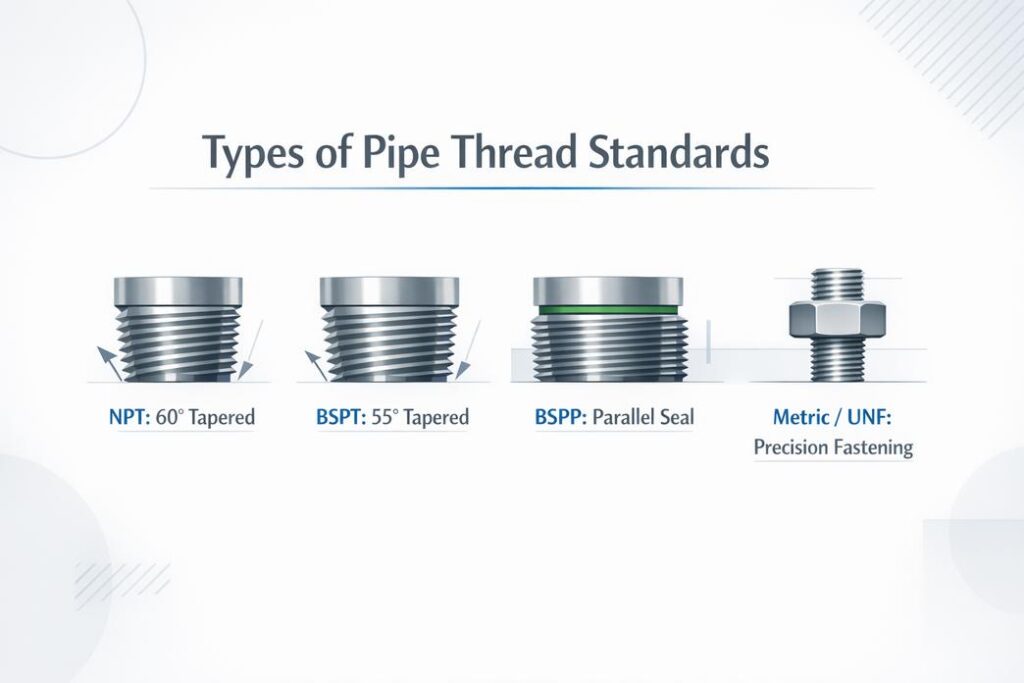
Unlike the American NPT standard, which uses a 60-degree thread angle, BSP threads utilize a 55-degree angle. As an engineer, why does this matter?
The Whitworth form features rounded peaks (crests) and valleys (roots). In high-pressure hydraulic applications, this rounded profile is mathematically superior for stress distribution. Flat-crested threads (like NPT) create sharp corners at the root where stress concentrations can lead to micro-cracks under intense pressure cycles. The 55-degree Whitworth form distributes that energy more evenly, making the fitting significantly more resistant to fatigue caused by system vibration and pressure surges.
2. What are the British Standard Threads? Understanding BSPP vs. BSPT
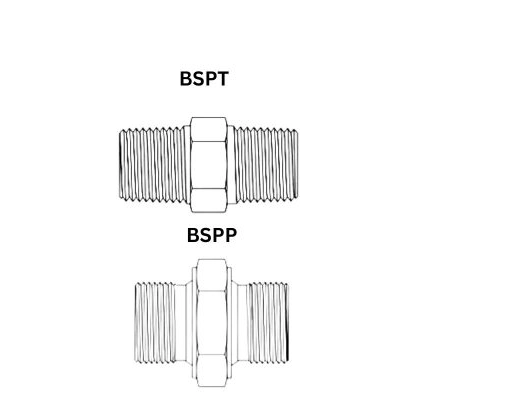
To ensure a leak-free environment, one must first master the two primary branches of the British standard.
BSPP (British Standard Pipe Parallel – G Threads)
Governed by ISO 228-1, BSPP threads maintain a constant diameter along the entire length of the thread.
-
Sealing Logic: In a parallel system, the threads themselves do not provide the seal. Instead, the seal is achieved through a secondary component—most commonly a bonded seal (often called a Dowty washer), an O-ring, or an ED seal (Elastic Sealing).
-
The Engineer’s Choice: BSPP is preferred in applications where the orientation of the fitting is critical. For example, when installing an elbow fitting onto a manifold, a parallel thread allows you to lock the fitting in a specific direction using a locknut and seal, whereas a tapered thread’s orientation is dictated by its tightness.
BSPT (British Standard Pipe Tapered – R/Rc Threads)
Governed by ISO 7-1 and BS 21, BSPT threads feature a 1:16 taper ratio.
-
Sealing Logic: As the male thread is screwed into the female port, the increasing diameter creates an “interference fit.” This metal-to-metal contact forms the primary seal.
-
Field Practice: While technically self-sealing, professional engineering standards still recommend the use of high-quality anaerobic liquid sealants or PTFE tape. This not only fills microscopic voids but also acts as a lubricant to prevent “galling”—the cold-welding of threads during high-torque installation.
3. The “Trade Size” Paradox: A Measurement Reality Check
A common error among junior technicians is attempting to measure british standard pipe thread fittings with a caliper and expecting the measurement to match the name.
If you measure a 1/2″ BSP thread, you will find a major diameter of approximately 20.96mm. This is because the size refers to the nominal internal bore of the pipe, not the thread’s outside diameter. This historical convention ensures that regardless of how wall thicknesses change with modern metallurgy, the external threads remain compatible.
Comprehensive BSP Thread Data Chart
| Trade Size (Inch) | TPI (Threads Per Inch) | Major Diameter (mm) | Minor Diameter (mm) | Tap Drill Size (mm) |
| 1/8″ | 28 | 9.728 | 8.566 | 8.7 |
| 1/4″ | 19 | 13.157 | 11.445 | 11.6 |
| 3/8″ | 19 | 16.662 | 14.950 | 15.0 |
| 1/2″ | 14 | 20.955 | 18.631 | 19.0 |
| 3/4″ | 14 | 26.441 | 24.117 | 24.5 |
| 1″ | 11 | 33.249 | 30.291 | 30.8 |
| 1-1/4″ | 11 | 41.910 | 38.952 | 39.5 |
| 1-1/2″ | 11 | 47.803 | 44.845 | 45.3 |
| 2″ | 11 | 59.614 | 56.656 | 57.1 |
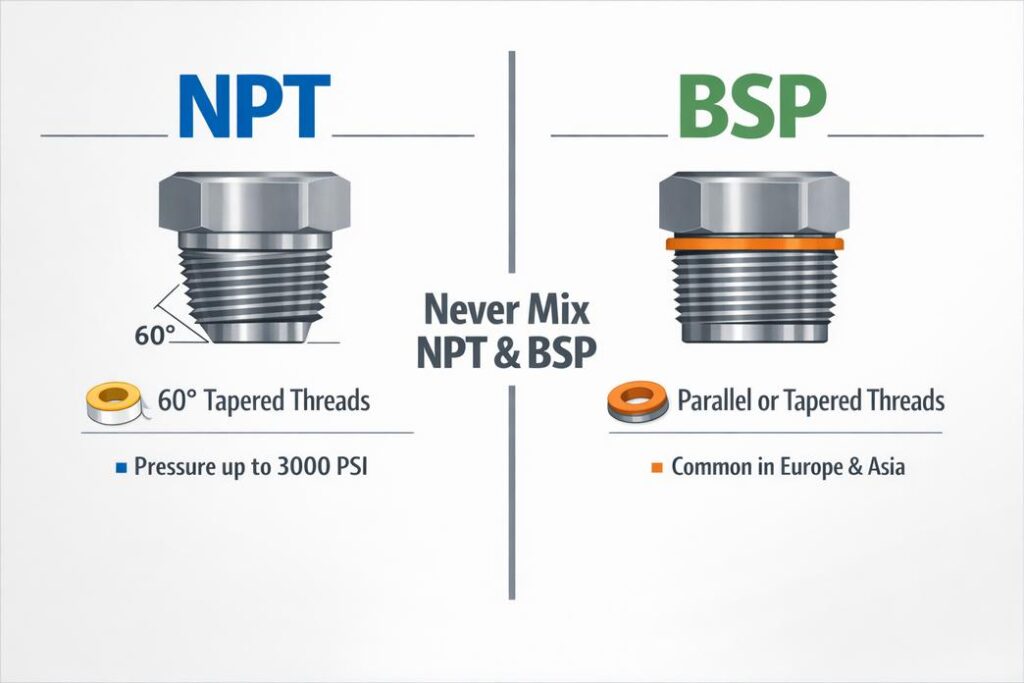
4. Is BSP Thread the Same as NPT? Why They Are Not Interchangeable
It is a dangerous but frequent assumption in international procurement that BSP and NPT are “close enough.” They are not.
-
Pitch Variance: For a 1/4″ fitting, BSP has 19 TPI while NPT has 18 TPI.
-
Angle Mismatch: Forcing a 55-degree male into a 60-degree female creates a “spiral leak path.”
-
Safety Risk: Under high-pressure hydraulic load, this mismatch leads to thread deformation and eventual explosive ejection of the fitting. At our Taizhou factory, we use optical projectors to ensure that every thread profile meets the strict 55-degree requirement, preventing any cross-contamination of standards.
5. Advanced Material Science: Beyond the Thread Standard
As a professional manufacturer, we understand that a british standard pipe thread fittings is only as reliable as its metallurgical foundation.
-
Stainless Steel (AISI 303/304/316): Critical for corrosive environments like food processing or marine applications. AISI 316, containing Molybdenum, offers superior resistance to chlorides. Our CNC process ensures that the 55° thread flanks are smooth to a Ra 0.8 finish, which is critical for stainless steel to prevent “galling” during high-torque installation.
-
Carbon Steel (AISI 1020, 1045, Q355): The workhorse of heavy-duty hydraulics. We often process Q355 steel, which has officially replaced the older Q345 standard. These fittings typically receive Zinc-Nickel or Chrome plating, providing over 720 hours of salt spray resistance.
-
The Role of Automation: By utilizing 15 truss robots in our Taizhou facility, we maintain a 0.01mm tolerance level that manual lathes simply cannot replicate. This consistency ensures that every batch of fittings maintains a perfect 1:16 taper ratio for BSPT.
6. Practical Identification: The Three-Step Protocol
If you are in a workshop or at a job site and need to identify a fitting, follow this engineering protocol:
-
The Taper Test: Use a caliper to measure the thread diameter at both ends. If the diameter changes, it is BSPT (R/Rc). If it stays constant, it is BSPP (G).
-
The Pitch Gauge: Count the threads per inch. If you find 19 TPI on a 1/4″ or 3/8″ fitting, it is a British standard. NPT would be 18 TPI.
-
The Visual Inspection: Under magnification, check the crests. Rounded crests confirm the Whitworth form of a BSP fitting.
7. Installation Pitfalls and HSE Compliance
Regular care prevents leaks and maintains compliance with Pressure Systems Safety Regulations.
-
Avoid Over-Torquing: Especially with BSPT. Excessive torque can crack the female port (Rc) due to the wedge effect of the taper.
-
Inspect the Seal Seat: For BSPP, the seal is the O-ring, not the thread. If the flat face or the groove is dirty or damaged, the system will leak regardless of how tight it is.
-
Energy Efficiency: Proper identification and selection of british standard pipe thread fittings can cut compressed air waste by up to 30%, a significant factor for UK workshops and global manufacturing lines facing high energy prices.
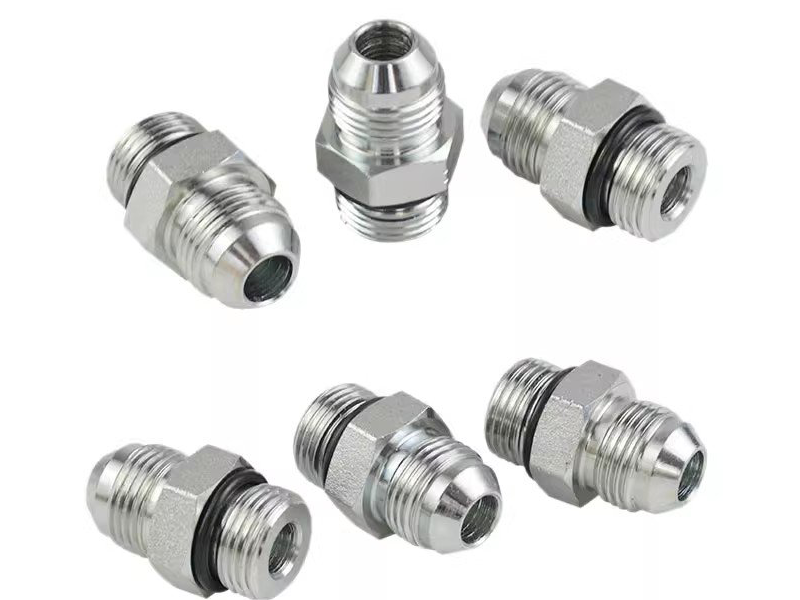
8. FAQ: Frequently Asked Questions
Q1: Are G threads and BSPP the same?
Yes. “G” is the ISO designation for Parallel British Standard Pipe threads. Conversely, “R” stands for tapered male threads and “Rc” for tapered female threads (BSPT).
Q2: Can I use a BSPT male thread with a BSPP female port?
In low-pressure emergency repairs, it is physically possible because they share the same pitch. However, for a professional engineer, this is not recommended. The geometric conflict between a taper and a parallel line creates a weak connection that relies entirely on sealant.
Q3: How do you prevent thread galling on stainless steel BSP fittings?
We recommend two steps: first, ensure the fitting has a high-quality surface finish (like the Ra 0.8 finish we provide at Hongqian); second, use an anti-seize lubricant or anaerobic sealant during assembly.
Q4: Which international standards do your BSP fittings comply with?
Every fitting manufactured in our factory strictly adheres to ISO 228-1 (Parallel) and ISO 7-1 (Tapered), ensuring 100% compatibility with global equipment.
9. Conclusion: Secure Your Systems with Precision
Precision in manufacturing british standard pipe thread fittings is what separates a reliable industrial system from a liability. By understanding the Whitworth form, the nuances of parallel vs. tapered sealing, and the critical importance of material choice, you ensure the longevity of your infrastructure.
At Yuhuan Hongqian Machinery Co., Ltd., we combine 10+ years of technical expertise with high-volume CNC capacity to deliver fittings that exceed global expectations. Based in the manufacturing hub of Taizhou, Zhejiang, our factory stands out through advanced automation and ISO 9001:2015 compliance.
Ready to secure your supply chain with precision-engineered components?
Stop compromising on system integrity. [Contact Our Engineering Team Today] for custom blueprints, technical consultations, or volume quotes. Let’s build a leak-free future together.
Contact us for your british standard pipe thread fittings projects !