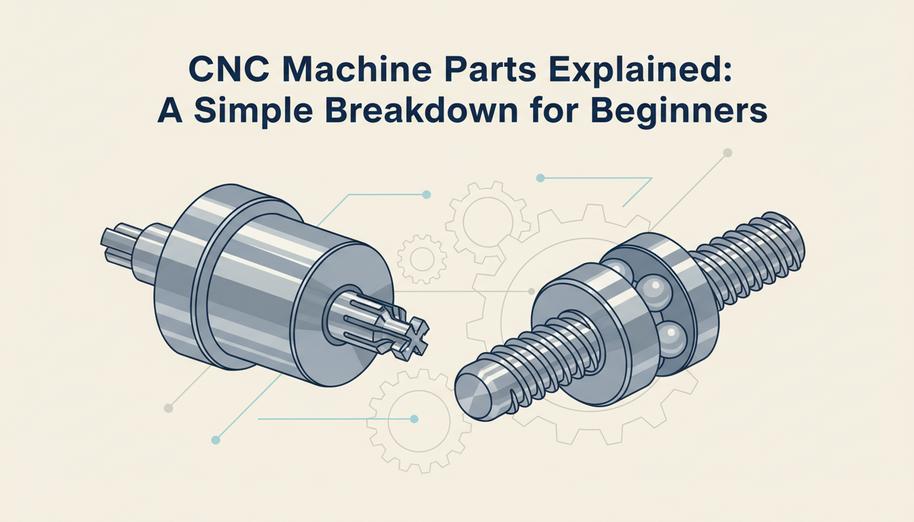
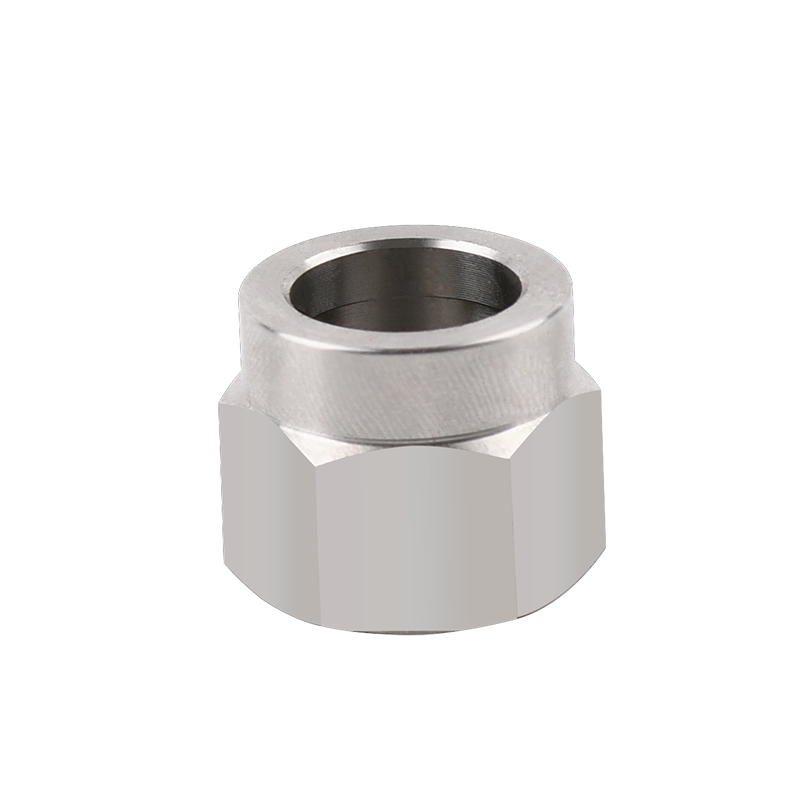
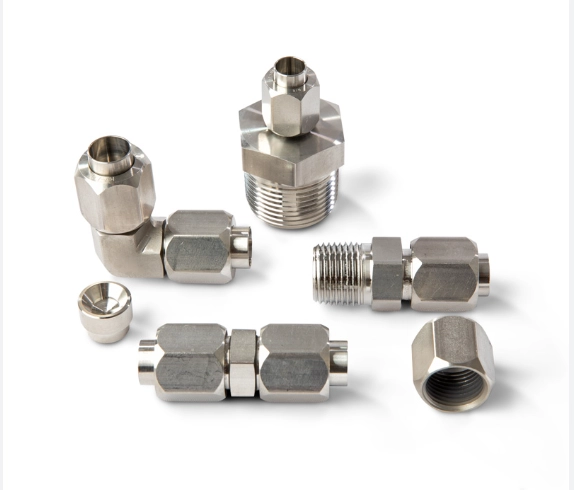
CNC machine parts are the unsung pit crew behind every flawless cut and mirror-smooth finish. When a spindle hesitates or a ball screw slips, production doesn’t just slow—it bleeds money. In shops across America, uptime is king, and every micron counts. Think of a CNC like a band on stage: if the drummer misses a beat, the whole song falls apart. Precision isn’t luck. It’s parts working in lockstep.
“Accuracy starts long before the tool touches metal,” notes a senior engineer at Yuuhuan Hongqian in a 2025 client briefing. Deloitte’s 2024 manufacturing outlook echoes it—unplanned downtime still ranks among the top profit killers for U.S. plants.
That’s the tension humming beneath your shop floor. Get the right components, and the machine sings. Get it wrong, and it’s a long night.
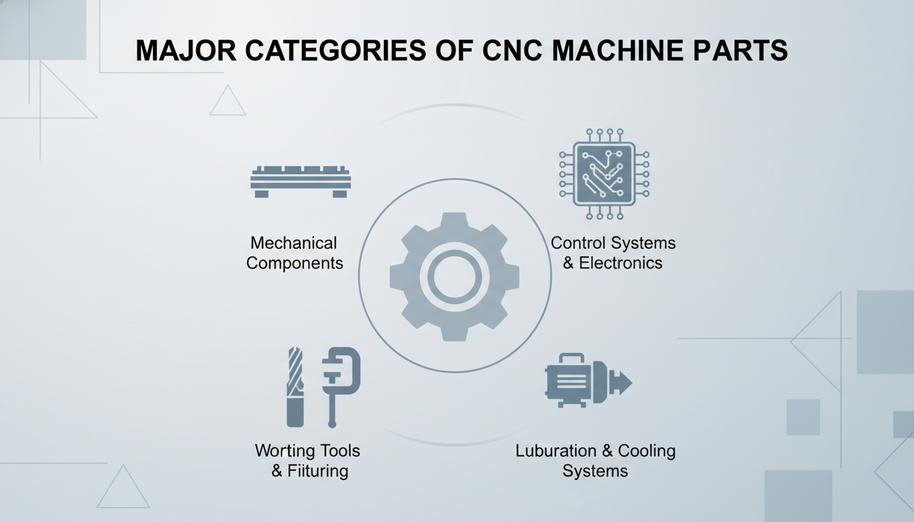
Major Categories Of CNC Machine Parts
CNC machine parts keep every CNC machine running smooth and steady. When people talk about cnc, machine parts, or full cnc machine parts, they’re really talking about the backbone of precision manufacturing. From heavy cast machine beds to smart CNC controllers, each unit inside a CNC system plays its own role, and missing one? That’s trouble.
Mechanical Components: Machine Beds, Castings, Bearings
When discussing cnc machine parts, mechanical hardware sits at the core.
- Machine Bed and Base form the structural Frame.
- Iron Casting and Steel Casting ensure Structural Integrity.
- Linear Bearing, Ball Bearing, and Roller Bearing support Precision Movement.
These elements work in layers:
- Structure & Stability
1.1 The Machine Bed absorbs cutting force.
1.2 Dense Casting improves Vibration Dampening.
- Motion Support
2.1 Bearing systems reduce Friction Reduction loss.
2.2 Proper preload increases Motion Control accuracy.
| Component Type | Typical Material | Vibration Absorption (%) | Load Capacity (kN) | Service Life (hrs) |
|---|---|---|---|---|
| Machine Bed | Cast Iron | 65 | 120 | 50,000 |
| Steel Casting Frame | Alloy Steel | 58 | 150 | 55,000 |
| Linear Bearing | Hardened Steel | 40 | 35 | 30,000 |
| Ball Bearing | Chrome Steel | 35 | 25 | 25,000 |
| Roller Bearing | Tool Steel | 45 | 60 | 40,000 |
Suppliers like yuuhuan hongqian focus heavily on stable casting and bearing integration, keeping cnc machine performance steady over years.
Control Systems & Electronics: CNC Controllers, Drives, Encoders
Inside modern cnc machine parts, intelligence matters as much as steel.
- CNC Controller
1.1 The Control Unit reads G-code.
1.2 The Motion Controller handles Axis Control.
- Servo Drive & Spindle Drive
2.1 The Motor Controller adjusts torque.
2.2 The Power Amplifier boosts signal output.
- Encoder Systems
3.1 Rotary Encoder tracks spindle angle.
3.2 Linear Encoder ensures tight Position Feedback.
In short bursts: control. react. correct. repeat. That’s how closed-loop systems maintain micron-level Axis Position accuracy in CNC equipment.
Brands like yuuhuan hongqian integrate matched Drive and Encoder packages, reducing signal noise and improving speed stability.
Cutting Tools: End Mills, Drills, Inserts
Material removal is where cnc machine parts meet raw metal.
• End Mill with multiple Flutes handles slotting.
• Drill Bit manages hole making and Chip Evacuation.
• Carbide Insert with smart Cutting Geometry extends tool life.
Process flow:
- Select proper Milling Cutter.
- Confirm Point Angle or insert grade.
- Mount in Tool Holder.
- Adjust feed and speed for steady Material Removal.
Short truth? Bad insert, bad finish. Good insert, smooth profiling.
Workholding & Fixturing: Vises, Chucks, Collets
No secure grip, no precision. Simple as that.
- Machine Vise
1.1 Strong Jaw design.
1.2 Balanced Clamping Force.
- Lathe Chuck
2.1 Accurate Centering.
2.2 Low Runout tolerance.
- Collet Chuck
3.1 Tight Clamping Range.
3.2 Reliable Precision Grip.
Good workholding devices keep workpiece stability high and machining accuracy on point, especially during high-speed cnc operations.
Lubrication & Cooling Systems: Coolant Pumps, Chillers, Nozzles
Heat is the silent killer of cnc machine parts.
- Coolant Pump ensures steady Flow Rate.
- Chiller manages Temperature Control for spindle cooling.
- Coolant Nozzle directs precise Fluid Jet for chip removal.
Operational chain:
- Fluid Delivery starts at the pump.
- Cooling passes through filtration.
- Spray Nozzle targets cutting zone.
- Heat transfers via Heat Exchange inside the chiller.
Keep it cool, keep it cutting. That’s the rule. High-quality cooling layouts, like those paired with yuuhuan hongqian assemblies, extend spindle life and protect every key machine part in the CNC system.
What Are The Main CNC Machine Parts?
When people talk about cnc machine parts, they usually mean the core mechanical and motion components that keep a CNC machine cutting smoothly. From spindle power to tool change speed, every part inside a CNC machine matters more than you might think.
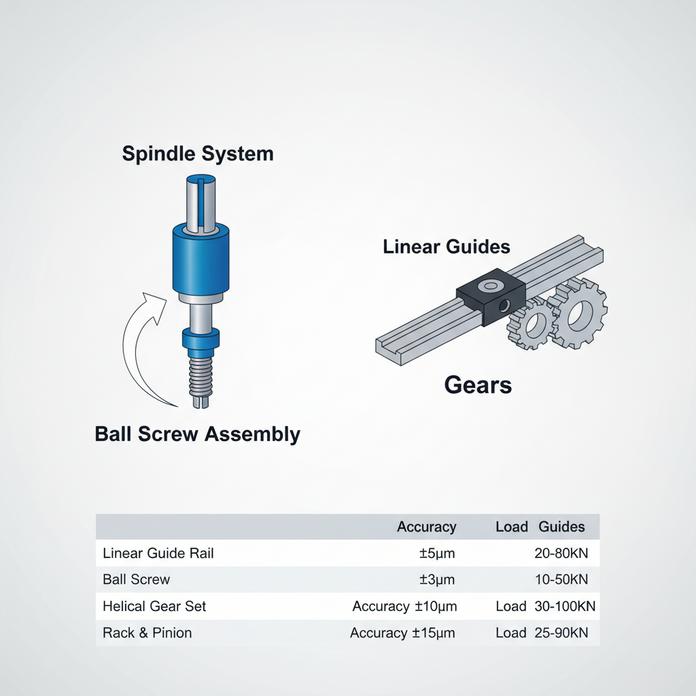
Spindles and Ball Screws
In the world of cnc machine parts, the heart of motion starts here.
- Spindle System
- Core drive
- spindle motor controls spindle speed and torque output.
- High-precision spindle bearing reduces heat and vibration.
- Functional role
- Transfers rotational force directly to the cutting tool.
- Maintains stable RPM under load.
- Performance focus
- Speed range (low RPM for heavy cuts, high RPM for finishing).
- Thermal stability for long machining cycles.
- Core drive
- Ball Screw Assembly
- Mechanical structure
- Precision ball screw paired with a circulating nut.
- Sometimes compared with a lead screw, but with far less backlash.
- Motion conversion
- Converts rotary motion into accurate axis movement.
- Ensures micron-level precision positioning.
- Maintenance factors
- Lubrication schedule.
- Alignment with guide rails.
- Mechanical structure
For manufacturers sourcing reliable cnc machine parts, brands like yuuhuan hongqian focus heavily on spindle durability and ball screw accuracy, since even tiny deviations can ruin surface finish.
Linear Guides and Gears
Smooth travel makes or breaks CNC machining parts performance. A shaky axis? That’s trouble.
- A hardened linear guide rail supports load.
- A recirculating linear bearing slides along with minimal friction.
- Each guide block keeps alignment tight under cutting force.
On the transmission side:
- Gear Interaction
- Drive gear receives torque.
- Torque passes through a defined gear ratio.
- The driven gear outputs controlled motion.
- Gearbox Support
- A compact gearbox stabilizes torque flow.
- Maintains smooth motion during heavy cuts.
Below is a simplified comparison of motion components often found in cnc parts systems:
| Component Type | Typical Accuracy (µm) | Load Capacity (kN) | Speed Capability (m/min) | Maintenance Interval (hrs) |
|---|---|---|---|---|
| Linear Guide Rail | ±5 | 20–80 | 60 | 2000 |
| Ball Screw | ±3 | 10–50 | 40 | 1500 |
| Helical Gear Set | ±10 | 30–100 | 30 | 2500 |
| Rack & Pinion | ±15 | 25–90 | 70 | 1800 |
This mix of cnc machine parts keeps machines steady even during aggressive cuts.
Servo Motors and Couplings
If the spindle is the muscle, the servo motor is the brainy athlete behind it.
- Servo Motor Core
- Integrated encoder tracks position in real time.
- Closed-loop feedback loop corrects errors instantly.
- Delivers controlled torque at set rotational speed.
- Power Transfer Chain
- Motor shaft connects through a precision coupling.
- Proper shaft alignment prevents vibration.
- Clean power transmission protects ball screws.
- Why It Matters in CNC Equipment Parts
- Faster acceleration improves cycle time.
- Stable torque keeps dimensional accuracy tight.
- Reduced backlash protects downstream cnc machining parts.
For high-demand production lines, yuuhuan hongqian integrates balanced servo systems into their cnc machine parts, keeping motion sharp and reliable without overcomplicating maintenance.
Tool Holders and Automatic Tool Changers
Cutting tools don’t magically swap themselves. This is where serious automation kicks in.
- Tool Holding Interface
- A rigid tool holder locks into the spindle taper.
- The collet grips the tool shank firmly.
- Runout control ensures clean cutting edges.
- Automatic Tool Change System
- Tools stored in a tool changer magazine.
- Rotating tool carousel selects the next tool.
- Optimized tool change time boosts productivity.
- Operational Flow
- Machine completes current cut.
- Spindle moves to change position.
- Old tool returns to its tool station.
- New tool loads automatically via programmed tool management.
Efficient tool systems turn standard cnc machine parts into high-output production assets. In modern workshops, cnc parts are judged by how fast and cleanly this swap happens. Reliable cnc machine parts from yuuhuan hongqian help reduce downtime, making the whole CNC machine feel quick, stable, and ready for the next job.
3 Key CNC Machine Parts Explained Simply
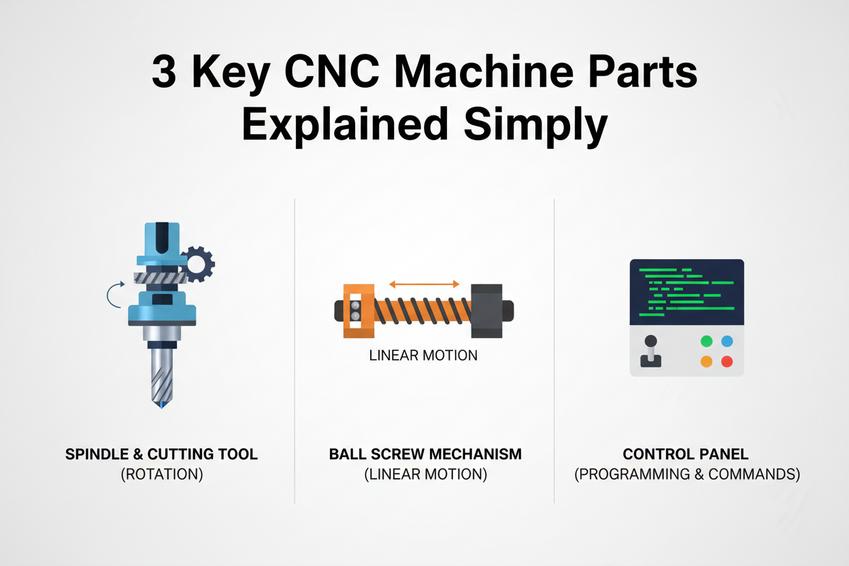
CNC machine parts keep modern workshops running without drama. When you break down cnc machine parts into spindle, motion, and control, the logic gets clear fast. This guide walks through core machine parts, key CNC components, and how every CNC machine system stays sharp and accurate.
Spindles: Heart of the CNC Machine
Among all cnc machine parts, the spindle sits right at the center of action.
- Core Drive Unit
- Spindle motor
- Controls torque output
- Stabilizes spindle speed under load
- Bearings
- Support radial and axial forces
- Reduce vibration for smoother cutting
- Spindle motor
- Tool Interface
- Spindle taper
- Connects securely to the tool holder
- Maintains concentric accuracy
- Cutting tool
- Transfers rotation into material removal
- Impacts finish quality directly
- Spindle taper
- Performance Metrics
| Parameter | Typical Range | Impact on Machining |
|---|---|---|
| Spindle Speed (rpm) | 6,000–24,000 | Surface finish quality |
| Runout (μm) | 1–5 | Dimensional accuracy |
| Power (kW) | 5–30 | Cutting capacity |
| Bearing Temp (°C) | 30–70 | Service life stability |
In cnc machine parts lists, spindle assemblies usually top the cost chart. No surprise. If the spindle drifts, the whole CNC machine feels off.
Ball Screws: Precision Motion Drivers
When people talk about cnc machine parts that handle positioning, this is it.
The ball screw shaft rotates. The ball nut rides along it. Tiny steel balls circulate inside, cutting friction down so linear motion feels almost effortless.
Key factors that shape axis performance:
- Pre-load level
- Light pre-load: lower heat, slight play
- High pre-load: better stiffness, less backlash
- Axis movement quality
- Smooth axis movement improves contouring
- Stable feed keeps surface marks minimal
- Accuracy control
- Micron-level accuracy depends on alignment
- Thermal growth must be monitored
You’ll often see machine parts specs listing backlash under 0.01 mm. That tiny number makes a big difference in finished molds and precision brackets. Among all cnc machine parts, ball screws quietly handle the heavy lifting of positioning.
CNC Controllers: The System’s Brain
Every set of cnc machine parts needs coordination. That job falls to the controller.
- Programming Layer
- G-code
- Defines tool paths
- Sets feed rates and coordinates
- M-code
- Activates coolant
- Controls spindle start and stop
- G-code
- Hardware Interface
- Control panel
- Operator inputs
- Real-time overrides
- User interface
- Visualizes tool paths
- Displays alarms clearly
- Control panel
- Motion & Feedback Core
- Motion control
- Synchronizes multi-axis interpolation
- Feedback loop
- Reads encoders
- Corrects position errors instantly
- Motion control
In the world of cnc machine parts, controllers tie every machine component together. Good programming and tight feedback keep the CNC machine steady, accurate, and safe. Strip away the casing, and you’ll see it’s all about coordination between machine parts working as one smart system.
Why Do Spindle Types Matter In CNC Machines?
Spindles sit at the heart of cnc machine parts, quietly deciding how smooth, fast, and accurate your cut turns out. Pick the wrong setup, and even premium machine components won’t save the day.
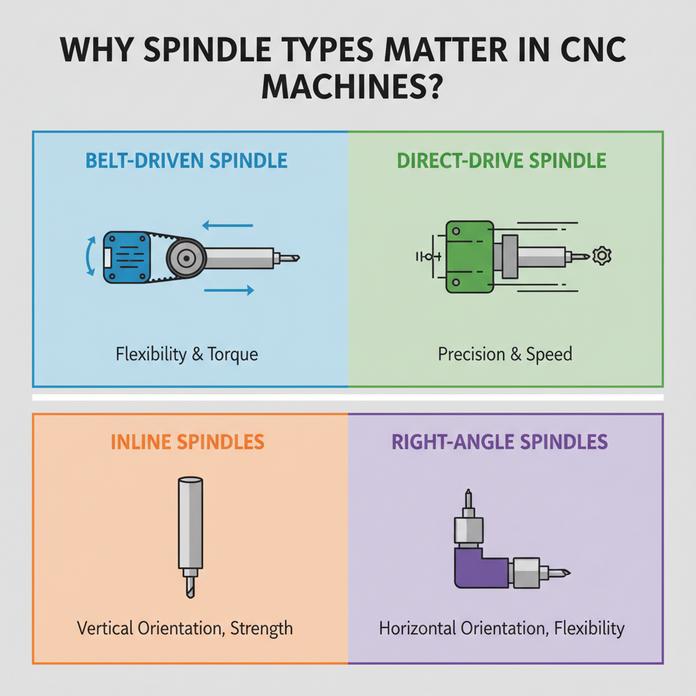
Belt-Driven Spindles vs. Direct-Drive Spindles
When comparing spindle options in cnc machine parts, the difference starts at power transfer and ends at surface finish.
- Power Transmission System
1.1 Belt-driven spindle
- Transfers power from motor to spindle through belts.
- Adjusting pulley ratios changes motor speed and torque output.
- Ideal for shops needing torque flexibility across varied cnc machine parts.
1.2 Direct-drive spindle
- Motor shaft connects directly to spindle.
- No belts means fewer mechanical losses.
- Higher achievable motor speed with tighter control.
- Performance Impact on CNC Machine Parts
2.1 Torque Delivery
- Belt systems amplify torque at lower RPM.
- Direct systems maintain consistent torque at high speeds, useful for detailed cnc machining parts.
2.2 Vibration and Surface Quality
- Belts can introduce slight vibration over time.
- Direct-drive reduces vibration, improving precision on critical cnc machine parts.
- Maintenance and Lifecycle
3.1 Belt-driven setups
- Require periodic belt checks.
- Lower upfront cost but ongoing maintenance.
3.2 Direct-drive setups
- Fewer wear components.
- Higher initial investment, often longer service intervals.
Grand View Research noted in a 2025 update that high-speed spindle demand continues rising due to precision-driven industries. That trend directly affects cnc machine parts sourcing decisions.
Manufacturers like yuuhuan hongqian align spindle configurations with application needs, ensuring cnc machine parts and core machine parts work as a tuned system, not random add-ons.
Inline Spindles vs. Right-Angle Spindles
Choosing between an inline spindle and a right-angle spindle shapes how cnc machine parts handle real-world jobs.
Inline spindles follow the machine’s main axis of rotation, usually vertical along the Z-axis. Clean. Direct. Familiar.
Key advantages:
- Better rigidity for standard face milling.
- Shorter tool length, which improves stability.
- Simple setup for everyday cnc machine parts production.
Right-angle spindles flip the script. The cutting tool sits 90 degrees to the main spindle axis.
- Access in Tight Spots
- Side drilling without repositioning the workpiece.
- Greater machining clearance inside deep cavities.
- Multi-Face Operations
- Machine several surfaces in one setup.
- Boost efficiency for complex cnc machine parts.
- Practical Trade-Offs
- Slight reduction in rigidity.
- Added consideration for access and balance.
★ Inline = straightforward strength.
★ Right-angle = flexibility in confined geometry.
For shops producing diverse cnc machine parts, mixing spindle types often makes sense. Experienced suppliers like yuuhuan hongqian understand how spindle choice connects with other cnc components, ensuring the entire cnc machine parts ecosystem runs smoothly, without costly trial and error.
Using Proper CNC Components Increases Production Efficiency By 35%
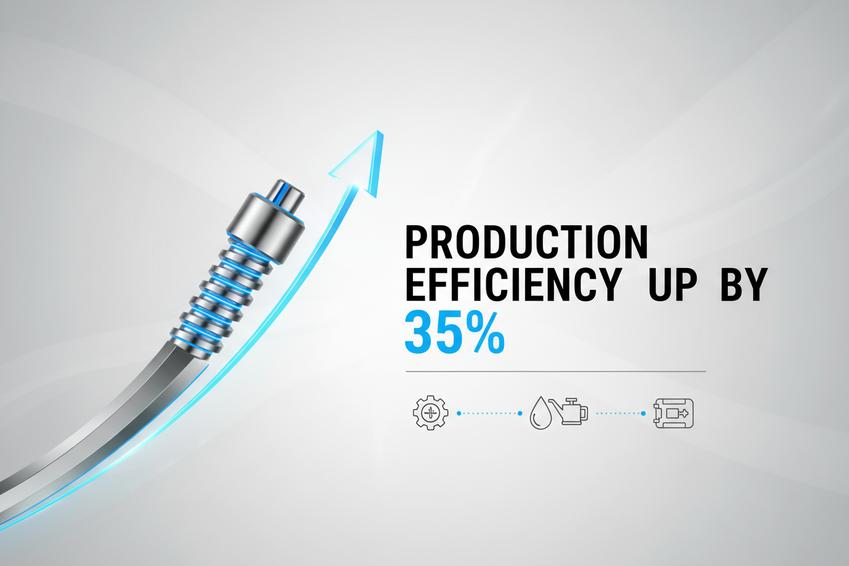
Tuning up cnc machine parts isn’t just tech talk—it’s how shops squeeze real speed and accuracy out of every shift. When core cnc components like ball screws, servo systems, and sensors work in sync, downtime drops and output climbs. Smart upgrades to cnc machine parts and precision machine components can lift consistency by 35%, and brands like yuuhuan hongqian make that jump feel practical, not theoretical.
Upgrade Ball Screws for Tighter Tolerances
When upgrading cnc machine parts, the Ball Screw system deserves serious attention because it directly drives Linear Motion and overall Accuracy.
- Core Performance Factors
- Precision
- Reduced Backlash through preloaded nuts
- Higher Stiffness under dynamic loads
- Structural Strength
- Improved Load Capacity for heavy cutting
- Stable positioning during rapid feed
- Precision
- Production Impact
- Smoother axis travel
- Less thermal drift
- More consistent part geometry
Shops replacing worn transmission components in their cnc machine parts often notice tighter tolerances within days. With yuuhuan hongqian ball screw assemblies, motion feels firm, controlled, and repeatable—exactly what high-speed machining needs.
Optimize Lubrication Systems: Better Coolant Flow
Cooling isn’t glamorous, yet it quietly protects vital machine parts inside modern cnc machine parts assemblies.
- Lubrication System Control
- Fluid path design
- Balanced Coolant Flow
- Directed Fluid Delivery
- Thermal stability
- Faster Heat Dissipation
- Extended Tool Life
- Fluid path design
- Maintenance Layer
- Clean filtration
- Planned System Maintenance
- Improved Chip Evacuation
Dial in coolant pressure, align nozzles, and monitor flow rate. The payoff shows up in lower insert costs and fewer surprise shutdowns.
Integrate High-Response Servo Motors
Servo upgrades transform how cnc machine parts behave under load.
- Motion Command Chain
- Servo Motor
- Faster Response Time
- Stable Torque output
- Control Loop
- Fine Speed Control
- Accurate Positioning Accuracy
- Servo Motor
- Axis Execution
- Sharp Axis Movement
- Better Dynamic Performance in contouring
High-resolution encoders tighten feedback. Acceleration improves. Corners stay crisp. For shops scaling production, yuuhuan hongqian servo-ready assemblies align perfectly with advanced control systems used in cnc machine parts setups.
Add Advanced Sensors and Probing Tools
Modern cnc machine parts rely on feedback, not guesswork.
Start with in-machine Sensors. Add Probing Tools for automatic Workpiece Measurement. Track Tool Wear before it becomes scrap. Then connect everything to real-time Data Acquisition for smarter Machine Calibration and ongoing Real-time Monitoring.
Short pause. Quick recalibration. Back to cutting.
That loop keeps precision machine components sharp and consistent, turning standard cnc machine parts into a self-correcting production system that saves time, material, and plenty of headaches.
FAQs about Cnc Machine Parts
What cnc machine parts most directly affect machining accuracy?
Precision lives in a tight chain of components:
1) Motion Core
- Ball Screws → control linear positioning, reduce backlash
- Linear Guides → stabilize axis travel under load
- Servo Motors + Encoders → translate commands into exact movement
2) Rotation & Cutting
- Spindles + Bearings → determine surface finish and tool stability
- Tool Holders → secure End Mills, Drills, and Inserts without vibration
3) Structural Base
- Machine Beds & Castings → absorb shock, prevent distortion
If one link weakens, tolerances drift—and production feels it immediately.
How do control systems influence cnc machine parts performance?
A machine breathes through its electronics.
- CNC Controllers coordinate multi-axis paths.
- Drives & Power Supplies regulate torque and speed response.
- Sensors & Scales confirm real-time positioning.
- Operator Panels bridge human intent with mechanical action.
When Controllers and Servo Motors respond in sync, Rotary Tables rotate smoothly, Automatic Tool Changers shift without hesitation, and cutting tools maintain rhythm instead of chatter.
Why are lubrication and cooling systems critical in long production runs?
Heat is the quiet saboteur.
| Component Area | Supporting System | Direct Impact |
|---|---|---|
| Spindles & Bearings | Lubrication Systems | Reduced friction, longer life |
| Cutting Zone | Coolant Pumps + Nozzles | Stable temperature, cleaner cuts |
| Fluid Quality | Filtration Units | Fewer contaminants, smoother finishes |
| High-Speed Jobs | Chillers | Thermal balance during long cycles |
Without steady cooling, Inserts dull faster, Taps seize, and surface finish fades under pressure.
How do workholding and structural elements protect consistency?
Repeat production depends on discipline at the base:
- Vises, Chucks, Collets, Clamps, Pallets keep parts aligned.
- Machine Beds, Enclosures, Gears, Couplings maintain rigidity under torque.
- Bearings steady Rotary Tables during heavy cuts.
A weak fixture shifts by microns—yet those microns echo across thousands of parts.
Can upgrading cnc machine parts significantly raise productivity?
Yes—and the change feels immediate.
• Replace aging Servo Motors → faster acceleration, tighter paths
• Add Probes, Tool Setters, or Vision Systems → fewer manual checks
• Upgrade Automatic Tool Changers → shorter idle gaps
• Integrate Laser Scanners or advanced Encoders → higher positioning confidence
Productivity rises not from one dramatic swap, but from coordinated improvements across motion, control, measurement, and cutting tools like Milling Cutters or Reamers.
When the system works as one, output climbs—and rework falls.
“Precision is a journey, not a destination.” Looking to upgrade your industrial components or need high-precision CNC machined parts with superior surface finishes? Whether it’s Electroless Nickel plating or complex pipe fitting geometries, our engineering team at Yuhuan Hongqian is ready to help.