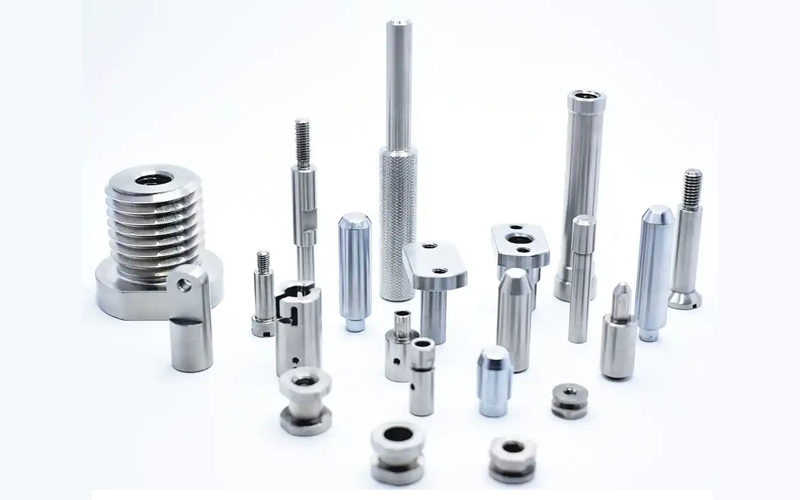
In modern manufacturing, producing reliable CNC turned parts is not only about having advanced machines. For machining parts manufacturers serving international markets, quality is determined by how well accuracy, machining strategy, and inspection methods are controlled throughout production.
In CNC turning services, machine specifications alone do not guarantee consistent results. Real-world part quality depends on tolerance planning, rough and finish machining strategies, and inspection methods that match both accuracy requirements and production volume. This article explains how professional manufacturers manage these factors to deliver stable and repeatable CNC machining parts.
CNC Turning Accuracy vs. Part Tolerance
A common misunderstanding in CNC turning is equating machine accuracy with finished part tolerance. In typical production environments, a general CNC lathe can achieve a machine-level accuracy of around 0.08 mm. However, this value does not represent the final dimensional accuracy of the part.
In practice, most CNC turned parts are produced within a tolerance range of ±0.02 mm to ±0.10 mm, depending on:
- Part geometry
- Material properties
- Machining allowance
- Fixturing stability
- Inspection method
For standard CNC machining parts, tolerances closer to ±0.1 mm are often acceptable. For CNC precision turned parts used in assemblies, sealing systems, or functional mechanisms, tighter control is required.
Why Rough Turning and Finish Turning Are Necessary
When precision requirements increase, machining strategy becomes critical. High-accuracy CNC turned parts are rarely completed in a single machining stage.
Rough Turning
Rough turning is used to remove the majority of material efficiently. It helps:
- Reduce internal stress
- Stabilize the workpiece geometry
- Prepare consistent allowance for finishing
Finish Turning
Finish turning is applied to:
- Achieve final tolerance (commonly around ±0.02 mm)
- Improve surface finish
- Control concentricity between OD, ID, and functional features
This two-step approach is widely used by professional CNC turning services, especially when accuracy requirements are high and machining allowance is relatively large.
Inspection Strategy Based on Tolerance and Production Volume
In CNC turning production, inspection methods should always match tolerance requirements and batch size. Over-inspection increases cost, while under-inspection increases risk. Professional machining parts manufacturers choose inspection tools based on practicality, not formality.
Low-Tolerance CNC Turned Parts
When dimensional accuracy requirements are not tight, standard inspection tools are sufficient.
- Inspection tools:
Micrometers or vernier calipers - Typical tolerance range:
±0.05 mm to ±0.10 mm - Sampling ratio:
Approximately 10% random sampling
This approach is widely used for general CNC machining parts, where functional fit is not highly sensitive and dimensional variation is acceptable within standard limits.
High-Precision, Large-Batch CNC Precision Turned Parts
When parts require tighter tolerances and are produced in large quantities, inspection efficiency and repeatability become critical.
For high-volume CNC precision turned parts, especially those with:
- Tight OD and ID tolerances
- Functional fits or sealing requirements
- Consistent geometry across large batches
Pneumatic (air) gauging systems with custom inspection fixtures are commonly adopted.
- Inspection focus:
Outer diameter (OD) and inner diameter (ID) - Inspection method:
Pneumatic measurement with dedicated fixtures - Advantages:
- Fast measurement speed
- High repeatability
- Minimal operator influence
This method allows CNC turning services to maintain consistent quality while keeping inspection time under control during large-scale production.
Comparison of CNC Turning Inspection Methods
| Inspection Condition | Typical Tool | Sampling Method | Application Scenario |
|---|---|---|---|
| Low precision requirement | Micrometer / Caliper | ~10% sampling | General CNC turned parts |
| Medium precision, small batch | Micrometer + Dial indicator | Increased sampling | Functional mechanical parts |
| High precision, large batch | Pneumatic gauge + custom fixture | In-process or 100% check | CNC precision turned parts |
| Critical dimensional control | CMM (spot verification) | Periodic validation | Customer-critical features |
This inspection strategy balances accuracy, efficiency, and production cost, which is essential for machining parts manufacturers supplying global customers.
Why Pneumatic Gauging Is Used for High-Precision CNC Turning
Pneumatic measurement systems are especially effective for OD and ID control in high-volume production.
Compared to manual tools:
- Measurement results are less dependent on operator skill
- Repeatability is significantly higher
- Inspection speed supports continuous production flow
For CNC precision turned parts, pneumatic gauges often function as process control tools, not just final inspection equipment.
FAQ: CNC Turning Inspection and Accuracy Control
When is caliper or micrometer inspection sufficient?
For CNC turned parts with relatively low precision requirements (typically ±0.05 mm to ±0.10 mm), micrometers or calipers combined with about 10% sampling inspection are generally sufficient.
Why is sampling inspection used instead of 100% inspection?
Sampling inspection reduces inspection time and cost while maintaining acceptable quality risk, especially when the machining process is stable.
When should pneumatic measurement be used in CNC turning?
Pneumatic measurement is recommended when tolerance requirements are tight, production volume is large, and OD or ID consistency is critical.
Is pneumatic gauging more accurate than micrometers?
Pneumatic gauging provides higher repeatability and faster inspection in batch production. Absolute accuracy still depends on proper calibration and fixture design.
Conclusion: Inspection Strategy Defines CNC Turning Quality
In CNC turning services, machine accuracy alone does not guarantee quality. Reliable CNC turned parts are produced through a combination of controlled machining strategy, appropriate rough and finish turning, and inspection methods aligned with tolerance and production volume.
For machining parts manufacturers, selecting the right inspection strategy is a key factor in delivering consistent CNC machining parts and high-quality CNC precision turned parts for international markets.