The Intersection of Material Science and Precision Forged Pipe Fittings
In the competitive landscape of high-precision manufacturing, selecting a premium material is only the foundational step. The true hallmark of a superior industrial component lies in the synergy between metallurgy and forging expertise. At Yuhuan Hongqian Machinery , we operate with over a decade of hands-on experience and a robust infrastructure featuring 80 specialized CNC machines. We have observed that the most common cause of component failure isn’t the material itself, but the application of an incompatible forging process. This article explores why Hot Forging (Red Punching) is the definitive solution for high-performance carbon and free-cutting steels.
1. The Mastery of Carbon Steel: Why We Prioritize Hot Forging for Forged Pipe Fittings
Carbon steel serves as the structural backbone for global industrial infrastructure. However, transforming a raw steel billet into a high-pressure forged pipe fitting requires more than just force; it requires controlled thermal energy. This is where Hot Forging, or Red Punching, becomes indispensable.
The Science of Grain Flow and Hardness
When we heat carbon steel above its recrystallization temperature (1100°C – 1250°C), the molecular structure becomes plastic. During the Red Punching process, the internal grain flow is redistributed to follow the part’s contours.
-
Increased Structural Integrity: Unlike cold forming, red punching ensures the crystal structure is more uniform and dense.
-
Enhanced Hardness: The controlled cooling after hot forging naturally increases the product’s hardness and fatigue resistance without the risk of internal stress fractures or the dreaded cracking seen in cold-processed brittle steels.

2. Standard Materials: The Foundation of Industrial Reliability
At yuhuan hongqian , our production lines are optimized for a wide array of carbon and alloy steels:
-
AISI 1020 & 1035: Ideal for general engineering with a balance of strength and ductility.
-
AISI 1045: High-strength medium carbon steel for high-wear components like gears and heavy-duty bolts.
-
42CrMo (AISI 4140): A chromium-molybdenum alloy offering exceptional toughness for high-pressure oil and gas fittings.
3. Case Study: Why 1215 & 12L14 Free-Cutting Steel Fail in Cold Heading
For procurement engineers, the failure of free-cutting steel in cold forming is a major technical pain point.
-
The Cracking Phenomenon: 12L14 contains Lead (Pb) for superior machinability. However, at room temperature, this makes the steel brittle. Forced deformation (Cold Heading) leads to catastrophic micro-cracking—invisible to the eye but fatal under pressure.
-
The Red Punching Solution: Hot forging bypasses this brittleness. The heat allows the steel to flow into complex shapes without fracturing, maintaining a structurally sound blank that is ready for our 80 CNC lathes.
4. Sandblasting and Surface Preparation for forged pipe fittings
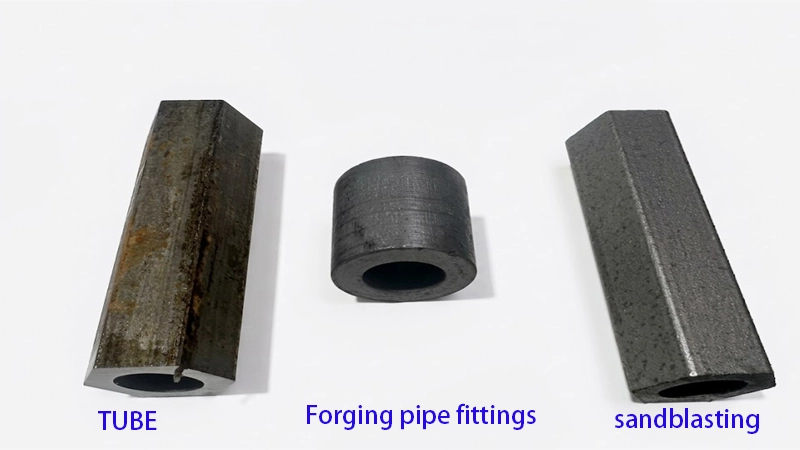
After the Red Punching process, a layer of black oxide scale (oxide skin) naturally forms on the surface due to high-temperature oxidation. At yuhuan hongqian , we include a mandatory Sandblasting/Shot Blasting stage before machining. This is a game-changer for three reasons:
I. Protecting Tooling and Improving Machinability
The “black skin” on forged pipe fittings is extremely hard and abrasive. By removing this impurity and hard scale through sandblasting, we create a uniform material surface.
-
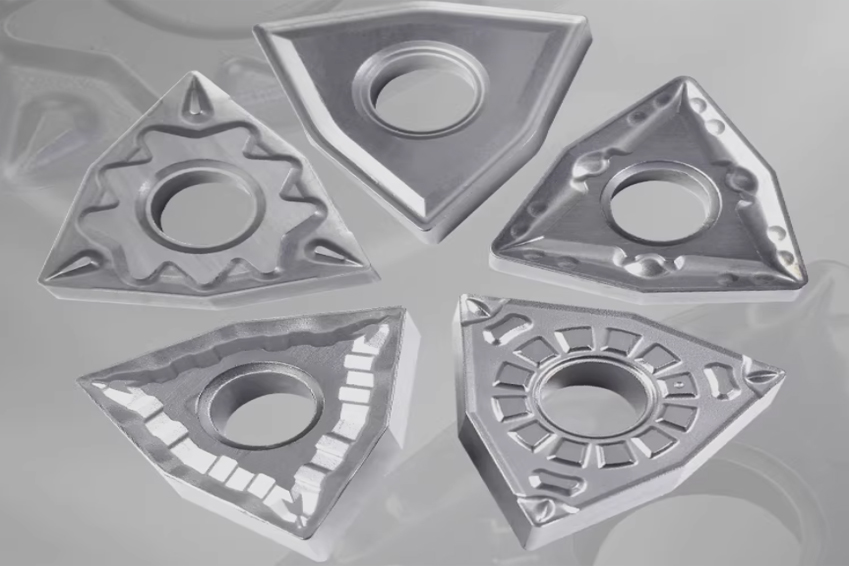
Tool Protection: This prevents “tool chipping” (broken inserts) during CNC turning.
-
Extended Tool Life: A cleaner surface means less friction and wear, allowing our machines to maintain tighter tolerances for longer periods.
II. Superior Aesthetics and Plating Quality
A clean surface is non-negotiable for high-end industrial parts.
-
Eliminating Defects: Without sandblasting, subsequent Electroplating (Zinc, Nickel, etc.) will trap impurities, leading to black spots, peeling, or uneven plating.
-
Professional Finish: Sandblasting ensures a smooth, matte finish that allows plating to bond perfectly, ensuring no black spots or surface irregularities.
III. Structural Uniformity
Sandblasting acts as a final stress-relief and cleaning stage, ensuring that the crystal structure at the surface is as consistent as the core, providing a truly high-quality forged pipe fittings.
5. Technical Comparison: Forging Methods for Specialized Steels
| Feature | Hot Forging (Red Punching) | Cold Heading / Cold Forming |
| Material Compatibility | 1215, 12L14, 42CrMo, 1045 | Low Carbon Soft Steels (1008/1010) |
| Risk of Cracking | Negligible (High Plasticity) | Critical Risk in 12L14 & 1045 |
| Surface Quality | Excellent (Post-Sandblasting) | Often contains residual oils/stresses |
| Plating Success Rate | 100% (Clean & Uniform) | Moderate (Risk of surface impurities) |
| Tool Life (CNC) | Longer (Abrasive scale removed) | Shorter (Due to hard spots) |
6. The Role of Automation: Precision Beyond Forging
With 15 Truss Robots and 80 CNC machining centers, we handle the transition from a sandblasted forged blank to a finished part with unmatched consistency.
-
Thread Precision: 6G/6H tolerances on NPT, BSPT, and Metric threads.
-
Consistency: Automation ensures that the 1st part and the 200,000th part are identical in quality and finish.
FAQ: Expert Insights
Q: Does sandblasting affect the dimensions of the part?
A: No. We calibrate our forging dies and CNC programs to account for the microns removed during sandblasting, ensuring the final dimensions are perfect.
Q: Why is 1045 steel better when hot forged?
A: Hot forging 1045 steel refines the grain size and increases hardness more uniformly than cold processes, making it far more reliable for structural use.
[CTA] Optimize Your Supply Chain with yuhuan hongqian
Stop settling for components with hidden cracks or poor plating quality. Partner with a manufacturer that masters the full cycle: Red Punching -> Sandblasting -> CNC Precision.