Forging vs Cold Forging on CNC Turning

In the cnc machining manufacture, When we get the custom oem cnc turning parts drawings , first we need check choose which type of forging type.。

How many material type in the cnc turned parts ?

Round bars, hexagonal bars, pipes, hot forging, cold forging, casting Iron parts etc.

Today we mainly discuss why we use hot forging and cold forging first . First when we get small batch cnc parts order , we first consider round bars , hexagonal bars ,pipes . Beucase these material is easy find in the stock market or low cost to custom pipe size .

But when we get a large volume of CNC turned parts, hot forging and cold forging can save costs and improve production efficiency.

The Detail of Hot Forging

Hot forging occurs when someone heats the material to a high temperature. This temperature is usually above the material’s recrystallization point. At this heat, the material can be easily shaped. This temperature range makes the material more malleable and less prone to cracking during deformation.

Benefits of Hot Forging:

  1. Improved Material Properties: Hot forging alters the grain structure of metals, making the final product stronger and more durable. This is especially useful in industries where strength and fatigue resistance are critical, such as automotive and aerospace.
  2. Suitable for Large Parts: Since hot forging requires heating the material, it is more effective when working with larger parts or thick materials that might be difficult to shape at room temperature.
  3. Cost-Effective for High-Volume Production: Hot forging is a great choice for mass production because it is highly efficient. When combined with automated CNC systems, hot forging can produce large quantities of parts quickly and with consistent results.
  4. Better for Complex Shapes: The malleability of hot-forged metals makes it easier to form more complex shapes. This is especially useful when creating parts that have intricate geometry or intricate features, such as automotive engine components.

The detail of Cold Forging

Cold forging, on the other hand, takes place at or near room temperature. This process is ideal for shaping smaller parts that require high precision. In cold forging, the metal is deformed without being heated, which increases its strength because of the strain hardening effect.

Benefits of Cold Forging:

  1. High Precision and Surface Finish: Cold forging allows manufacturers to achieve tight tolerances and smooth surface finishes without the need for extensive secondary machining. This makes it ideal for parts that require a high degree of accuracy, such as electrical connectors and small mechanical components.
  2. Energy-Efficient: Since there is no need to heat the metal in cold forging, the energy consumption is significantly lower compared to hot forging. This makes cold forging a more cost-effective option for smaller runs or parts with high precision requirements.
  3. Great for Small Parts: Cold forging is often used for smaller, high-precision parts, such as fasteners, bolts, and pins, which are commonly used in the electronics and medical device industries.
  4. Improved Material Properties at Smaller Sizes: Due to the strain hardening effect in cold forging, the material becomes stronger as it is shaped. This makes it an excellent choice for producing small parts with enhanced strength.

Advantages and shortage of Hot Forging and Cold Forging

Both hot and cold forging methods offer significant advantages, but they are not always interchangeable. Here’s a quick summary of the pros and cons of each method:

Advantages of Hot Forging:

  • Strength and Durability: Hot forging produces parts that are incredibly strong, making it ideal for high-stress applications.
  • Cost-Efficient for Mass Production: If you’re manufacturing large quantities of parts, hot forging is typically more cost-effective.
  • Great for Complex Parts: Hot forging can create parts with intricate shapes that would otherwise be difficult or impossible to achieve through machining alone.

shortage of Hot Forging:

  • Higher Energy Consumption: Heating the material to high temperatures requires a significant amount of energy, which can increase production costs.
  • Less Precision: Although hot forging produces strong parts, the process doesn’t offer the same level of precision as cold forging.
  • Limited to Larger Parts: Hot forging works better with larger parts, and may not be suitable for small, detailed components.

 Advantages of Cold Forging:

  • High Precision: Cold forging typically provides better precision and surface finish than hot forging, especially when tight tolerances are required.
  • Lower Energy Costs: Since no heating is involved, cold forging is more energy-efficient, making it a cost-effective choice for small parts.
  • Ideal for Small Parts: Cold forging is ideal for creating small, highly detailed components with intricate features.

Disadvantages of Cold Forging:

  • Not Suitable for Larger Parts: Cold forging is limited by the size of the material that can be shaped at room temperature, which makes it less suitable for larger parts.
  • Requires High Pressure: Cold forging typically requires high amounts of pressure to deform the material, which can limit its use with certain materials.

Which Forging Method is Right for Your CNC Machining Project?

Choosing the right forging method depends largely on the size, strength, and precision requirements of the parts you need to produce.

  • If you need large, high-strength parts with complex geometries, then hot forging is likely the best option. Hot forging is ideal for high-volume production and materials that need to be strong and durable.
  • If you’re looking for high-precision parts, especially smaller components, cold forging is the way to go. Cold forging offers superior dimensional accuracy and is perfect for parts that require tight tolerances and smooth surfaces.

Applications of Hot and Cold Forging in CNC Machining

The choice between hot and cold forging often depends on the industry and the application. Here are some common examples:

  • Hot Forging Applications:

  • Automotive Components: Engine blocks, crankshafts, and transmission parts that need to withstand high levels of stress,automobile parts .
  • Aerospace Parts: High-strength parts for aircraft engines and airframes.
  • Heavy Equipment Parts: Large, durable parts used in machinery.
  • Pipe fittings:bulkhead fittings , hydraulic fittings,pneumatic connector
  • Cold Forging Applications:

  • Precision Fasteners: Bolts, nuts, and pins used in automotive and machinery applications.
  • Medical Devices: Small components that require high precision, such as surgical instruments and implants.
  • Electronics: Small, intricate components like connectors, pins, and contacts.
  • Pipe fittings:bulkhead fittings , hydraulic fittings,pneumatic connector , this type can both use hot forging and cold forging based on the quantity.

The different quantity demand of hot forging and cold forging

When comparing hot forging and cold forging, the differences in quantity demand, mold costs, and mold development speed are quite distinct.

Hot forging :low quantity demand , low mould fee costs, improve hardness of material .fast mould develop speed ,Development Cycle [usally 15 days].

cold forging : Big quantity [more than 50000pcs] ,high mould fee costs, Development Cycle [usally 35 days]

Surface different bettween hot forging and cold forging

Forged Surface Finish

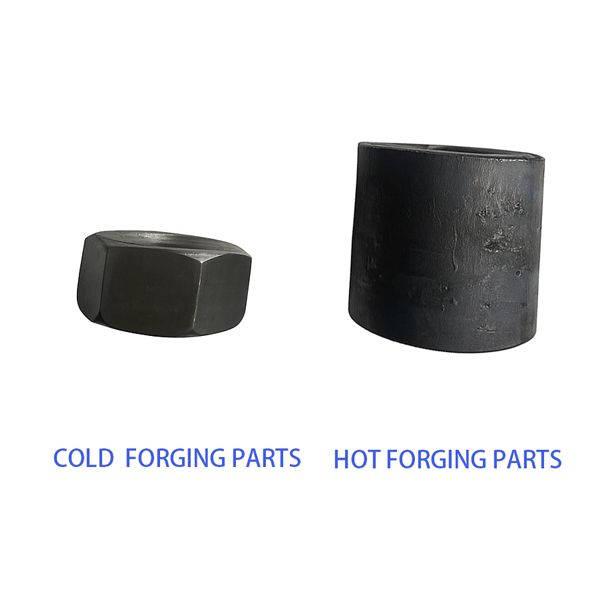
The surface finish of a forged part is generally rougher, with a surface roughness (Ra) typically between 3.2 to 25 micrometers. This is acceptable for industries like construction or heavy machinery. However, for more demanding uses like aerospace or automotive, additional finishing processes such as grinding or polishing are often required to achieve a smoother finish.

cold forging Finish

cold forging can achieve smoother surface finishes, with Ra values as low as 1.6 micrometers. It can satisfy mostly cnc parts demand and delete cnc machine .Save the costs and improve profit for the cnc machine manufacture .

Follow is cold forging parts and hot forging parts , you can check the detail surface .
Tolerances and Precision – Forging vs Machining

When it comes to tolerances, cold forging far surpasses forging.

cold forging Tolerances

cold forging can achieve extremely tight tolerances ±0.05 mm and satisfy high somooth surface . So some cnc turned parts can direclty deform by cold forging without cnc maching.

Forging Tolerances

Due to the nature of the shaping process, forged parts typically have looser tolerances. When high demand for the accuracy and surface , then It is necessary to have second machine to achieve tight tolerances and good surface.

This is common in industries where both strength and precision are required, such as automotive or aerospace. For instance, a forged automotive component may undergo finishing operations to meet the required dimensional specifications.

Conclusion: Hot Forging vs Cold Forging in CNC Machining

When deciding between hot forging and cold forging, it’s important to consider your specific needs. If you require large parts with high strength and can tolerate lower precision, hot forging is your best bet. On the other hand, if you need high-precision, small components with excellent surface finishes, cold forging will be the most suitable option.

Both methods offer distinct advantages in CNC machining, and understanding when and how to use each can help you produce high-quality forged CNC parts that meet your production goals.

By choosing the right forging method for your CNC machining needs, you can ensure that your parts are strong, durable, and cost-effective, whether you’re working in automotive, aerospace, or medical industries.

Request a Quote