In high-precision CNC turning for tube fittings machining, maintaining 0.02mm parallelism is one of the most critical geometric tolerances. Even a small deviation can cause sealing failures, assembly difficulties, or rejected parts in high-pressure systems.
Many CNC workshops struggle to maintain parallelism within 0.02mm, especially when parts require multiple clamping operations.
At our factory, we have developed a set of CNC turning strategies specifically designed to eliminate re-clamping errors and maintain tight tolerance CNC turning for parts of different sizes.
Why Parallelism Control Is Challenging in Traditional CNC Turning
In conventional CNC turning parts machining, the most common cause of parallelism error is re-clamping.
A typical process involves:
- Machining one side of the part
- Removing the part from the chuck
- Flipping the part
- Re-clamping and machining the second side
When using a 3-jaw chuck, several issues appear:
Concentricity Loss
The second setup rarely aligns perfectly with the first machining reference, affecting CNC turning tolerance.
Deformation from Clamping Force
Thin-wall tube fittings machining can deform when high clamping pressure is applied to the outer diameter.
Parallelism Drift
Even a 0.01mm misalignment or dust inside the chuck can create unacceptable deviation, causing failure in tight tolerance machining.
Because of these factors, maintaining 0.02mm parallelism is extremely difficult using traditional methods.
Solution 1: Internal Expansion Collets for Small CNC Turning Parts
For smaller components (typically under 30mm diameter), we use high-precision internal expansion collets CNC turning, which ensure tight tolerance machining.
Engineering Principle
Instead of clamping the outside diameter, the part is located using the internal bore as the primary datum reference.
The expanding mandrel centers the component from its internal axis for better CNC turning tolerance control.
Typical Performance
For parts under 30mm diameter, parallelism can be maintained within 0.03mm – 0.05mm, ensuring tight tolerance CNC turning.
Limitation
For larger diameter parts, vibration and leverage may increase parallelism deviation to 0.03mm – 0.07mm, which we overcome with single-setup CNC turning for tube fittings
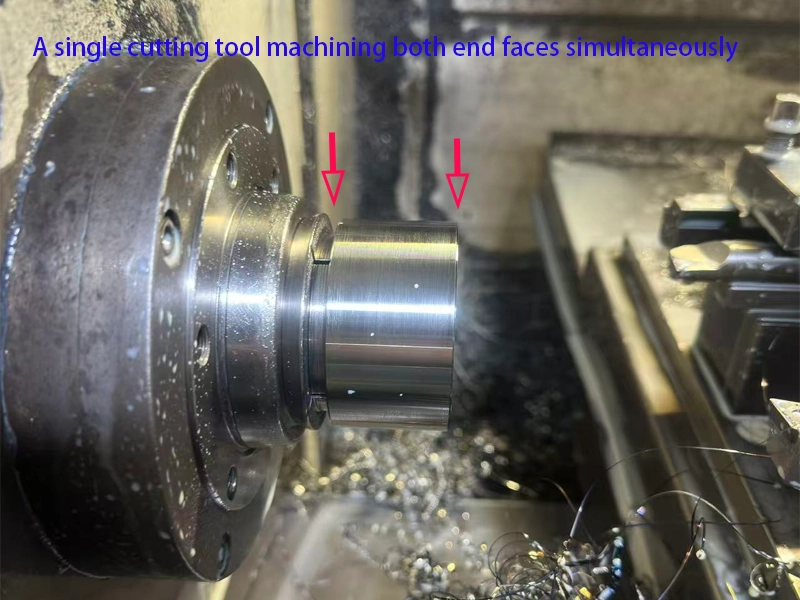
Solution 2: Single-Setup CNC Turning to Eliminate Re-Clamping Errors
The most effective way to achieve ultra-tight parallelism is to eliminate flipping and re-clamping completely.
We redesigned our internal expansion fixture into a gap-design internal clamping system.
H3: How the System Works
Internal Support: The fixture expands inside the bore to locate the part securely.
Tool Accessibility: Engineered clearance allows cutting tools to reach both end faces and the outer diameter.
Single Setup Machining: Both sides can be machined in one operation, eliminating the risk of misalignment.
Result: Parallelism is now controlled by machine axis accuracy, not operator skill, achieving 0.01mm or near-zero parallelism error in high-precision CNC turning parts.
Solution 3: Surface Grinding for Extreme Precision Requirements
When internal clamping is impossible due to geometry or hard materials, we use surface grinding CNC turning as a secondary operation.
H3: Advantages
- Extremely high flatness
- Superior parallelism control
- Suitable for tight tolerance machining
H3: Disadvantages
- Additional manufacturing step
- Higher production cost
Manufacturing Policy:
We prioritize single-setup CNC turning, which provides the best balance of precision, speed, and cost. Grinding is only used when design strictly requires it.
Comparison of Parallelism Control Methods
| Method | Parallelism | Production Speed | Cost Efficiency | Best Application |
|---|---|---|---|---|
| Internal Expansion Collet | 0.03 – 0.05mm | High | Excellent | Small CNC turning parts, tube fittings machining |
| Single-Setup Gap Design | 0 – 0.01mm | High | Best | High-precision tube fittings, tight tolerance machining |
| Surface Grinding | <0.005mm | Medium | Higher | Aerospace-level CNC parts |
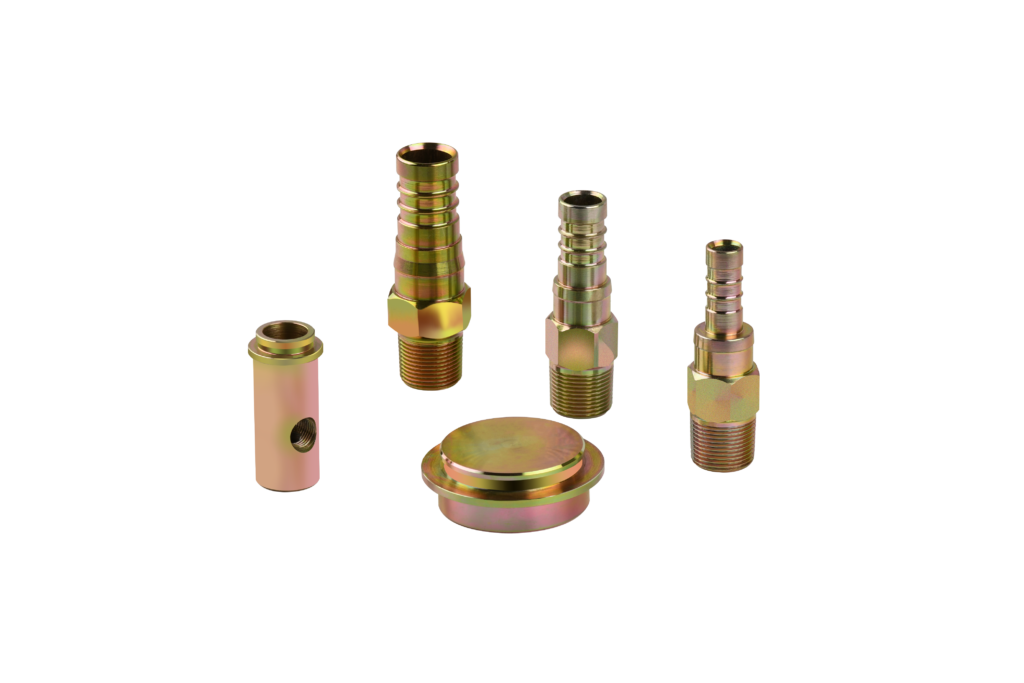
Why Parallelism Matters in Tube Fittings
For high-pressure tube fittings, poor parallelism can cause:
- Sealing failure
- Uneven load distribution
- Assembly difficulty
- Leakage under pressure
By controlling parallelism at the CNC turning stage, every tube fitting meets tight tolerance CNC turning standards.
FAQ: Precision CNC Machining for Tube Fittings
Q: Why does part diameter affect parallelism?
A: As diameter increases, any angular deviation at the center becomes magnified at the outer edge, affecting CNC turning tolerance.
Q: Can you maintain 0.02mm parallelism for stainless steel 316?
A: Yes. Using single-setup CNC turning, we maintain tight tolerances while avoiding work-hardening caused by repeated clamping.
Q: How do you prevent deformation in thin-wall fittings?
A: Internal expansion collets distribute clamping force evenly, reducing deformation compared with external chucking. Essential for thin-wall tube fittings machining.
Q: Is single-setup machining more expensive?
A: No. It reduces handling time, operator error, and scrap rate, making tight tolerance CNC turning more cost-efficient.
Q: What surface finish can you achieve with surface grinding?
A: We can achieve a surface finish of around Ra 0.8 µm on stainless steel and carbon steel, providing smooth and precise mating surfaces for high-quality tube fittings.
Q: Want to ensure your tube fittings meet the highest precision and surface quality?
A: Contact us today for a customized CNC machining solution and quote.