In heavy industry, carbon steel pipe fittings are the quiet workhorses nobody brags about—until one fails and the whole job site grinds to a halt. Picture a refinery turnaround on a tight deadline: crews on overtime, weld arcs flashing, and one mismatched elbow throws the schedule off by days. That’s when cost, pressure rating, and certification stop being fine print and start feeling like high-stakes poker.
Carbon steel still accounts for over half of global steel demand, according to the World Steel Association. There’s a reason seasoned engineers say, “Strength is standard. Proof is power.” Mill Test Certificates, ASME specs, coating choices—these aren’t paperwork; they’re insurance policies in hard hats.
Choosing right isn’t about bells and whistles. It’s about fit, compliance, and sleeping well the night before hydrotest.
Quick Insights on Carbon Steel Pipe Fittings
➔ Select the Right Type: elbows, tees, reducers, flanges or couplings must match your connection—be it butt-weld, threaded, socket-weld, flanged or grooved.
➔ Verify Material & Standards: rely on ASTM A234 WPB or A105 specs, ASME B16.9/B16.11 dimensions and traceable Mill Test Certificates.
➔ Ensure Coating & Corrosion Resistance: choose black, galvanized, epoxy-coated or shot-blasted finishes for aggressive oil, gas or water environments.
➔ Confirm Compliance & Performance: ISO 9001, PED, CE Mark, NACE MR0175 and hydrotest pressure ratings guarantee reliability and safety.
Why Choose Carbon Steel Pipe Fittings?
Carbon steel pipe fittings sit at the heart of modern piping systems. From energy plants to water lines, carbon steel, steel pipe, and industrial pipe fittings keep flow steady and safe. Choosing the right carbon steel pipe fittings is not just technical talk—it directly affects uptime, cost, and long-term reliability.
Versatile Fittings Types: Elbows, Tees, Reducers, and More
Carbon steel pipe fittings cover a wide family of components designed for flexible layouts:
- Core connection types
- Direction change
- Elbows for 45° and 90° turns
- Branch flow
- Tees for splitting or combining lines
- Size transition
- Reducers for smooth diameter shifts
- Direction change
- End and joint solutions
- Sealing
- Caps to close pipeline ends
- Rotational alignment
- Flanges for bolted connections
- Extension and adaptation
- Stub Ends and Couplings for system adjustments
- Sealing
In real projects, carbon steel pipe fittings support butt-weld, threaded, socket-weld, and flanged systems. That range means fewer headaches during installation. Steel pipe fittings made from carbon steel handle structural load well, keeping pipelines tight and aligned. For contractors working with yuuhuan hongqian, sourcing carbon steel pipe fittings in matched specifications saves time on site and reduces rework.
Proven Performance in Oil and Gas & Petrochemical
In Oil and Gas fields and the Petrochemical Industry, carbon steel pipe fittings are trusted for tough jobs. High flow. Vibration. Sudden pressure spikes.
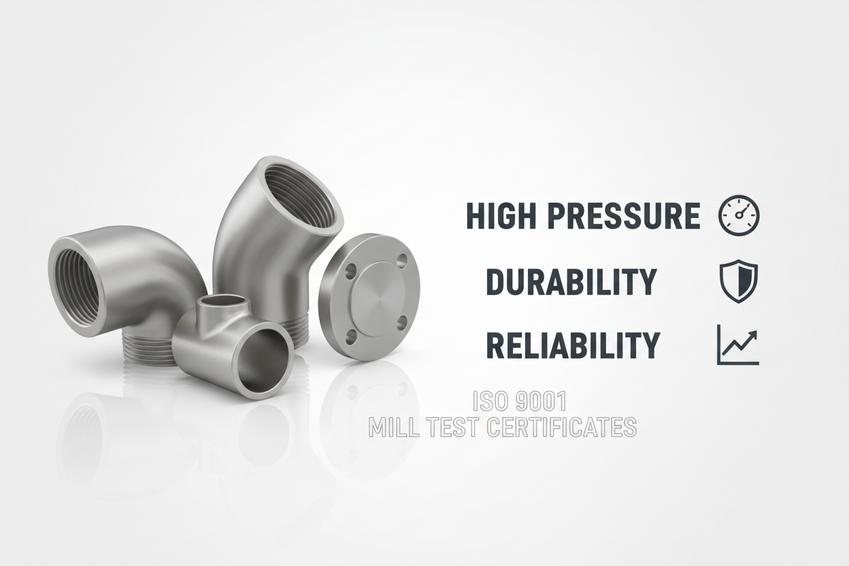
- Built for High Pressure systems
- Engineered for steady Durability
- Designed to maintain Reliability in critical lines
A few key strengths stand out:
- Solid mechanical strength under thermal cycling
- Practical Corrosion Resistance when paired with coatings
- Proven use across heavy Industrial Applications
Carbon steel pipe fittings keep transmission lines stable in refineries, offshore platforms, and power plants. Industrial pipe fittings made from carbon steel are often chosen when strength matters more than shine. That’s why many EPC contractors stick with carbon steel pipe fittings for long-haul pipelines and processing units.
Cost Efficiency Paired with ISO 9001 and Mill Test Certificates
Carbon steel pipe fittings balance price and performance in a way that project managers appreciate.
- Cost structure
- Lower base material cost
- Clearly Cost-Effective compared to many alloys
- Reduced replacement cycles
- Strong Long-Term Value
- Lower base material cost
- Certification and traceability
- System control
- ISO 9001 Certification manufacturing processes
- Documentation
- Verified Mill Test Certificates
- Compliance
- Alignment with global Material Standards and Quality Assurance practices
- System control
For budget-driven projects, carbon steel pipe fittings help protect the Project Budget without cutting corners. Steel pipe fittings from yuuhuan hongqian are supplied with full traceability, giving buyers confidence that every carbon steel pipe fitting meets required specifications. In practical terms, that means fewer disputes, smoother inspections, and pipelines that simply get the job done.
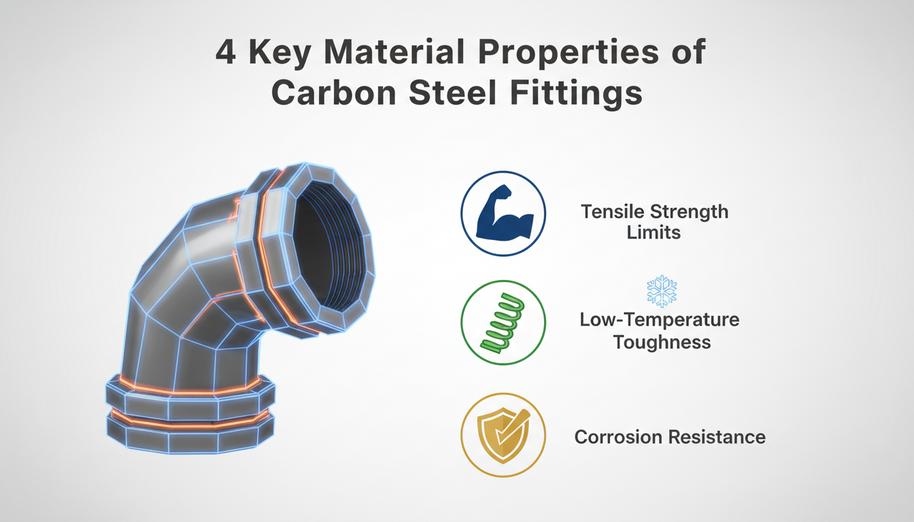
4 Key Material Properties Of Carbon Steel Fittings
Carbon steel pipe fittings sit at the core of pressure piping, refinery lines, and water systems. When people talk about carbon steel, pipe fittings, or steel pipe connectors, the real focus is performance. Below breaks down what truly matters in carbon steel pipe fittings and why smart buyers stick with proven makers like yuuhuan hongqian.
Tensile Strength of ASTM A234 WPB Components
When selecting carbon steel pipe fittings, tensile capacity defines safe operation.
- Core Material Standard
- ASTM A234 WPB
- Controls material specification
- Ensures stable mechanical properties
- ASTM A234 WPB
- Performance Indicators
- Verified tensile strength
- High load bearing capacity
- Long-term structural integrity
In high-pressure pipelines manufactured under ASME B16.9, these carbon steel fittings resist pulling forces without cracking. That’s critical for oil, gas, and heavy water transport.
For buyers comparing pipe fittings carbon steel grades, consistent tensile data means fewer surprises on-site. yuuhuan hongqian keeps production aligned with strict inspection routines so every batch of carbon steel pipe fittings delivers steady performance.
Yield Limits in Carbon Steel Grade B Fittings
Yield strength sounds technical, but it’s simple: it’s the point where steel stops bouncing back.
- Defined yield limit keeps fittings from bending permanently.
- Stable carbon steel grade B chemistry controls plastic deformation.
- Balanced ductility supports welding and field adjustment.
- Under pipeline stress:
- Maintains material strength
- Improves stress resistance
- Protects pipe fittings at junction points
Recent industry data reflects steady demand growth:
“Global demand for carbon steel pipe fittings continues to rise with energy infrastructure expansion in Asia-Pacific and the Middle East,” notes a 2025 outlook by Grand View Research.
That trend pushes manufacturers to tighten quality control. For contractors buying carbon steel fittings in bulk, predictable yield behavior means fewer shutdown headaches.
Low-Temperature Toughness for Cryogenic Applications
Cold service changes everything for carbon steel pipe fittings.
- Temperature Challenge
- Sub-zero temperatures
- Rapid pressure fluctuation
- Risk Factors
- Brittle fracture
- Reduced material performance
To manage this:
- Impact Testing
- Confirms low-temperature toughness
- Validates impact resistance
- Application Focus
- LNG lines
- Cryogenic applications in chemical plants
Low temperature carbon steel keeps structure stable when extreme cold tries to make steel snap instead of bend. That extra margin protects operators and equipment.
Corrosion Resistance Enhanced by Epoxy Coated Surfaces
Steel is strong, but moisture and chemicals don’t play nice.
- Surface Options:
- Epoxy coating
- Galvanizing
- Industrial varnish
Each surface treatment forms a protective layer that boosts corrosion resistance and blocks chemical attack.
In water treatment and petrochemical lines, coated carbon steel pipe fittings last longer and cut replacement cycles. Good coating work improves durability and supports environmental protection goals.
For projects needing reliable steel pipe fittings that handle pressure and rough surroundings, yuuhuan hongqian offers coated solutions that balance cost and long service life—without overcomplicating the spec sheet.
4 Steps To Inspect New Pipe Fittings
Before installing carbon steel pipe fittings, it pays to slow down and inspect what just arrived. A quick but sharp review keeps your carbon steel fittings performing right and avoids costly rework. Below is a practical way to check every batch of carbon steel pipe fittings with confidence.
Verifying Dimensional Standards per ASME B16.9
When checking carbon steel pipe fittings, dimensional control is non‑negotiable. Focus on measurable facts tied to ASME B16.9 and related standards.
- Confirm wall thickness, outer diameter, and center-to-end length.
- Compare real values against published pipe fitting dimensions.
- Verify compliance with required tolerances.
For quick reference:
| Nominal Size (NPS) | Standard OD (mm) | Min Wall Thickness (mm) | Center-to-End (mm) | Tolerance (±mm) |
|---|---|---|---|---|
| 1/2″ | 21.3 | 2.77 | 38 | 1.5 |
| 1″ | 33.4 | 3.38 | 38 | 1.5 |
| 2″ | 60.3 | 3.91 | 51 | 2.0 |
| 4″ | 114.3 | 6.02 | 102 | 3.0 |
| 6″ | 168.3 | 7.11 | 152 | 3.0 |
If numbers drift outside dimensional accuracy limits, the steel pipe fittings shouldn’t move forward.
Confirming Material Specs: ASTM A105 vs API 5L
Material defines strength. Every shipment of carbon steel pipe fittings must match its paperwork.
- Review the Mill Test Certificate.
- Check ASTM A105 for forged fittings.
- Confirm API 5L when pipeline grade is required.
Dig into:
- Material composition (C, Mn, Si levels)
- Tensile strength and yield strength
- Stated carbon steel grade and traceability number
If the material certification doesn’t line up, pause the order. Reputable suppliers like yuuhuan hongqian keep full trace records for all carbon steel pipe fittings.
Surface Finish Check: Black, Galvanized, Shot Blasted
Surface tells a story.
For each batch of carbon steel pipe fittings, examine:
- Black oxide coating consistency
- Thickness of galvanized coating
- Cleanliness after shot blasting
Look closely at:
- Rust spots
- Uneven surface texture
- Damaged protective coating
Good surface finish improves corrosion resistance and extends service life of carbon steel elbow fittings and tees alike.
Connection Integrity: Butt-weld, Threaded, Socket-weld
Connection style decides joint safety.
For butt-weld fittings:
- Inspect bevel angle and edge smoothness.
- Confirm proper weld preparation.
For threaded connection types:
- Check thread depth and pitch accuracy.
- Inspect sealing surfaces for nicks.
For socket-weld and flanged fittings:
- Measure socket depth.
- Verify flange facing and joint integrity.
Quality carbon steel pipe fittings from yuuhuan hongqian are machined to match each fitting type precisely, helping installers avoid leaks and alignment headaches. When every detail checks out, your carbon steel pipe system runs tight, safe, and built to last.
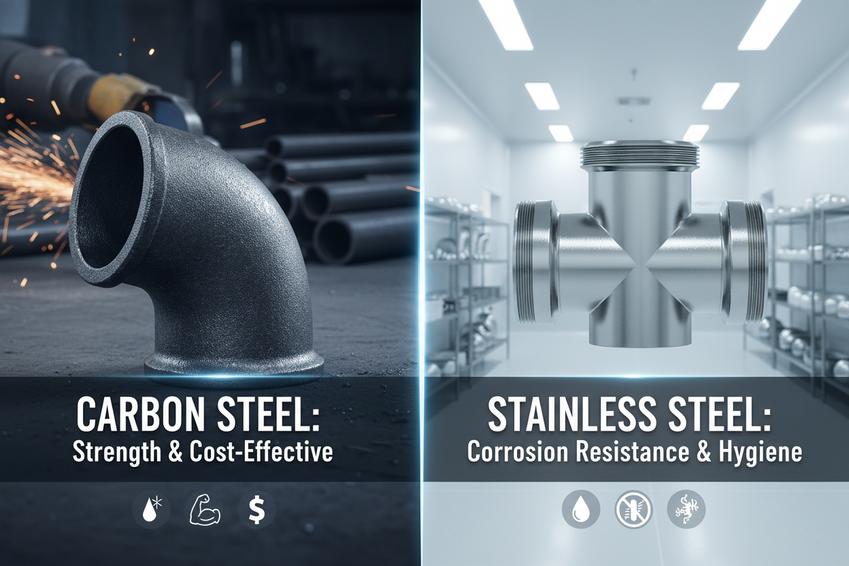
Carbon Steel Vs. Stainless Steel Fittings
Choosing between carbon steel pipe fittings and stainless options can feel like picking tools from the same toolbox—similar at a glance, totally different in action. From pressure lines to food plants, carbon steel, steel pipe fittings, and stainless alloys each bring their own strengths to the job.
Carbon Steel Pipe Fittings
Carbon steel pipe fittings are widely used in oil, gas, and general industrial lines because the balance between material grade and cost just makes sense. When selecting carbon steel fittings, decision-making usually follows a technical path:
- Material Grade Selection
- ASTM A234 WPB
- ASTM A105
- Evaluation based on tensile strength and yield limits
- Dimensional & Structural Factors
- Wall thickness
- Standard (STD)
- Extra Strong (XS)
- Schedule-based classification
- Connection type
- Butt weld
- Socket weld
- Threaded
- Wall thickness
- Performance Parameters
- Pressure rating matched to ASME B16.9
- Temperature resistance in high-heat service
- Managed corrosion resistance through coatings or painting
Below is a typical comparison table used in industrial procurement for carbon steel pipe fittings:
| Material Grade | Tensile Strength (MPa) | Pressure Rating (Class) | Max Temp (°C) |
|---|---|---|---|
| A234 WPB | ≥ 415 | 150–2500 | 425 |
| A105 | ≥ 485 | 150–2500 | 425 |
| A350 LF2 | ≥ 485 | 150–1500 | 345 |
| A106 Gr.B | ≥ 415 | 150–900 | 430 |
In heavy-duty pipe fittings carbon steel still dominates where strength beats aesthetics. Steel pipe fittings of this type handle vibration, shock loads, and long transmission lines without drama.
Stainless Steel Pipe Fittings
Stainless steel pipe fittings lean toward environments where corrosion just won’t quit. In chemical plants or food factories, stainless pipe fittings keep things clean and steady.
Key technical checkpoints include:
- Alloy type such as 304, 316, or duplex grades
- Required surface finish for hygiene compliance
- Verified welding compatibility to avoid cracking
Selection often moves like this:
- Confirm chemical exposure level.
- f4 Match alloy to required chemical resistance.
- Review mechanical load for long-term durability.
- Check sanitary codes tied to hygienic properties.
A quick breakdown makes it clearer:
- 304: good general corrosion resistance.
- 316: stronger in chloride-rich settings.
- Duplex: higher strength with improved stress resistance.
In side-by-side comparisons, carbon steel pipe fittings win on budget and raw strength, while stainless steel fittings take the crown for corrosion control and clean-service performance. For many projects, the smart move is simple—match the fitting to the environment, not just the price tag.
Oil Refinery: High-Pressure Steel Fitting Selection
Refinery piping is no place for guesswork. When pressure spikes and sour gas flows, carbon steel pipe fittings must hold steady. The right carbon steel pipe, pipe fittings, and finish keep operations smooth and downtime low.
High Yield Carbon Steel for Pressures Above 2000 psi
When refinery lines exceed 2000 psi, material choice becomes serious business. High Yield Carbon Steel used in carbon steel pipe fittings must meet strict Pressure Rating demands, backed by verified Material Strength data.
- Mechanical Performance
- Yield Strength
- Minimum yield: 35,000–70,000 psi depending on grade
- Prevents deformation under sustained load
- Tensile Strength
- Handles surge pressure events
- Maintains joint integrity in steel pipe fittings
- Yield Strength
- Operational Stability
- Maintains alignment in carbon steel pipe systems
- Reduces fatigue cracking in pipe fittings
Typical mechanical ranges seen in refinery-grade materials:
| Property | Minimum Value | Typical Application |
|---|---|---|
| Yield Strength | 35,000 psi | Medium-pressure lines |
| Yield Strength | 60,000 psi | High-pressure reactors |
| Tensile Strength | 70,000+ psi | Transmission headers |
Brands like yuuhuan hongqian supply carbon steel fittings engineered for these pressure zones, keeping carbon steel pipe fittings dependable under load.
Flanged Connections Meeting ASME B16.5 Requirements
Refinery flanges must align perfectly or sealing fails fast. Flanged Connections built to ASME B16.5 control everything from bolt spacing to Face Finish.
- Flange Standards
- Pressure class verification
- Dimensional tolerance checks
- Gasket Seal
- Surface smoothness
- Compression balance
- Bolt Torque
- Even preload
- Prevents leakage paths
Properly machined carbon steel pipe fittings reduce rework and field welding stress. For carbon steel pipe systems moving volatile media, tight flange control simply saves headaches.
NACE MR0175 Compliance for Sour Service
Sour service lines expose carbon steel pipe fittings to Hydrogen Sulfide. Without NACE MR0175 compliance, cracking risk jumps.
- Material Compatibility
- Controlled hardness levels
- Verified heat treatment records
- Corrosion Resistance
- Resistance to Sulfidic Environments
- Lower susceptibility to sulfide stress cracking
Refineries moving sour crude rely on carbon steel fittings that pass lab testing and field validation. yuuhuan hongqian provides steel pipe fittings designed for these harsh zones, keeping carbon steel pipe connections stable even in aggressive streams.
Epoxy Coated Finish to Combat Corrosive Streams
Refinery air carries salt, moisture, and chemical mist. Bare carbon steel pipe fittings won’t last long without protection.
• Epoxy Coating forms a dense barrier
• Shields against Corrosive Streams
• Enhances Abrasion Resistance
Application usually follows a clear path:
- Surface blasting for clean metal
- Primer layer for adhesion
- Final Protective Finish curing
The result is stronger Surface Protection and longer service life. In real-world refinery yards, that extra coating often means fewer shutdowns and more stable carbon steel pipe performance.
FAQs about Carbon Steel Pipe Fittings
What types of carbon steel pipe fittings are commonly used in industrial piping?
In major Industrial Piping systems, selection shapes performance and safety.
1) Flow direction control
- Elbows (45°, 90°)
- Tees for branch lines
2) Size transition & closure
- Reducers, Caps
3) Connection integration
- Flanges, Couplings, Unions
These fittings are produced under ASME B16.9, ASME B16.11, and ASME B16.5, supporting Butt-weld, Threaded, Socket-weld, Flanged, and Grooved connections across Oil and Gas, Water Treatment, and Power Generation projects.
Why are high yield materials critical in Oil and Gas applications?
In high-pressure refineries, failure is not an option.
- High Yield Carbon Steel handles pressures above 2000 psi
- ASTM A234 WPB suits butt-weld fittings in long transmission lines
- ASTM A105 supports forged Flanges and Socket-weld components
- Compliance with NACE MR0175 protects against sour service cracking
For Petrochemical and Oil and Gas plants, material grade directly defines plant safety margins.
How do certifications build buyer confidence in bulk orders?
Every shipment tells a story of traceability.
• Produced under ISO 9001 systems
• Delivered with Mill Test Certificates verifying chemistry and tensile strength
• Available with CE Marking and PED Compliant documentation
• Dimensional checks per ASME B16.9 or MSS SP-75
This chain of proof protects contractors managing multi‑million‑dollar Industrial Piping installations.
What surface finishes extend service life in harsh environments?
Corrosion creeps silently; finish selection stops it early.
| Surface Finish | Typical Use Environment |
|---|---|
| Black | Indoor pipelines |
| Galvanized | Water Treatment systems |
| Epoxy Coated | Marine & Petrochemical |
| Varnished | Storage & transport |
| Shot Blasted | Pre-paint preparation |
For coastal Oil and Gas terminals, Epoxy Coated fittings often become the quiet guardian against salt attack.
What should be checked before accepting a shipment?
Inspection is the last defense before installation.
- Confirm material grade: Carbon Steel Grade B, Low Temperature Carbon Steel, or specified API 5L compatibility.
- Verify dimensions against ASME B16.9 drawings.
- Inspect Elbows, Tees, Reducers, and Caps for coating damage.
- Match connection type—Butt-weld or Flanged—to project drawings.
A careful review at this stage prevents costly shutdowns later in Power Generation or Petrochemical facilities.
Contact us if you have any carbon steel pipe fittings project need quote and cnc machinery !