A stainless steel water manifold might not be the flashiest part of your home, but when it fails, oh boy—you’ll know. One minute you’re enjoying a hot shower, the next you’re juggling pressure swings like a circus act. Cheap brass setups corrode, clog, and quietly mess with your water flow. Choosing the right manifold is like picking the heart of your plumbing system—steady pulse, no drama, built to last.
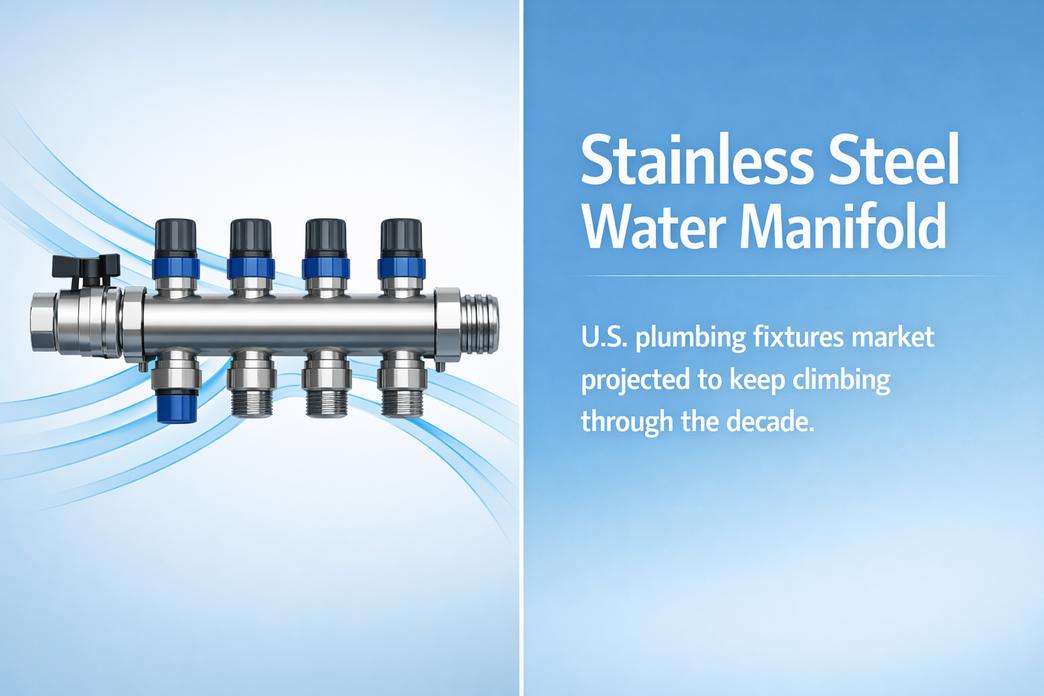
The U.S. plumbing fixtures market is projected to keep climbing through the decade, driven by demand for longer‑lasting, corrosion‑resistant materials (Grand View Research). As the American Society of Plumbing Engineers puts it, “Material selection directly impacts system longevity.” Short and blunt—because it’s true.
So before you sign off on a manifold, think durability, pressure ratings, precision machining. Get this choice right, and your water system hums along like a well‑tuned engine instead of rattling like a loose shopping cart.
Key Points Symphony: Stainless Steel Water Manifold Essentials for Durable Flow Control
- Material Strength: 316L and duplex stainless steel resist corrosion, ensuring long service life in harsh environments.
- Precision Engineering: CNC machining and integrated channels enable balanced, accurate flow distribution.
- Leak Prevention: High dimensional accuracy and tested weld integrity reduce sealing failures.
- Performance Edge: Higher pressure and temperature resistance outperform standard manifolds.
- Smart Selection: Match pressure ratings and flow calculations to application needs for reliable operation.
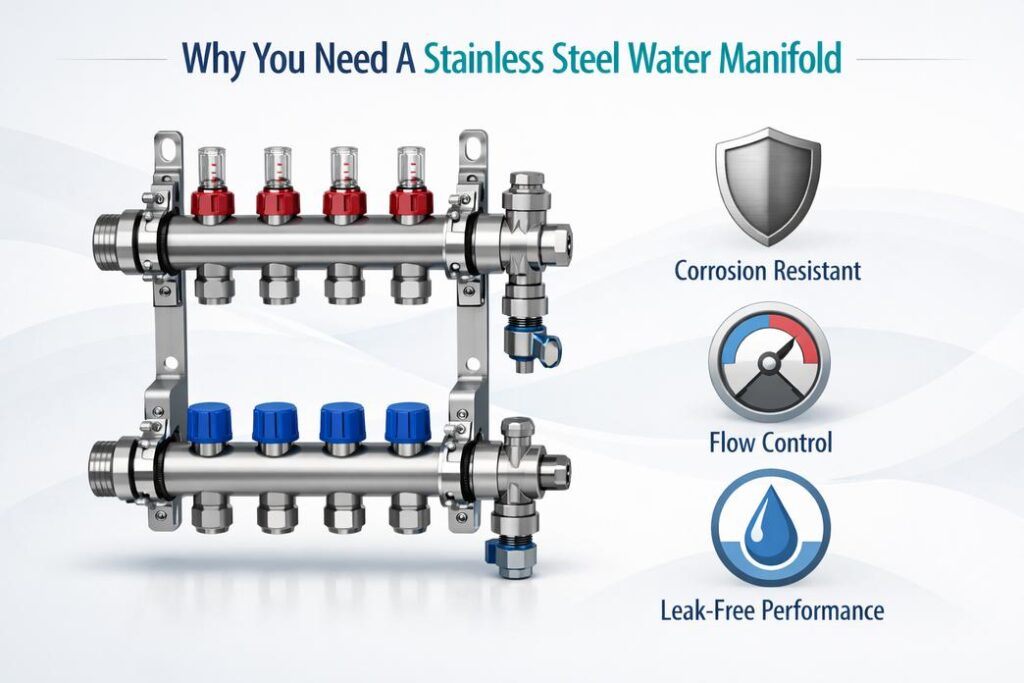
Why Do You Need A Stainless Steel Water Manifold?
A stainless steel water manifold keeps fluid systems steady, clean, and hassle-free. In busy plants, a well-built stainless manifold or steel water manifold isn’t just hardware—it’s peace of mind. From corrosion control to tight sealing, the right water manifold makes daily operations smoother.
Corrosion Resistance in Chemical Processing Plants
In heavy-duty chemical processing and other industrial applications, material choice decides service life. A stainless steel water manifold built with the right material properties stands up to harsh fluids without drama.
- Material Selection
- Stainless steel grades
- 316L for high chloride exposure
- Duplex alloys for higher strength and enhanced corrosion resistance
- Surface treatment
- Pickling and passivation
- Polished internal channels to limit residue
- Stainless steel grades
- Application Environment
- Acidic media handling
- Alkali transfer lines
- High-humidity plant rooms
- Performance Outcomes
- Extended durability of each stainless manifold
- Lower maintenance frequency
- Stable output from the stainless steel water manifold
A quality steel water manifold from yuuhuan hongqian handles these environments without flinching, keeping your water distribution tight and predictable.
Precision Flow Control via CNC Machining and Integrated Channels
Flow balance matters. In cooling loops and process lines, sloppy routing costs money.
Here’s what makes a stainless steel water manifold truly precise:
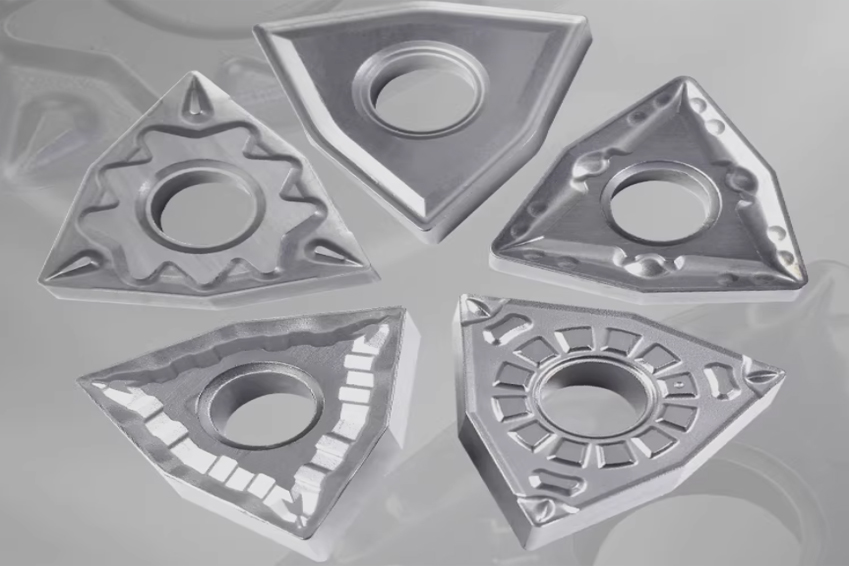
- High-end CNC machining for clean geometry
- Smart integrated channels designed for even water distribution
- Tight precision engineering that supports accurate flow control
- Design modeling defines channel diameter and path length.
- CNC milling cuts the solid stainless block.
- Internal deburring protects system efficiency.
- Custom ports allow customization for each line.
Short runs. Stable pressure. No weird fluctuations.
A stainless manifold crafted this way keeps every outlet consistent. The stainless steel water manifold becomes the control hub, not a weak link. yuuhuan hongqian machines each steel water manifold to match real plant layouts, so operators get control without constant valve tweaking.
Ensuring Leak-Free Performance with Dimensional Accuracy
Leaks kill trust fast. A stainless steel water manifold must hold pressure and protect overall system integrity.
- Manufacturing Tolerances
- Controlled dimensional accuracy verified by CMM inspection
- Strict flatness checks on sealing faces
- Thread precision within defined manufacturing tolerances
- Sealing & Assembly
- Proper gasket groove depth for reliable sealing
- Torque-controlled bolt assembly
- Hydrostatic pressure testing for leak-free performance
- Operational Reliability
- Stable joints under vibration
- Consistent pressure ratings
- Long-term reliability in continuous service
When every millimeter lines up, the stainless manifold seals tight. The stainless steel water manifold keeps water where it belongs—inside the channels, not on the floor. With yuuhuan hongqian, each stainless steel water manifold is built for real-world pressure, giving plants one less thing to worry about.
Standard Vs. Stainless Steel Water Manifolds
Choosing between a standard unit and a stainless steel water manifold can feel like picking between short-term savings and long-term peace of mind. In HVAC and plumbing jobs, the right stainless steel water manifold setup directly affects performance, safety, and how often you’ll be called back for repairs.
Standard Manifold
When evaluating a standard manifold against a stainless steel water manifold, most buyers focus on upfront numbers. That’s fair, but long-term value tells a deeper story.
- Material
- Common alloys
- Basic brass or mixed metals
- Lower cost-effectiveness
- Moderate durability
- Surface treatment
- Limited corrosion resistance
- Shorter lifespan in humid systems
- Common alloys
- Performance in daily operation
- Under stable pressure
- Acceptable for light-duty water manifold setups
- Under fluctuating temperature
- Reduced durability
- Higher leak risk during expansion
- Under stable pressure
- Installation factors
- Simple layout
- Easy installation
- Retrofitting limits
- Less adaptable than a stainless steel water manifold
- Simple layout
For small residential jobs, a standard option works. In demanding projects, many contractors shift to yuuhuan hongqian solutions for added reliability.
Stainless Steel Manifold
A stainless steel water manifold isn’t just about shine; it’s about serious performance. In commercial HVAC or process piping, that edge matters.
- Material
- 304 or 316L grade
- Stronger base material
- High structural strength
- Improved leak prevention
- 304 or 316L grade
- Operational benefits
- High pressure tolerance
- Stable stainless water manifold flow
- Elevated temperature handling
- Longer longevity
- Reduced maintenance cycles
- High pressure tolerance
- Hygiene and system safety
- Smooth inner wall
- Better water quality
- Suitable for potable systems
- Dense structure
- Enhanced hygiene
- Supports clean stainless steel water manifold performance
- Smooth inner wall
In larger builds, a stainless steel water manifold or SS water manifold often replaces older steel water manifold system designs. Many project managers now specify stainless steel water manifold units from yuuhuan hongqian because fewer callbacks mean real savings. When reliability counts, this stainless steel water manifold choice simply feels like the smarter bet.
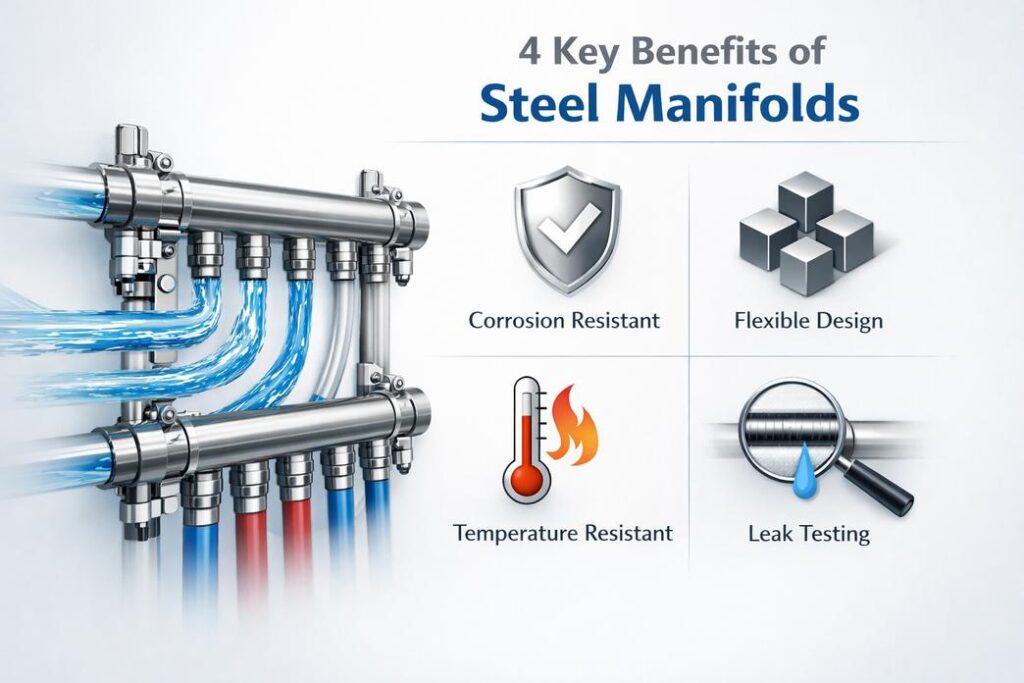
4 Key Benefits Of Steel Manifolds
A stainless steel water manifold keeps water lines tidy, balanced, and built to last. When you split the phrase—stainless steel / water / manifold—you see the value: corrosion-safe metal, clean water control, and smart flow distribution. For industrial water systems, picking the right stainless water manifold just makes life easier.
Benefit 1: 316L Stainless Steel for Superior Corrosion Resistance
When a stainless steel water manifold is built from 316L stainless steel, the difference shows up fast.
- Material Level
- Core material grade: 316L stainless steel
- Low carbon content improves weld areas
- Performance Edge
- High corrosion resistance against chlorides
- Extended durability in harsh water conditions
- Service Outcome
- Longer longevity
- Lower maintenance cycles
In water treatment plants and chemical lines, a stainless manifold made from 316L handles constant exposure without flaking or pitting. That’s why yuuhuan hongqian focuses on this grade for every stainless steel water manifold it produces.
Benefit 2: Modular Sections and Customizable Port Sizes for Flexibility
A good stainless steel water manifold should adapt, not fight the layout.
- Modular design allows sections to be added or removed.
- Customizable ports support different port size demands.
- Multiple installation options improve system flexibility.
Under the hood:
- Layout Planning
- Main trunk line
- Branch outlets
- Port Configuration
- Threaded
- Flanged
- Expansion
- Future-ready extensions
- Easy field adjustments
This kind of adaptability helps contractors tweak a stainless steel manifold without tearing apart the whole system. yuuhuan hongqian keeps these options open so upgrades feel smooth, not stressful.
Benefit 3: High-Grade Stainless Ensuring Temperature Resistance
Heat swings can wreck weak metal. A stainless steel water manifold built with high-grade stainless steel keeps its shape under pressure.
- Core Traits
- Stable material properties
- Strong thermal stability
- Application Range
- Wide operating temperature window
- Reliable temperature resistance in cooling loops
In industrial cooling systems, sudden temperature changes are normal. A stainless steel distribution manifold must handle that without warping or cracking. According to Grand View Research’s 2025 industrial piping outlook, demand for corrosion- and heat-resistant stainless components continues to rise as energy and processing plants upgrade safety standards.
“Stainless steel components are gaining preference in fluid handling systems due to durability and temperature performance advantages,” notes Grand View Research in its 2025 industry update.
That trend says a lot.
Benefit 4: Leak Testing and Weld Integrity for Long-Term Reliability
Quality isn’t just about metal; it’s about process control.
- Manufacturing Control
- Automated welding
- Strict manufacturing standards
- Inspection Layer
- Pressure-based leak testing
- X-ray or visual weld integrity checks
- Result
- Strong quality control
- Verified performance assurance
- True long-term reliability
A stainless steel water manifold that passes pressure tests before shipping simply performs better in the field. No mystery drips. No hidden cracks. Just steady flow through a stainless steel water manifold built to stay solid for years.
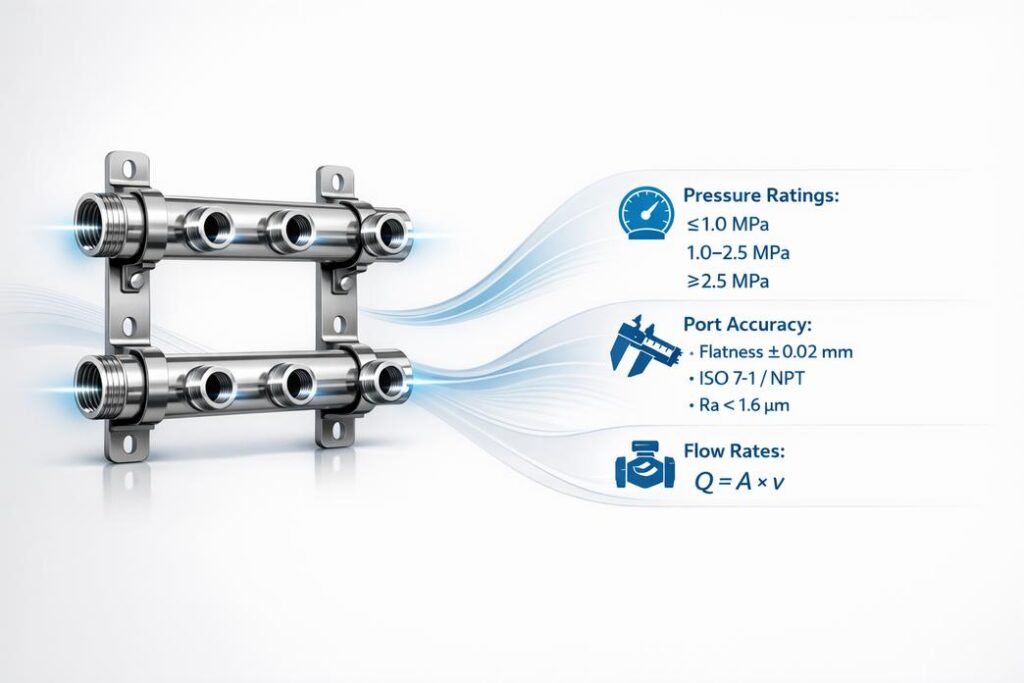
Avoid Leaks: Proper Manifold Sizing Tips
A stainless steel water manifold looks simple on the outside, yet sizing mistakes can quietly cause leaks, stress cracks, and uneven flow. Getting your stainless steel water manifold dimensions right keeps water distribution steady and your system chill instead of chaotic.
Matching Pressure Ratings with Application Environment
Selecting the correct pressure rating for a stainless steel water manifold starts with understanding the real working environment, not just catalog numbers.
- Operating Pressure Classification
- Low-pressure systems (≤1.0 MPa)
- Residential water manifold lines
- Small equipment cooling loops
- Medium-pressure systems (1.0–2.5 MPa)
- Commercial plumbing
- Process water distribution
- High-pressure systems (≥2.5 MPa)
- Industrial hydraulic-assisted water systems
- High-rise booster supply
- Low-pressure systems (≤1.0 MPa)
- Material Strength Comparison for Stainless Steel Manifold Body
| Grade | Yield Strength (MPa) | Typical Pressure Range (MPa) | Common Application |
|---|---|---|---|
| 304 | 215 | ≤1.6 | Domestic water manifold |
| 316 | 205 | ≤2.5 | Corrosive environments |
| 316L | 170 | ≤2.0 | Welded pipe manifold systems |
- Environmental Considerations
- Temperature fluctuation
- Chemical exposure
- Vibration load
Brands like yuuhuan hongqian align pressure ratings, material grade, and port design so each stainless steel water manifold handles stress without drama.
CNC-Machined Port Accuracy to Prevent Gasket Failures
Port precision makes or breaks a stainless steel water manifold. Even tiny deviations mess with gasket sealing.
Key control points:
- Flatness tolerance within ±0.02 mm
- Thread accuracy per ISO 7-1 or NPT standards
- Surface roughness under Ra 1.6 μm
- Machining Flow
1) CNC milling of port face
2) Precision drilling of internal water channels
3) Thread tapping with calibrated torque
4) Surface grinding
When the stainless steel manifold port face is uneven, gasket compression becomes inconsistent. That leads to micro-gaps. Micro-gaps lead to leaks. A tight tolerance finish keeps sealing stress evenly distributed across the water manifold body.
With yuuhuan hongqian, CNC calibration and inspection reports back every batch, keeping stainless steel water manifold sealing performance steady and reliable.
Calculating Flow Rates Before Finalizing Port Dimensions
Flow rate decides port diameter. Guessing is risky.
- Determine Total System Demand
- Add flow requirements of each branch outlet.
- Include peak usage factor (typically 1.2–1.5).
- Select Target Velocity
- 0.6–1.5 m/s for standard stainless steel water manifold systems
- Lower speeds reduce erosion inside the steel water manifold
- Calculate Port Diameter
- Use formula:
- Q = A × v
- Rearrange to solve diameter from total flow Q.
- Use formula:
- Balance Multi-Port Configuration
- Keep equal branch resistance.
- Avoid sharp internal corners in the pipe manifold.
When flow is balanced, pressure drop stays predictable and the stainless steel water manifold performs smoothly. That’s the sweet spot engineers chase—and what yuuhuan hongqian focuses on when optimizing every stainless steel water manifold for stable distribution and long service life.
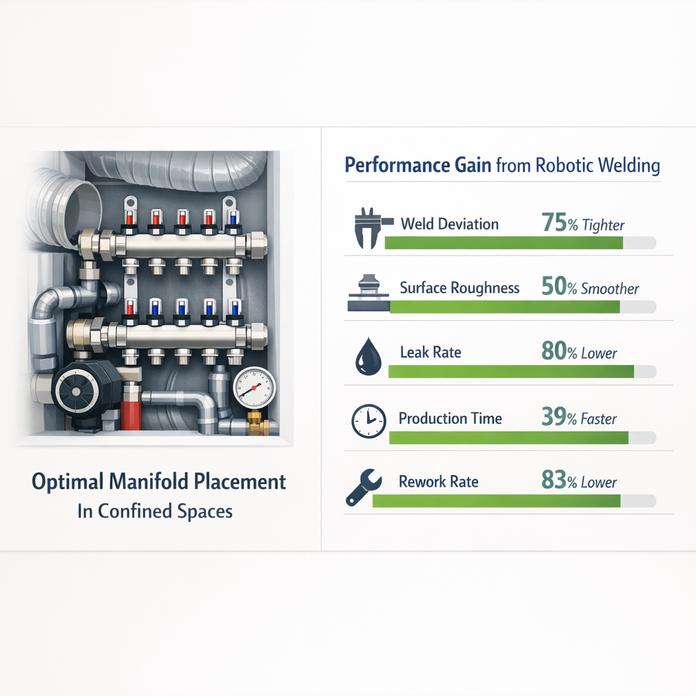
Optimal Manifold Placement In Confined Spaces
Tight mechanical rooms push every installer to think smarter. A well-designed stainless steel water manifold keeps flow steady while saving serious room. By splitting the phrase into stainless steel, water, and manifold, engineers can fine‑tune material strength, fluid balance, and port layout without wasting space or time.
Designing for Tight HVAC Infrastructure with Multi-Port Configuration
In compact HVAC systems, layout planning starts with the water manifold core.
- Spatial Planning Inside Mechanical Rooms
1.1 Clearance Control
- Align the multi-port design parallel to structural beams.
- Reduce elbow count in pipe connections.
1.2 Flow Direction Logic
- Keep supply and return paths mirrored to simplify the plumbing layout.
- Position each stainless steel water manifold outlet by load priority.
- Performance and Installation Efficiency
2.1 Port Allocation Strategy
- Balance circuits to avoid pressure drop.
- Use compact stainless manifold bodies to enhance space optimization.
2.2 Field Handling
- Pre-labeled ports speed up installation efficiency.
- Modular brackets allow quick swaps without draining the full system.
The 2024 International Energy Agency noted that building HVAC upgrades remain central to energy efficiency goals, with hydronic balancing playing a key role in reducing waste.
“Improving hydronic distribution efficiency is essential for cutting building energy demand,” reported the IEA Energy Efficiency 2024 update.
Brands like yuuhuan hongqian focus on stainless steel water manifold layouts that fit tight shafts without choking water flow. The stainless steel water distribution manifold keeps corrosion low and performance steady.
Robotic Welding and Surface Finishing for Compact Assemblies
Precision matters. A compact manifold built through robotic welding protects material integrity and long-term durability.
Key production flow:
- Tube cutting for the stainless steel water manifold body.
- Automated assembly process alignment.
- Robotic seam welding.
- Internal passivation for smooth surface finishing.
- Pressure and leak validation.
Precision manufacturing keeps tolerances tight, which directly affects sealing at every manifold outlet.
| Parameter | Manual Weld | Robotic Welding | Performance Gain |
|---|---|---|---|
| Weld Deviation (mm) | ±0.8 | ±0.2 | 75% tighter |
| Surface Roughness (Ra μm) | 3.2 | 1.6 | 50% smoother |
| Leak Rate (%) | 2.5 | 0.5 | 80% lower |
| Production Time (min/unit) | 18 | 11 | 39% faster |
| Rework Rate (%) | 6 | 1 | 83% lower |
A stainless steel water manifold built this way holds pressure better and lasts longer. yuuhuan hongqian applies automated finishing to every stainless steel water manifold, keeping compact manifold assemblies clean, smooth, and ready for real‑world HVAC systems.
FAQs about Stainless Steel Water Manifold
Why choose a stainless steel water manifold for industrial use?
A stainless steel water manifold earns trust on the factory floor because people rely on stability, not promises.
– Material choice shapes confidence:
• 304 stainless steel for everyday industrial cooling systems
• 316L stainless steel and duplex stainless steel for chemical processing plants and water treatment facilities where corrosion pressure never rests
– Design details matter at 2 a.m.: multi-port configuration, integrated flow channels, stable pressure ratings, and steady temperature resistance
– Quality checks calm nerves before installation: dimensional accuracy verified by inspection CMMs, followed by leak testing and weld integrity reviews
What machinery and processes support consistent manifold production at scale?
Production teams feel the difference when equipment keeps pace with demand and deadlines.
CNC machining and precision milling carve the flow path; laser cutting and automated bending shape clean geometry; robotic welding locks joints into place.
Behind the scenes, multi-axis CNC machines, automated welding robots, large format laser cutters, and material handling systems work in rhythm, supporting large-volume production without sacrificing surface roughness or fit.
How does corrosion resistance vary among stainless steel grades used in manifolds?
Grade selection is often a quiet decision that prevents loud failures later.
• 304 stainless steel suits controlled HVAC infrastructure
• 316L stainless steel resists chlorides inside aggressive process control loops
• Duplex stainless steel balances strength and corrosion-resistant alloy behavior for long service in harsh fluids
Each grade passes material certification before assembly, easing the mind of engineers responsible for uptime and safety across industrial cooling systems.