Introduction: Why Plating Thickness Matters for Galvanized pipe Fittings
For procurement managers in the automotive and industrial sectors, the reliability of carbon steel fittings is not just a preference—it’s a safety requirement. Have you ever faced the frustration of receiving a batch of galvanized pipe fittings only to find early signs of oxidation before they were even installed?
In the high-stakes world of automotive manufacturing, “good enough” galvanizing is a myth. Success depends on the precise calibration of material grade, thread integrity (like NPT or Metric), and most importantly, the science of corrosion resistance. At our manufacturing facility in Taizhou, equipped with 80 high-precision CNC lathe machines, we’ve analyzed thousands of test samples to bridge the gap between theoretical protection and real-world performance. This guide will reveal how a mere 2μm difference in plating thickness can be the deciding factor between a high-quality galvanized pipe fittings and a costly field failure.
What is the Neutral Salt Spray (NSS) Test (ASTM B117)?
Salt Spray Testing (SST) Technical Standards & Classifications
Salt Spray Testing (SST) is an accelerated environmental simulation used to evaluate the corrosion resistance of products. Common international standards include ISO 9227 (equivalent to GB/T 10125). The test is primarily categorized into Neutral Salt Spray (NSS), Acetic Acid Salt Spray (ASS), and Copper-Accelerated Acetic Acid Salt Spray (CASS).
Core parameters for NSS include a 5% NaCl solution, a pH of 6.5–7.2, and a controlled chamber temperature. Test results are evaluated using a 1–10 rating system or by identifying specific corrosion products.
I. Primary Testing Standards
-
International Standard: ISO 9227:2006
-
United States: ASTM B117
-
China (National Standards): GB/T 10125-2012 (Surface treatment of industrial products), GB/T 2423.17 (Electrical and electronic products)
-
Germany: DIN 50021
-
Japan: JIS Z2371
II. Test Types and Specific Conditions
1. Neutral Salt Spray Test (NSS)
-
Application: Metals and their alloys, metallic coatings, conversion films, etc.
-
Conditions: 5% NaCl solution, pH 6.5–7.2, Temperature: 35°C, optimized fog collection rate.
2. Acetic Acid Salt Spray Test (ASS)
-
Application: Decorative coatings (e.g., Copper + Nickel + Chromium).
-
Conditions: Glacial acetic acid is added to the NSS solution to drop the pH to 3.1–3.3.
3. Copper-Accelerated Acetic Acid Salt Spray Test (CASS)
-
Application: Products with extremely high corrosion resistance requirements (e.g., Copper + Nickel + Chromium).
-
Conditions: Higher temperature (typically 50°C), with copper chloride added to the ASS solution.
III. Evaluation Criteria (The 10-Grade Rating Method)
After testing, the corrosion area is observed and classified into 10 grades (Grade 10 is the best; Grade 0 is the worst):
-
Grade 10 (A): Zero corrosion; no change on the surface.
-
Grade 9 (B): Corrosion area < 0.1%; slight discoloration.
-
Grade 8 (C): Corrosion area 0.1% – 0.25%; severe discoloration or trace corrosion.
-
Grade 7 (D): Corrosion area 0.25% – 0.5%; severe loss of gloss or trace corrosion products.
-
Grade 6 (E): Corrosion area 0.5% – 1.0%; localized thin layers of corrosion products.
-
Grades 5 to 1: Corrosion intensity increases (Grade 1 indicates an area of 25% – 50%).
IV. Typical Industry Exposure Times
Duration is set based on the product grade, typically following intervals: 2h, 6h, 12h, 24h, 48h, 96h, 240h, 480h, 720h, etc.
-
General Hardware: 24–48 Hours.
-
Automotive Components: Typically requires 96–720 Hours or even higher.
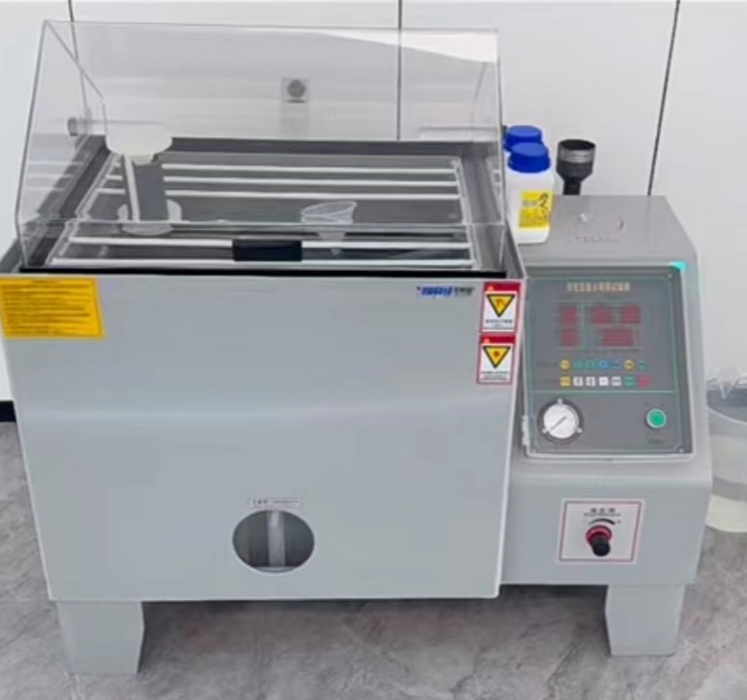
We primarily conduct Neutral Salt Spray (NSS) testing in accordance with ASTM B117/ISO 9227 because it provides the most accurate simulation for galvanized steel pipe fittings in automotive and industrial environments
Choosing the Right Surface Treatment for Galvanized pipe Fittings: Zinc, HDG, and Zinc-Nickel Plating for
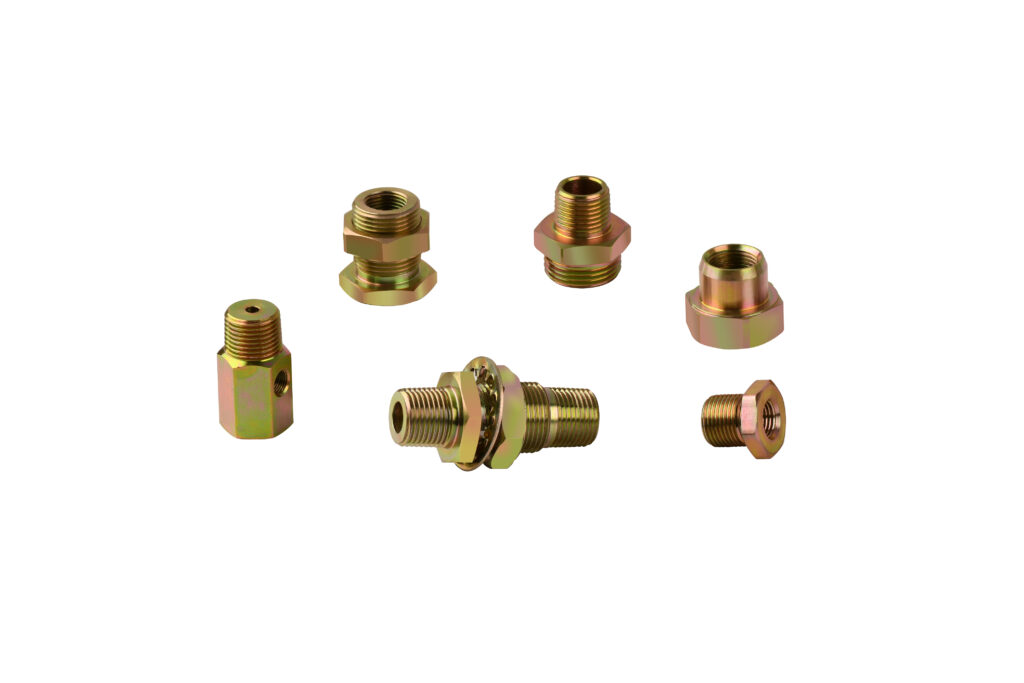
To meet the diverse corrosion resistance requirements of the automotive and industrial sectors, selecting the appropriate surface treatment for carbon steel fittings is critical. For precision CNC-machined parts, the challenge lies in balancing the protective layer’s thickness with the strict tolerances of the threads.
We primarily offer three types of plating for galvanized steel fittings, each serving different environmental demands:
-
Electro-Zinc Plating (Zinc + Sealer): This is the most common choice for automotive components. It provides a highly uniform coating that ensures the perfect fit of NPT or Metric threads. By using a high-performance sealer, a 12μm layer can consistently exceed the 96-hour salt spray benchmark.
-
Hot-dip Galvanized (HDG): Best suited for heavy-duty galvanized steel plumbing fittings in outdoor or marine environments. While it offers superior thickness (50μm+), it is less precise and often requires specialized thread over-tapping.
-
Zinc-Nickel Plating: This is the ultimate solution for high-end automotive clients (e.g., chassis or engine bay components). Zinc-nickel provides exceptional heat resistance and can withstand 720 hours to over 1,000 hours of Neutral Salt Spray (NSS) testing, even with a relatively thin coating.
Comparison of Surface Treatment Processes
| Plating Process | Typical Thickness | Salt Spray Resistance (NSS) | Thread Precision | Typical Application |
| Electro-Zinc (Standard) | 8μm – 15μm | 48h – 96h | Excellent | General automotive & CNC parts |
| Zinc + High-Perf Sealer | 10μm – 15μm | 120h – 240h | Very Good | Premium automotive & hydraulic |
| Hot-dip Galvanized (HDG) | 50μm – 100μm | 500h – 800h+ | Fair | Outdoor construction & plumbing |
| Zinc-Nickel Alloy | 8μm – 12μm | 720h – 1000h+ | Excellent |
Why Sealing (Topcoat) is Mandatory for High-Performance Corrosion Resistance
To push the limits of galvanized pipe fittings from a standard 96 hours to an elite 120–240 hours of salt spray resistance, simply increasing the zinc thickness isn’t always the most efficient solution. This is where Sealing (also known as Topcoat) becomes the game-changer for galvanized steel fittings.
After the electro-galvanization and trivalent chrome passivation process, we apply a high-performance organic or inorganic sealer. This process is crucial for several reasons:
-
Sealing Micro-pores: All zinc plating has microscopic pores. The sealer fills these voids, creating an additional physical barrier that prevents corrosive ions from reaching the zinc layer.
-
Surface Passivation Stability: It stabilizes the chromate film, ensuring the galvanized pipe fittings maintain their protective properties even after being handled or assembled.
-
Chemical Resistance: The topcoat provides extra protection against acidic or alkaline environments, which is essential for galvanized steel plumbing fittings used in harsh industrial settings.
By combining a 12μm zinc layer with a specialized Sealing treatment, we can consistently achieve Grade 9 (B) or Grade 10 (A) ratings in ASTM B117 tests for over 200 hours without the need for excessively thick coatings.
The Impact of Plating Thickness on Precision Galvanized pipe Fittings Tolerances
While adding a 12μm zinc layer and a sealer enhances the lifespan of galvanized pipe and fittings, it introduces a new challenge: Dimensional Deviation. In the world of high-precision automotive components, a few microns can be the difference between a perfect fit and a rejected batch.
Calculating the Plating Allowance for Threads
When we apply a 12μm coating (per side), we are effectively adding 0.024mm to the pitch diameter of a male thread. If your CNC shop ignores this “Plating Allowance,” the final fitting galvanized pipe will likely fail the GO-gauge test.
-
The Problem: Standard NPT or Metric threads machined to mid-tolerance will become “oversize” after plating, making assembly impossible for your customers.
-
Our Solution: At our Taizhou factory, we utilize a Pre-Plating Offset Strategy. We program our 80 CNC lathe machines to cut the threads slightly “undersize” (for male threads) or “oversize” (for female threads) by the exact value of the intended coating. This ensures that after the 12μm-15μm plating process, the galvanized pipe fittings hits the perfect “sweet spot” of the thread gauge.
Managing the “Edge Build-up” and Tolerance Stack-up
Electroplating naturally tends to be thicker on sharp edges—a phenomenon known as the “Faraday Cage” effect. On a compression fitting for galvanized pipe, this build-up can affect the seating surface.
By precisely controlling our CNC turning parameters and monitoring the plating current density, we manage the tolerance stack-up. This guarantees that your galvanized pipe fittings remain ASTM B117 compliant while maintaining the high-precision mechanical fit required for automotive fluid systems.
Comparison of Dimensional Change vs. Plating Thickness
| Plating Specification | Thickness (Per Side) | Diameter Increase (Male Thread) | Assembly Impact |
| Standard Zinc | 8μm | +0.016 mm | Low impact on standard threads |
| Automotive Grade | 12μm | +0.024 mm | Requires CNC Offset Compensation |
| High Corrosion (with Sealer) | 15μm+ | +0.030 mm+ | Critical – Must use pre-plating prep |
Seeing is Believing: Salt Spray Test Video & Real-World Case Study
To provide our clients with total peace of mind, we don’t just promise quality—we prove it. Integrating visual evidence and data-driven results is a core part of our quality assurance at Yuhuan Hongqian Machinery.
Laboratory Insight: The 240-Hour Challenge (Video)
Watch our precision CNC turning parts undergo rigorous salt spray validation.
Video Description: This footage captures a batch of our galvanized steel fittings inside the ASTM B117 test chamber. Observe how the 12μm zinc layer, enhanced by our specialized sealer, maintains a pristine surface even after prolonged exposure to the atomized 5% NaCl solution.
Case Study: Solving Red Rust for a Tier-1 Automotive Supplier
-
The Problem: A client’s previous vendor supplied compression fittings for galvanized pipe that failed the salt spray test at just 72 hours, showing significant Red Rust on the threads.
-
The Diagnosis: Our technical team analyzed the failed parts and found the zinc thickness in the thread roots was only 5μm. Additionally, the lack of a plating allowance meant the coating was being damaged during assembly due to excessive friction.
-
The Solution: We recalibrated our CNC lathe machines to provide a 0.024mm pitch diameter offset. We then applied a 12μm zinc-plating + high-performance sealer process.
-
The Result: The new batch successfully passed a 168-hour NSS test with a Grade 10 (A) rating. Furthermore, the assembly failure rate dropped to zero thanks to our precise dimensional compensation.
FAQ: Expert Answers on Galvanized pipe Fittings & Corrosion Testing
Q1: Why is Neutral Salt Spray (NSS) preferred over CASS for galvanized pipe fittings? A: NSS (ASTM B117) provides the most realistic simulation of the atmospheric corrosion that carbon steel fittings face in automotive and industrial environments. CASS is generally reserved for decorative Copper-Nickel-Chrome plating.
Q2: Does a 12μm coating make the threads too tight? A: Not if you partner with a manufacturer that understands plating allowance. At our factory, we adjust our CNC turning parameters to account for the coating thickness, ensuring that your galvanized pipe fittings pass the GO-gauge test every time.
Q3: Can you achieve 720-hour salt spray resistance for carbon steel? A: Yes. For extreme environments, we offer Zinc-Nickel alloy plating, which provides over 720 hours of resistance while maintaining high dimensional precision for CNC parts.
Q4: How do you verify the thickness of the plating? A: We use non-destructive X-ray fluorescence (XRF) measuring tools to ensure the zinc layer meets the specified 12μm–15μm requirement across the entire geometry of the fitting.
Conclusion: Partner with a Precision CNC Factory in Taizhou
Navigating the complexities of corrosion resistance, plating thickness, and mechanical tolerances requires more than just machinery; it requires expertise. With 80 high-precision CNC lathe machines and a deep understanding of ASTM B117 and ISO 9227 standards, Yuhuan Hongqian Machinery is your ideal partner for high-performance galvanized steel pipe fittings.
We don’t just manufacture parts; we engineer solutions that ensure your products remain rust-free and perfectly functional throughout their entire lifecycle.
Ready to Secure Your Supply Chain?
Stop worrying about red rust and assembly failures. Contact our technical team today for a quote or a sample batch of our 96-hour certified galvanized fittings.