Your production line’s breathing down your neck. You need precision, fast turnaround, and a partner who won’t ghost you halfway through a big order. So when you’re googling “custom CNC parts near me,” you’re not just looking for a shop—you’re hunting for the holy grail of consistency, skill, and someone who doesn’t flinch at five-figure quantities.
Problem is, most shops talk a big game. But once you dig in? Half don’t machine titanium right. Others tap out after prototype runs. And then there’s the quoting process—so long and confusing it feels like applying for college again.
You’ve got real deadlines to hit and zero patience for flaky vendors or mystery pricing models. This article’s here to cut through the noise—no fluff, no filler—and show you how to spot the kind of CNC supplier that delivers on time, every time, even when the pressure’s cranked high.
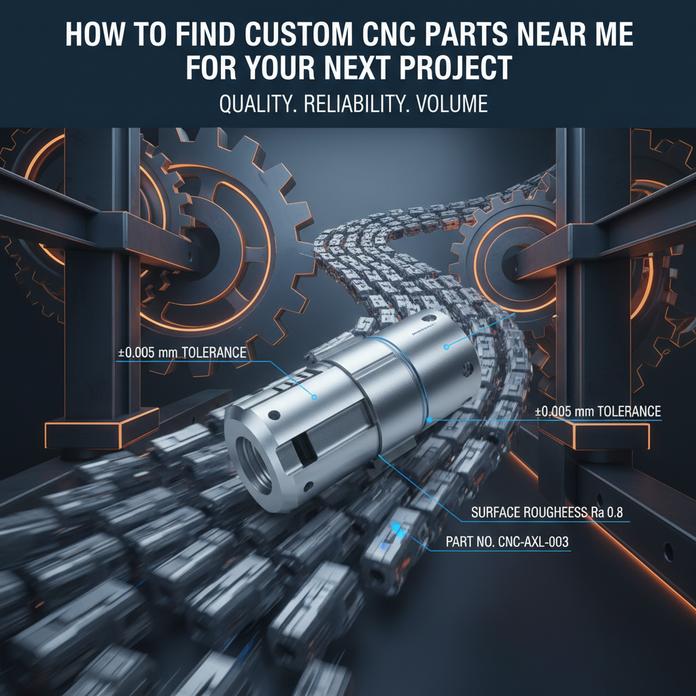
How to Search Effectively for Custom CNC Parts Near Me
Finding the right CNC shop nearby doesn’t need to feel like a scavenger hunt. Here’s how to make your search smart, fast, and accurate.
Understanding the Best Keywords for Local CNC Part Search
- “CNC machining near me” helps you connect with machine shops in your area quickly.
- Add material-specific terms like “custom titanium CNC parts” if you’re working with specialty metals.
- Include service types such as “precision CNC services” or “prototype CNC parts” to narrow results.
Short-tail variations like “CNC parts near me,” “local machining,” and “custom fabrication shops nearby” should also be part of your search game plan. These tweaks help surface more relevant listings when hunting down custom CNC parts near me.
Utilizing Local CNC Services for Material-Specific Needs
Different materials require different machining know-how—and not every shop is up to the task. Here’s what to look out for:
- If you’re working with aluminum, prioritize shops offering aluminum CNC machining, which ensures clean finishes and tight tolerances.
- For structural projects needing strength, go with providers experienced in steel CNC fabrication or even titanium CNC services, especially if corrosion resistance matters.
- Don’t forget about plastics—some local outfits specialize in plastic CNC parts, ideal for lightweight components or insulation needs.
So when searching “custom cnc parts near me,” match it with your material type—this keeps things efficient and saves rework later.
Choosing CNC Suppliers Based on Process Expertise
You don’t want just any machinist—you want one who gets your part’s complexity without blinking.
• Shops offering 5-axis CNC machining can handle intricate cuts that simple mills can’t dream of doing.
• Need fast turnaround? Look into those advertising rapid prototyping CNC, especially helpful if you’re iterating designs quickly.
• When tolerances are tight, suppliers skilled in both CNC milling services and precision-level CNC turning services will deliver consistent results.
For best results, pair process terms with location-based keywords like “nearby” or “in my city” when typing out queries such as “CNC turning shop near me.” It sharpens the accuracy when sourcing reliable help nearby.
How to Compare CNC Part Manufacturers Near You
Before you hit that Request Quote button, here’s a quick breakdown of what really matters:
Check their machines – Do they use multi-axis mills? Are they set up for batch work or prototypes only?
Review their offerings – Some provide only cutting; others include finishing like anodizing or powder coating (CNC finishing options) too.
Look at quality control – Certifications matter; ISO-certified shops often maintain better consistency (certification CNC suppliers).
Once you’ve got a shortlist from searching “custom cnc parts near me,” compare not just cost but also lead time, flexibility on revisions, and responsiveness—because nothing slows down a project like waiting three days just to get an email back!
What to Expect From High-Quality Custom CNC Parts Near Me
Looking for top-tier custom CNC parts near me? Here’s what really makes the difference in quality and performance.
The Role of Precision and Tight Tolerances in Quality CNC Parts
- Precision machining is all about getting repeatable, accurate results. That means every part that rolls off the machine matches your specs—no guesswork.
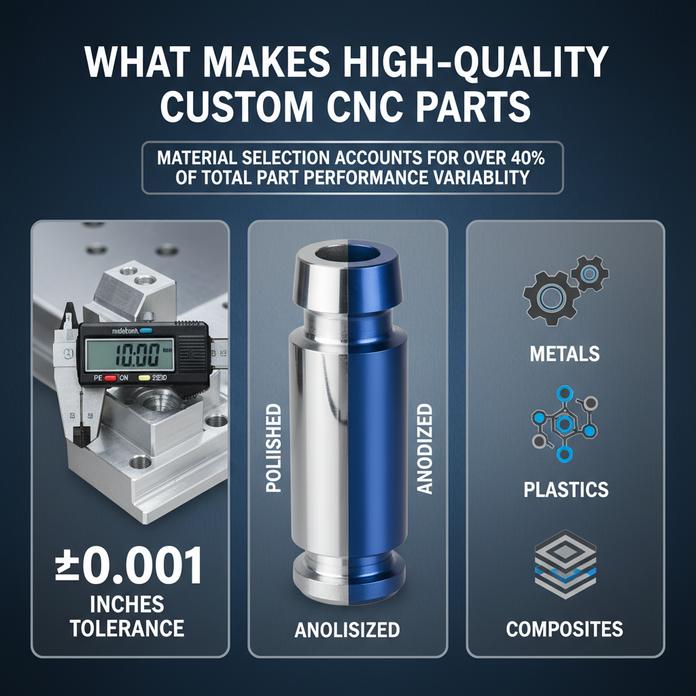
- Tight tolerances (we’re talking ±0.001″ or tighter) are crucial when you’re building parts for high-stakes industries like aerospace, automotive, or medical devices.
- Good shops use advanced metrology tools—think laser scanners and CMMs—to ensure dimensional accuracy down to the micron.
- It starts with CAD files that define exact dimensions.
- Then comes CAM programming to translate those into tool paths.
- High-end machines follow through with consistent, precise cuts.
- Finally, inspection ensures everything meets spec before shipping.
→ Without tight tolerances, even a tiny misalignment can cause major failures in mechanical assemblies.
A shop offering reliable custom CNC machining near me should be obsessed with precision—not just close enough but dead-on every time.
Essential Surface Finishes for Custom CNC Components
Different finishes do more than make your parts look pretty—they protect them too:
- Anodizing: Adds corrosion resistance and color options for aluminum parts.
- Polishing: Smooths out surfaces for aesthetics or friction reduction.
- Blasting (like bead blasting): Gives a uniform matte texture that hides minor imperfections.
Grouped by purpose:
For protection:
- Hard anodizing
- Zinc plating
- Powder coating
For aesthetics:
- Brushed finish
- Mirror polishing
- Color anodizing
For function:
- Low-friction coatings
- Thermal barrier sprays
- Conductive finishes
When ordering custom enclosures or housings from a local shop offering CNC services near me, ask about finish options upfront—they impact both looks and lifespan.
How Material Selection Impacts the Performance of CNC Parts
Different jobs call for different materials—and picking the wrong one can wreck your whole project:
• Need strength without weight? Go with titanium alloys—great for aerospace brackets or bike components thanks to their insane strength-to-weight ratio.
• Want something easy to machine but still durable? 6061 aluminum hits that sweet spot between cost, machinability, and corrosion resistance.
• Working on high-wear mechanical components? Carbon steel offers excellent toughness and fatigue resistance—but it needs surface treatment to fight rust.
Grouped by material type:
Metals:
- Stainless steel: great corrosion resistance
- Brass: ideal for electrical conductivity
- Titanium: lightweight yet ultra-tough
Plastics:
- Delrin (acetal): low friction, good wear resistance
- Nylon: strong and slightly flexible
- PEEK: high-performance under extreme heat
Composites:
- Carbon fiber-reinforced polymers: lightweight + rigid = perfect combo
According to a recent report from Global Industry Analysts (2024), “Material selection accounts for over 40% of total part performance variability in precision-machined applications.” So yeah—it matters a lot when choosing suppliers of custom CNC parts near me, especially if you’re prototyping critical components.
How Much Should Custom CNC Parts Near Me Really Cost?
Curious about what drives the price tag on those machined parts? Let’s break it all down with clarity and no fluff.
Pricing Breakdown for CNC Machining Services by Material Type
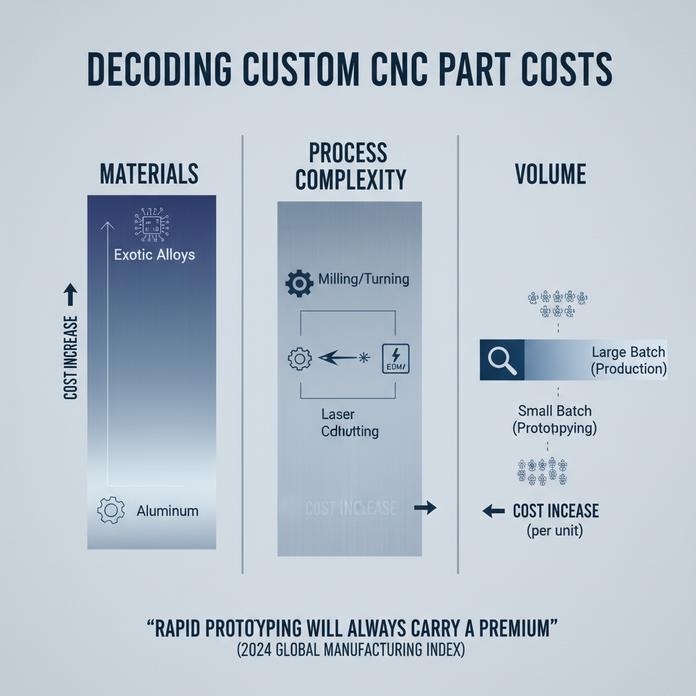
Materials drive cost more than most folks realize. Here’s why that titanium bracket costs three times more than aluminum.
- Aluminum: Lightweight, easy to machine, and widely available—this keeps costs low for most custom CNC parts near me.
- Steel: Stronger but tougher to work with; higher material cost, longer machining time.
- Plastic: Cheap and fast to cut, but not ideal for structural components.
- Brass: Excellent machinability but pricier due to raw stock rates.
- Titanium: High-performance but brutal on tools—expect a steep jump in both material and machining costs.
- Exotic alloys (like Inconel): These will chew through cutters and your budget thanks to extreme wear resistance.
If you’re sourcing locally, expect fluctuations based on regional supply chains. That’s where brands like yuuhuan hongqian come in—they streamline sourcing across material types so you’re not stuck paying inflated local margins.
The Cost Implications of Different CNC Processes (Milling, Turning, etc.)
Not all cutting is created equal. Some processes are quick and cheap. Others? Not so much.
- CNC milling – Versatile but setup-heavy; great for complex geometries.
- CNC turning – Ideal for cylindrical shapes; faster cycle times reduce labor charges.
- EDM (Electrical Discharge Machining) – Niche use cases; slow but surgically precise.
- Laser cutting – Fast cuts on sheet materials; low labor input makes this economical.
- Grinding & polishing – Adds finishing costs; necessary if tolerances are ultra-tight.
Process complexity matters big time—more tool changes = more setup = higher price tag.
And don’t forget labor rates vary by region too. A shop doing high-volume turning might charge less per part than one specializing in intricate milling jobs—even if both offer “custom CNC parts near me”.
Understanding the Pricing of Prototyping vs. Production CNC Parts
Getting a one-off prototype made? Brace yourself—it won’t be cheap per unit.
• Low volume = no economies of scale
• You’re footing the bill for tooling/setup (NRE costs)
• Batch size is tiny, so the shop doesn’t spread fixed costs around
Now compare that to production:
• Larger batch sizes slash unit prices dramatically
• Tooling gets amortized over hundreds or thousands of pieces
• Less downtime between runs means lower labor overhead
“Rapid prototyping will always carry a premium,” according to a 2024 report from Global Manufacturing Index. “But it accelerates innovation cycles enough to offset initial outlay.”
So when you search for “custom cnc parts near me,” consider whether you need just one prototype or a full run—that decision alone could swing your quote by hundreds or even thousands.
FAQs about Custom CNC Parts Near Me
1. How can I identify a skilled local CNC supplier for complex production runs?
Look for shops with multi-axis machines and Swiss-type lathes, as they handle complex geometries such as precision bores and threaded features with ease. A facility supplying the aerospace industry or medical device sector often holds higher tolerance standards, which translates to reliable results in bulk orders. Asking to tour their workshop — checking the hum of well-tuned equipment like CNC milling machines or seeing sample workpieces in aluminum alloy or titanium grade — gives you a clear measure of craftsmanship.
2. Why does material choice alter both price and performance?
Every metal has its attitude:
- Aluminum alloy – quick to cut, lightweight, ideal for custom enclosures or electrical connectors where speed matters.
- Stainless steel / Carbon steel – resilient under stress; perfect mechanical parts for automotive manufacturing or defense contracting but slower in machining time.
- Brass alloy – elegant finish that suits fixtures tooling inside electronics assembly settings.
- Titanium grade – unmatched strength; cherished by aerospace engineers yet demanding on tool wear and cycle times, increasing costs per unit while assuring longevity.
3. Which machining processes most impact large-batch pricing?
Pricing dances hand-in-hand with process choice:
• The milling process shapes flat profiles beautifully but pulls more cutting hours when designs require multiple angles and fine surface finishes.
• The turning process, especially via fast-running CNC turning centers, thrives on producing rounded mechanical parts efficiently at scale.
• Adding secondary steps like drilling operations or tapping services ensures functional assemblies yet nudges cost upward due to extra setups.
4. What inspection practices should high-quality suppliers follow before delivery?
A trustworthy shop serves accuracy as its daily bread:
– Coordinate measuring systems scrutinizing tight tolerances within microns for aerospace industry compliance;
– Material verification ensuring brass alloy is truly brass, carbon steel remains unblended;
– Detailed reports documenting each check so your chain-of-custody stands strong — vital if you’re supplying medical devices or military contracts.
5. Do prototyping services differ much from full production machining costs?
Yes — think of prototyping as rehearsals before opening night: setup costs are concentrated into just a few pieces crafted under close watch using multi-axis configurations for precise fitment testing across custom enclosures or fixtures tooling prototypes in stainless steel/aluminum alloys hybrid builds; when curtain rises on mass-production runs, automated equipment lines repeat those perfected motions hundreds of times over, spreading setup investment thin while boosting yield efficiency dramatically—making every part sing uniformly from first cut to final polish in production machining rhythm.