
When looking for stainless steel pipe fittings from global suppliers, one of the biggest challenges is ensuring the material is truly 316 stainless steel pipe fittings, rather than lower-grade alternatives such as 201 or misrepresented 304.
Based on our manufacturer experience, this is one of the most common issues in the industry—especially when dealing with new or unverified stainless steel pipe fittings suppliers.
A wrong material choice can lead to:
- Corrosion
- Leakage
- Reduced lifespan of piping systems
This guide combines practical inspection methods + manufacturing experience + industry standards to help you make the right decision.

1. Basic Identification Methods for Stainless Steel Pipe Fittings (On-Site Quick Checks)
1.1 Magnetic Test for Threaded Pipe Fittings Stainless Steel
For commonly used threaded pipe fittings stainless steel, magnetic testing is the first quick screening method:
- Strong magnetic attraction → Ferritic or martensitic steel (e.g., 430, 410)
- Weak or no magnetism → Typically austenitic stainless steel (e.g., 304 or 316 stainless steel pipe fittings)
Important (Based on manufacturing experience):
Cold working processes such as CNC machining, threading, or forming can introduce slight magnetism in 304 and 316 stainless steel pipe fittings. This is completely normal and often leads to misjudgment.
1.2 Surface Appearance and Finish
- Stainless steel pipe fittings:
- Bright silver color
- Smooth and uniform surface
- Carbon steel fittings:
- Darker surface
- Prone to oxidation and rust
However, this method cannot distinguish between 201, 304, and 316 stainless steel pipe fittings.
2. 304 vs 316 Stainless Steel Pipe Fittings (Industry Standard Comparison)
Understanding the difference between 304 and 316 is critical when selecting stainless steel pipe fittings.
| Feature | 304 Stainless Steel Pipe Fittings | 316 Stainless Steel Pipe Fittings |
|---|---|---|
| Chromium (Cr) | ~18% | ~16–18% |
| Nickel (Ni) | ~8% | ~10–14% |
| Molybdenum (Mo) | None | 2–3% |
| Corrosion Resistance | Good | Excellent |
| Application | General use | Marine, chemical, high corrosion environments |
Key Industry Insight:
The addition of Molybdenum (Mo) is what makes 316 stainless steel pipe fittings significantly more resistant to chloride corrosion.
3. Industrial Identification of Stainless Steel Pipe Fittings (PMI Testing)
3.1 Spectrometer (PMI) Analysis
Professional stainless steel pipe fittings suppliers use PMI (Positive Material Identification) to verify material composition.
This is also aligned with industry standards such as ASTM (American Society for Testing and Materials) for stainless steel materials.
Elements Tested:
- Chromium (Cr)
- Nickel (Ni)
- Molybdenum (Mo)
Typical Composition Reference
| Grade | Cr | Ni | Mo | Application |
|---|---|---|---|---|
| 201 | 16–18% | 3.5–5.5% | None | Low-cost fittings |
| 304 | ~18% | ~8% | None | General industrial |
| 316 | ~16–18% | ~10–14% | 2–3% | High corrosion resistance |
Advantages:
- Extremely accurate
- Provides certified reports
- Widely used for export-quality stainless steel pipe fittings
Limitation:
- Equipment is expensive (tens of thousands of dollars)
- Not suitable for everyday buyers
4. Real Industry Problem: Material Substitution Risk
In the stainless steel industry, one of the most common risks is:
201 stainless steel being sold as 304 or 316 stainless steel pipe fittings
Typical consequences:
- Rust appears quickly
- Product fails under pressure
- Entire batch rejection
In many cases we have seen in production, the issue is not processing—but incorrect raw material.
Conclusion from real experience:
No matter how precise your CNC machining is, material quality determines the final performance of stainless steel pipe fittings.
5. Chemical Testing for Stainless Steel Pipe Fittings (Practical Solution)
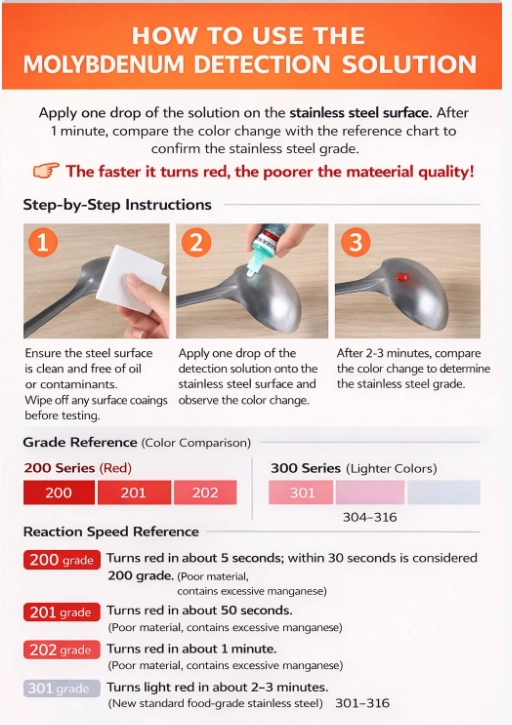
5.1 Stainless Steel Testing Solution
For daily inspection—especially when working with multiple stainless steel pipe fittings suppliers—testing liquid is the most practical method.
How to use:
- Apply one drop on the surface
- Observe color reaction
Results:
- No color change / slow reaction → 304 or 316 stainless steel pipe fittings
- Rapid red reaction → 201 or low-grade material
Advantages:
- Low cost
- Fast and convenient
- Suitable for bulk inspection
Limitations:
- Cannot provide exact composition
- Should not replace PMI testing for critical applications
6. How to Choose Reliable Stainless Steel Pipe Fittings Suppliers
To ensure consistent quality, professional buyers always evaluate suppliers based on:
Key Requirements:
- Material Test Certificate (MTC)
- PMI (spectrometer) reports
- Batch traceability
Additional Indicators:
- Stable production process
- Experience in exporting stainless steel pipe fittings
- Clear quality control procedures
Red Flags:
- Price significantly below market
- No testing documentation
- Vague material descriptions
7. Common Mistakes When Identifying Stainless Steel Pipe Fittings
- Relying only on magnet testing
- Judging by surface appearance only
- Ignoring supplier credibility
- Not verifying material reports
These mistakes are the main reason buyers receive non-compliant stainless steel pipe fittings.
Comparison of Identification Methods
| Method | Accuracy | Cost | Recommended Use |
|---|---|---|---|
| Magnetic Test | Low | Free | Quick screening |
| Visual Check | Low | Free | Initial inspection |
| Testing Solution | Medium | Low | Daily use |
| PMI (Spectrometer) | Very High | High | Export & certification |
FAQ:
Q1: What is the most reliable way to identify 316 stainless steel pipe fittings?
PMI (spectrometer) testing is the most accurate method.
Q2: Why do stainless steel pipe fittings become magnetic?
The raw material after cnc machnery , cnc turning prcoess will have magnetic .
Q3: How can I avoid fake 304 or 316 stainless steel pipe fittings?
Always require:
- Material certificates
- PMI reports
- Verified suppliers
Conclusion
Selecting the right stainless steel pipe fittings is not just about appearance—it is about material integrity, testing methods, and supplier reliability.
For critical applications:
- Use 316 stainless steel pipe fittings
- Work with trusted stainless steel pipe fittings suppliers
- Always verify with PMI testing
CTA:
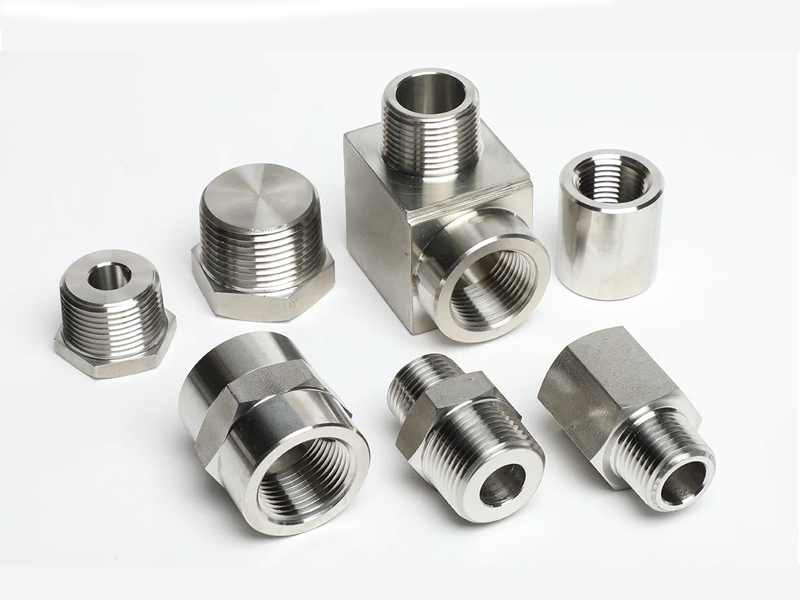
Looking for a reliable supplier of:
- 316 stainless steel pipe fittings
- Threaded pipe fittings stainless steel
- CNC machined custom fittings
We provide:
- Verified raw materials
- Full inspection reports (MTC + PMI)
- OEM & custom solutions
Contact us today to get a fast quote and avoid material risks.