Sourcing from brass pipe fittings manufacturers might not sound like heart-thumping drama, but for project leads juggling deadlines, budgets, and compliance codes—it’s the difference between smooth sailing and a five-alarm fire in your supply chain. One wrong vendor, and you’ve got leaky systems, missed inspections, or worse—angry clients pacing the site.
You’ve probably been there: pallets show up late (or never), certificates don’t match specs, and support disappears faster than free donuts in the breakroom. You’re not just buying hardware—you’re buying peace of mind on every jobsite.
According to a 2023 Global Industrial Supply Chain report by McKinsey & Company, over 68% of construction delays tied directly to inconsistent component sourcing—yep, even down to nuts and elbows.
If you’re sourcing at scale—and your reputation’s riding on it—then buckle up. This guide breaks down what separates trustworthy manufacturers from fancy brochures with no follow-through.
Key Points to Consider When Choosing Brass Pipe Fittings Manufacturers
- Material Specifications: Evaluate brass alloy composition for corrosion resistance, lead-free standards, tensile strength, and pressure rating suitability.
- Manufacturing Processes: Investigate forging capabilities, machining precision, casting techniques, and quality control procedures to ensure top-tier performance.
- Certifications and Standards: Focus on NSF/ANSI 61, ISO 9001, CSA compliance, and RoHS to ensure safety, reliability, and compliance with industry norms.
- Supply Chain Logistics: Assess shipping lead times, inventory management systems, and cost optimization for seamless product delivery.
- Technical Support: Seek manufacturers offering engineering design assistance, product customization, installation guides, and troubleshooting.
- Pricing and Payment Terms: Review volume discounts, price stability, and payment terms to optimize costs for bulk orders.
- Sustainability Practices: Prioritize manufacturers following lead-free brass standards and adopting eco-friendly manufacturing methods to reduce environmental impact.
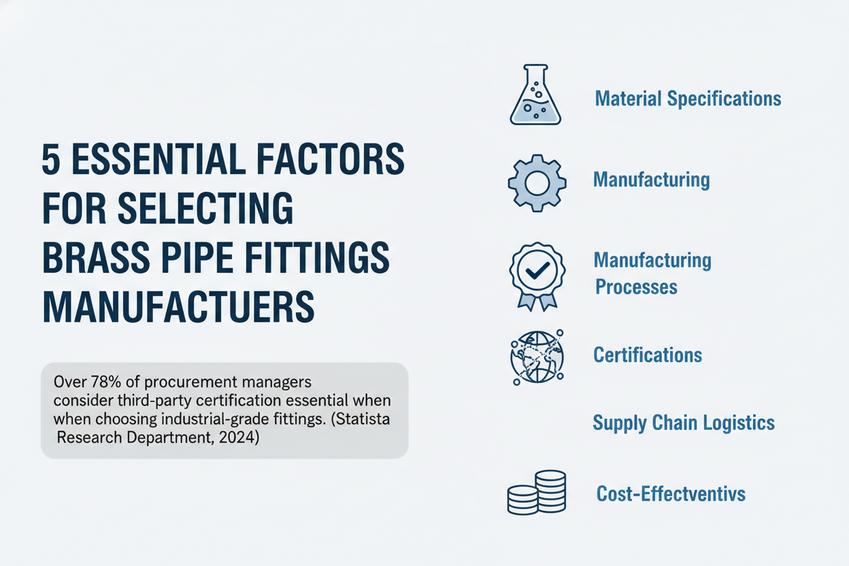
5 Essential Factors for Selecting Brass Pipe Fittings Manufacturers
Picking the right brass pipe fittings manufacturers is more than just checking prices—it’s about long-term reliability, safety, and logistics that won’t let you down.
Understanding Material Specifications for Durable Brass Fittings
• Always check the material composition—high copper content improves corrosion resistance.
• Look for low lead content, especially if you’re sourcing for potable water systems.
• Verify compliance with dezincification resistance standards like ASTM B858.
Short-term savings don’t always equal long-term value. If a fitting can’t handle your system’s pressure or fails under stress, you’re looking at costly replacements and potential safety risks.
In short: strong brass alloys, proper material grades, and durability certifications are non-negotiable when choosing fittings that last.
The Importance of Manufacturing Processes in Quality Assurance
Precision matters, especially when it comes to how fittings are made:
- Forging vs. casting: Forged brass has superior strength and grain uniformity, ideal for high-pressure applications.
- Tight machining tolerances reduce leak risk—look out for CNC-controlled processes with micron-level accuracy.
- Surface finishing isn’t just cosmetic; a smooth finish reduces corrosion buildup over time.
- Reliable manufacturers conduct rigorous leak testing using both air pressure and hydrostatic methods.
It’s not just about producing volume—it’s about producing consistency through automation and strict quality control checks at every stage.
Certifications to Look for in Brass Pipe Fittings Manufacturers
You want peace of mind? Then these certifications better be on the label:
✔️ ISO 9001: Confirms the manufacturer follows structured quality management systems.
✔️ NSF/ANSI 61 & CSA certified: Crucial if you’re dealing with drinking water systems across North America.
✔️ Check for compliance with applicable ASTM standards, which define physical properties and dimensions precisely.
✔️ For European markets, look into WRAS approval to ensure safe contact with potable water supplies.
According to a recent Global Plumbing Components Study by Statista Research Department (2024), over 78% of procurement managers consider third-party certification essential when choosing industrial-grade fittings.
How Supply Chain Logistics Impact Your Brass Fittings Purchase
Inventory hiccups or shipping delays can wreck project timelines fast—so here’s what really counts:
• Do they offer real-time inventory tracking? A good system prevents backorders before they happen.
• Shorter lead times mean fewer headaches during installation crunches.
• Global sourcing networks help mitigate regional disruptions—but only if their distribution network is solid and responsive.
Also worth checking: do they provide bulk packaging options? That cuts down on freight costs big time—and makes warehouse handling way smoother.
When you’re juggling multiple job sites or tight delivery windows, things like integrated labeling services and reliable warehousing become more than just “nice-to-haves.” They’re essentials that separate dependable suppliers from risky ones.
And yes—while many buyers focus on product specs alone, smart pros know that behind every fitting is a supply chain either built to support your deadlines—or blow them up completely.
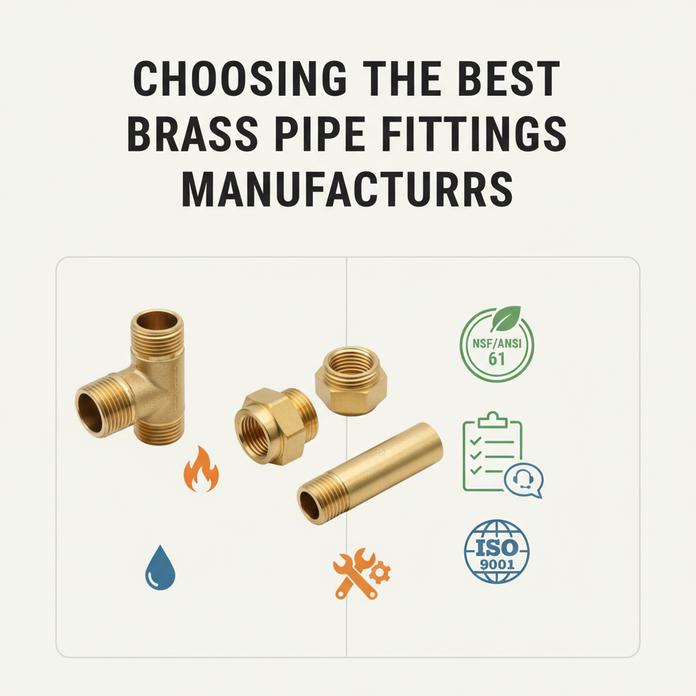
How to Identify the Best Brass Pipe Fittings Manufacturers for Your Needs
Choosing the right brass pipe fittings manufacturers can make or break your project. Here’s how to spot the best match for your job.
Evaluating Fitting Types for Your Specific Application
• Threaded adapters are great if you’re dealing with rigid pipes and need something easy to install.
• Compression fittings work well when you want a tight seal without using heat—ideal for water systems.
• Flare fittings? They’re solid picks for high-pressure gas lines, especially where vibration is a concern.
• Push-to-connect types snap into place—super handy if you’re short on tools or time.
Different jobs demand different fitting types, so always match your choice with the system’s pressure ratings, expected temperature ranges, and potential exposure to corrosive elements. And don’t forget about compatibility with specific thread types or brass alloys—they matter more than you’d think.
Why Certifications and Standards Matter for Your Project
- Certified products keep you compliant with local building codes and safety regulations.
- Look out for NSF/ANSI 61 if potable water is involved—it’s non-negotiable.
- ISO 9001 means their production process meets global quality benchmarks.
- CSA and ASTM labels give extra peace of mind, especially in North American projects.
Reliable certifications ensure that your fittings meet strict industry standards and pass rigorous quality control checks. That’s not just paperwork—it’s real-world assurance that things won’t blow apart under pressure (literally). Always ask manufacturers what kind of regulatory compliance their parts carry—if they hesitate, walk away.
How Technical Support Can Influence Your Buying Decision
▸ Need help designing a custom layout? Good tech support should offer detailed CAD files and engineering assistance.
▸ Facing installation hiccups? A quick response time from support can save hours—or days—on-site.
▸ Want to tweak an off-the-shelf fitting? Go with a team that offers customization options backed by solid documentation like spec sheets and manuals.
The best brass pipe fitting suppliers aren’t just selling parts—they’re solving problems. Whether it’s pre-sale guidance or post-installation troubleshooting, strong technical support, including access to detailed product documentation and responsive service teams, makes all the difference when deadlines loom large.
Understanding Pricing and Payment Terms for Bulk Orders
| Volume Tier | Discount Rate | Minimum Order Quantity | Payment Terms |
|---|---|---|---|
| Tier 1 | None | <500 units | Net 15 |
| Tier 2 | 5% | ≥500 units | Net 30 |
| Tier 3 | 10–15% | ≥2000 units | Net 45 / L/C open |
When buying big, don’t just chase low prices—pay attention to how those prices behave over time. Some manufacturers lock in rates even as metal costs fluctuate; others don’t. Ask about their approach to price stability during volatile periods. Also check if they offer flexible terms like credit lines or staggered payments based on shipping milestones. Smart buyers also factor in hidden costs like freight charges based on incoterms or minimum order surcharges—it adds up fast when you’re sourcing from overseas brass pipe fitting producers like yuuhuan hongqian who cater globally but expect certain thresholds met before shipping kicks off.
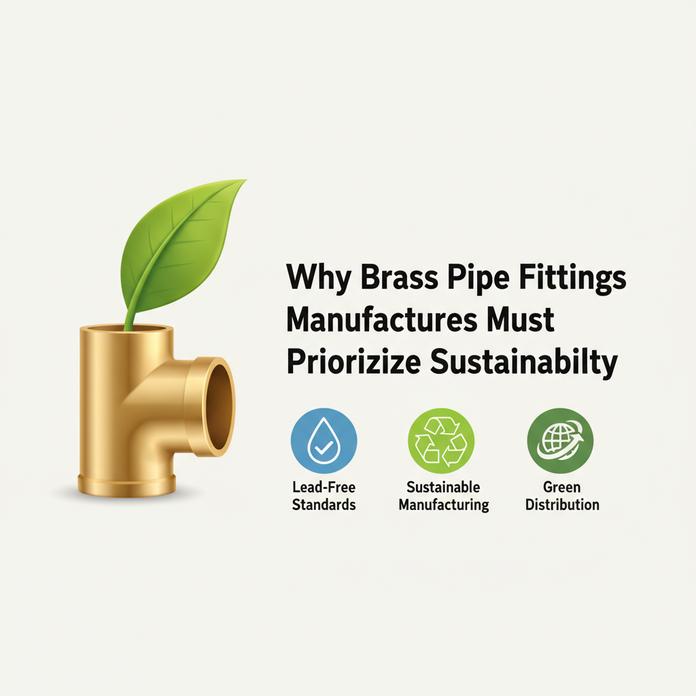
Why Brass Pipe Fittings Manufacturers Must Prioritize Sustainability
Sustainability isn’t just a buzzword—it’s the new standard. Here’s how modern-day brass pipe fittings players can stay ahead without trashing the planet.
Lead-Free Brass Standards and Their Environmental Benefits
- ✅ Reduces toxic runoff into soil and water systems
- ✅ Supports safer drinking water infrastructure worldwide
- ✅ Meets evolving global health regulations like NSF/ANSI/CAN standards
- Adopting lead-free brass protects both end-users and ecosystems.
- It aligns with mandates on potable water safety, especially across North America and Europe.
- Many regions now require lead content below 0.25%, making compliance non-negotiable.
Short-term cost bumps? Sure. But long-term environmental gains are worth every penny.
Clean pipes, clean conscience: Switching to sustainable materials like lead-free brass means fewer contaminants leaching into municipal supplies, preserving both public health and groundwater purity.
Strict rules are driving change fast. For instance:
• U.S. Safe Drinking Water Act updates now mandate ultra-low lead levels.
• The EU’s REACH regulation penalizes non-compliance harshly.
• Asia-Pacific is catching up quickly with similar reforms.
For any brass pipe fittings manufacturers looking to stay relevant, ignoring these shifts isn’t an option anymore.
Sustainable Manufacturing Processes and Their Impact on the Industry
♻️ Eco-friendly production isn’t just about saving whales—it’s about cutting costs too.
Grouped benefits of sustainable manufacturing for brass fittings producers:
• Energy Efficiency: Smart furnaces and induction heating reduce electricity bills while lowering emissions.
• Waste Reduction: Closed-loop cooling systems recycle water; scrap metal is re-melted instead of dumped.
• Resource Conservation: Precision CNC machining minimizes raw material use, trimming waste at the source.
By adopting a circular economy mindset, forward-thinking firms are rewriting what it means to be efficient.
Take forging operations as an example:
- Switching from coal-based heat sources to electric arc furnaces slashes carbon output by more than half.
- Integrating digital monitoring reduces overproduction and scrap rates by up to 30%.
If you’re sourcing from outdated facilities, you’re likely paying for inefficiency—and pollution—you don’t need.
The Role of Global Distribution Networks in Reducing Carbon Footprints
Global logistics often get blamed for climate impact—but smart routing changes everything.
Multiple short insights on greener distribution:
— Consolidated shipping cuts down empty miles driven by freight trucks.
— Regional warehousing minimizes long-haul air transport needs.
— AI-powered route planning avoids traffic bottlenecks that burn extra fuel unnecessarily.
Here’s where things get interesting:
Some top-tier brass pipe fittings manufacturers now design their supply chains around carbon metrics—not just cost or speed—which actually helps them win contracts with eco-conscious builders and municipalities.
A company like yuuhuan hongqian stands out by optimizing its international supply hubs near major ports, reducing inland freight reliance significantly—all while keeping delivery times sharp.
So if your current supplier still operates like it’s the ’90s—think twice before renewing that contract. Efficient logistics aren’t just better for the planet—they’re better for your bottom line too.
FAQs about Brass Pipe Fittings Manufacturers
What material checks matter most before committing to a large order?
The right brass alloy can mean the difference between years of reliable service and premature failure. Buyers often check:
- Brass alloy composition to ensure lasting corrosion resistance properties.
- Lead-free brass standards for potable water safety.
- Material tensile strength and ductility requirements matched to application stress levels.
- Pressure rating suitability that aligns with system demands—never ignore this under tight timelines; it’s what makes fittings safe under load.
How do manufacturing methods influence fitting reliability over time?
Every forged curve, machined thread, and polished surface tells part of a performance story:
- Forging capabilities keep grain structure intact for extra durability in high-pressure environments.
- Machining precision ensures perfect threads—misaligned cuts lead quickly to leaks or costly downtime.
- Controlled casting techniques reduce hidden flaws inside thicker sections of couplings or adapters.
- Surface finishing treatments resist tarnish while easing assembly on site during long shifts in tough weather conditions.
Which certifications signal trustworthy production quality?
An experienced manufacturer wears its credentials like armor:
★ NSF/ANSI 61 certification – proves fittings are suitable for drinking water systems where public trust is key.
★ CSA standards compliance – signals readiness for North American regulations without last-minute rework worries.
★ ISO 9001 accreditation – means quality control procedures aren’t left up to chance.
★ ASTM material specifications & RoHS compliance – satisfy engineers who won’t cut corners.
Why does supply chain planning play such a big role when ordering by the thousands?
A well-run logistics plan feels almost like choreography across borders—a misstep costs days:
| Key Element | Human-Centered Impact |
|---|---|
| Bulk packaging options | Protects fittings from damage during transit so crews don’t waste mornings sorting bent parts |
| Shipping lead times | Keeps construction schedules intact when every hour counts |
| Inventory management | Prevents sudden shortages that halt work midstream |
| Global distribution network & freight cost optimization | Balances speed against budget pressures without draining resources |