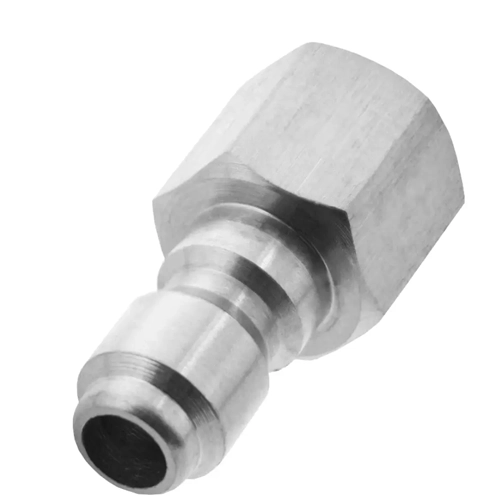
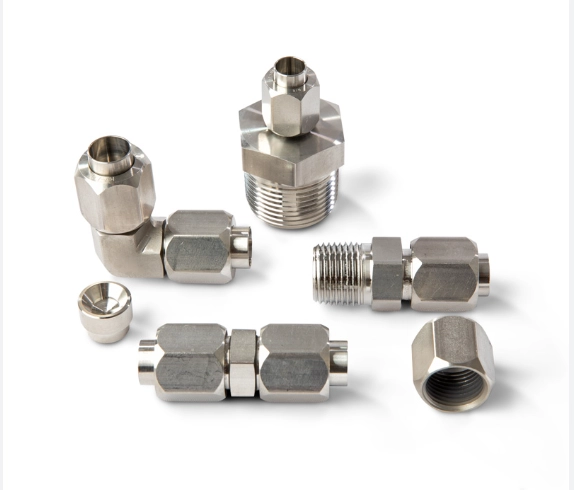
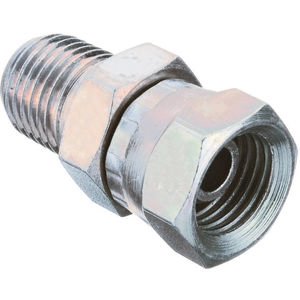
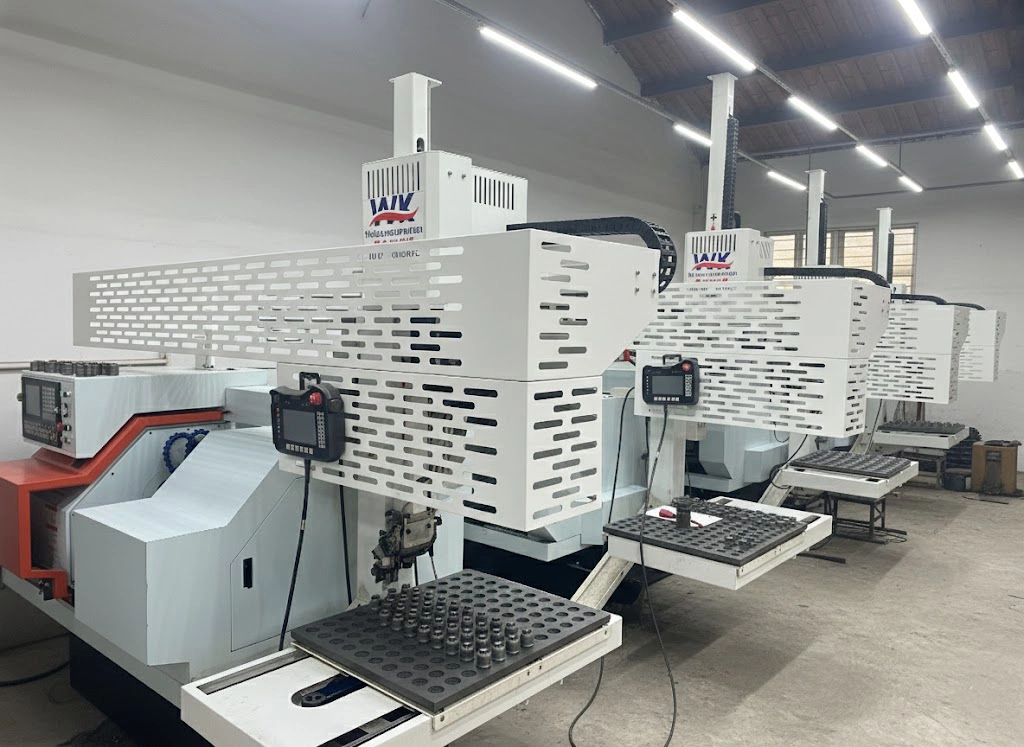
When customers send drawings to our stainless steel pipe fitting manufacture, one question appears again and again:
“Rz 12.5 equals Ra 3.2, right?”
In many cases, yes — practically speaking.
But from a machining and inspection perspective inside a real CNC turning parts factory, the answer is more nuanced.
This article explains Ra and Rz conversion from a factory point of view, especially for stainless steel pipe fittings made from 201, 303, 304, 316, and 316L.
No theory for theory’s sake — only what matters on the shop floor.
1. What Ra and Rz Really Mean in Production
Surface roughness reflects the microscopic peaks and valleys left after machining. The spacing is usually below 1 mm and cannot be judged by eye.
In pipe fitting manufacture, roughness directly affects:
- Thread sealing performance
- O-ring compression reliability
- Fatigue strength
- Corrosion behavior
- Plating or passivation quality
If the surface is too rough, leakage risk increases.
If it is unnecessarily smooth, cost increases without functional benefit.
Ra – Arithmetic Average Roughness
Ra is the arithmetic average of the absolute deviation from the mean line within a sampling length.
In simple factory language:
Ra tells you the overall smoothness level.
It is the most widely used parameter in export drawings.
Rz – Maximum Height of Profile (Ten-Point Height)
Rz measures:
- Average of five highest peaks
- Plus average of five deepest valleys
It reflects peak-to-valley extremes.
In real machining inspection:
Rz is more sensitive to scratches and vibration marks.
2. Can Ra and Rz Be Converted?
You often hear this formula in workshops:
Rz = Ra × 8
If we calculate:
Rz 12.5 ÷ 8 = 1.6 Ra
But many comparison tables show:
Rz 12.5 ≈ Ra 3.2
Why the difference?
Because there is no universal fixed conversion.
The ratio depends on:
- Material type
- Tool geometry
- Cutting speed
- Feed rate
- Machine stability
- Surface profile shape
The “×8” formula is an empirical estimate, not a strict mathematical rule.
3. Practical Reference Table Used in CNC Turning
In stainless steel pipe fitting manufacture, we commonly use the following practical reference:
| Rz (µm) | Approximate Ra (µm) | Machining Stage | Typical Application |
|---|---|---|---|
| 6.3 | 0.8 | Fine finishing | Sealing surfaces |
| 12.5 | 1.6 – 3.2 | Semi-finish turning | Threaded fittings |
| 25 | 3.2 – 6.3 | Rough turning | Structural parts |
| 50 | 6.3 – 12.5 | Heavy roughing | Pre-machining |
For stainless steel 304 and 316 fittings, Rz 12.5 usually falls within Ra 1.6–3.2 range.
That is why in practical communication:
Rz 12.5 is often considered close to Ra 3.2.
But inspection reports should always use the parameter specified in the drawing.
4. Why Stainless Steel Makes Roughness Control Harder
As a stainless steel pipe fitting manufacture, we work mainly with:
- 201
- 303
- 304
- 316
- 316L
Each material behaves differently in turning.
201 Stainless Steel
Higher hardness, more prone to vibration marks.
303 Stainless Steel
Contains sulfur, better machinability, easier to achieve lower Ra.
304 Stainless Steel
Most common, but tends to form built-up edge.
316 / 316L Stainless Steel
Better corrosion resistance but stickier during cutting.
316L especially requires careful parameter control to maintain Ra 3.2 or below.
5.How We Measure Ra and Rz in Stainless Steel Pipe Fitting Manufacture
In a real CNC turning environment, ensuring $Ra leq 3.2$ or $Rz leq 12.5$ is not about guesswork. We use four primary methods to verify surface quality during and after production.
1. Stylus Profilometer (The Gold Standard)
This is the most precise method used in our QC laboratory.
-
The Process: A diamond-tipped stylus moves at a constant speed across the stainless steel surface. The vertical displacement of the tip is converted into an electrical signal.
-
Best For: Final inspection reports for 316L high-precision fittings or sealing surfaces where a digital printout of the $Ra$ or $Rz$ curve is required.
2. Portable Surface Roughness Testers (Shop Floor Reality)
To maintain efficiency, operators cannot run to the lab after every part.
-
The Process: Handheld digital units allow for “on-machine” measurement before the part is even unclamped.
-
Pro-Tip: Because 304 and 316 stainless steel are “sticky,” the surface must be thoroughly cleaned of cutting oil and microscopic chips with a lint-free cloth before measuring, or the sensor will give a false high reading.
3. Surface Roughness Comparison Specimens (The Quick Check)
This is a low-cost, high-speed qualitative method.
-
The Process: The operator compares the machined part against a set of standard calibrated metal plates (e.g., an $Ra 3.2$ specimen) using visual inspection and a “fingernail test.”
-
Limitation: It is a subjective judgment. While excellent for roughing or semi-finishing stages, it cannot replace a digital meter for final certification.
4. Non-Contact Optical Profiling (For High-Purity Fittings)
For specialized 316L fittings used in the semiconductor or pharmaceutical industries, physical contact might be prohibited.
-
The Process: Using laser scanning or confocal microscopy to map the surface.
-
Advantage: It prevents microscopic scratches that a diamond stylus might leave on ultra-smooth surfaces ($Ra < 0.4$).
Technical Note: The Importance of Sampling Length ($L_e$)
In international trade, disputes often arise not because the part is bad, but because the measurement settings differ. For an $Ra 3.2$ requirement, the industry standard usually dictates:
-
Sampling Length ($L_r$): $0.8$ mm
-
Evaluation Length ($L_n$): $4$ mm
Factory Advice: Always ensure your customer’s QC department and your production team are using the same cutoff length settings on their devices, otherwise, you might see a $20%$ discrepancy in results.
6. Why Outer Diameter Turning Fails to Meet Roughness
Inside a real CNC turning parts factory, roughness failure usually comes from four major areas.
6.1 Machine Rigidity and Vibration
Most common cause.
If:
- Spindle bearings are worn
- Guideways have clearance
- Chuck clamping is weak
- Tool overhang is too long
You get chatter marks.
Chatter directly increases both Ra and Rz.
In thin-wall stainless steel pipe fittings, vibration is even more critical.
6.2 Tool Condition
Common issues include:
- Incorrect nose radius
- Improper lead angle
- Dull insert
- Built-up edge
- Tool center height deviation
For 304 and 316 stainless steel, low cutting speed easily causes built-up edge, which scratches the surface and increases Rz significantly.
6.3 Cutting Parameters
Cutting speed too low:
- Built-up edge formation
- Surface tearing
Feed rate too high:
- Directly increases theoretical roughness
Insufficient coolant:
- Heat accumulation
- Surface discoloration
- Tool wear acceleration
6.4 Chip Control
Wrong chip breaker:
- Chips hit finished surface
- Scratching occurs
Uneven stock allowance:
- Depth variation
- Vibration increase
7. Factory-Level Solutions to Improve Surface Roughness
From our experience in stainless steel pipe fitting manufacture, improvements focus on process stability.
1. Increase Rigidity
- Reduce tool overhang
- Ensure proper machine leveling
- Check spindle condition
2. Optimize Tool Geometry
- Larger nose radius for finishing
- Correct rake angle for stainless steel
- Use sharp inserts designed for austenitic materials
3. Adjust Cutting Parameters
- Increase cutting speed moderately
- Reduce feed rate in finishing pass
- Maintain constant depth of cut
4. Use Proper Coolant
Stainless steel requires strong cooling and lubrication.
Dry cutting increases surface damage.
5. Multi-Step Machining Strategy
Rough turning → Semi-finishing → Finishing
Skipping finishing pass usually results in Ra exceeding 3.2.
8. Real Case in 316 Pipe Fitting Production
Requirement:
Ra ≤ 3.2 on sealing surface
Initial measurement:
Ra = 4.5
Root cause:
- Insert slightly worn
- Feed rate too high
- Coolant pressure insufficient
Adjustment:
- Replace insert
- Reduce feed by 25%
- Increase spindle speed
- Improve coolant flow
Final result:
Ra stabilized at 2.4–2.8
This is typical optimization inside a professional CNC turning parts factory.
9. Which Parameter Should Be Specified in Drawings?
From export experience:
- European customers usually specify Ra
- Some industrial hydraulic drawings specify Rz
- Automotive components may require both
For stainless steel threaded pipe fittings, Ra 3.2 is commonly required.
For sealing surfaces, Ra 1.6 or lower may be necessary.
Always confirm:
- Measurement standard
- Sampling length
- Inspection instrument
10. Summary: Is Rz 12.5 Equal to Ra 3.2?
Short answer:
In many practical turning conditions, yes — they are often treated as comparable.
Technical answer:
They are not mathematically equal.
Rz ≈ Ra × 8 is only an empirical approximation.
In stainless steel pipe fitting manufacture, actual values depend on:
- Material grade (201, 303, 304, 316, 316L)
- Tool condition
- Machine rigidity
- Cutting parameters
Surface roughness control reflects manufacturing capability.
It is not about formulas.
It is about process stability.
FAQ
1. Is Rz always 8 times Ra?
No. The ratio varies depending on material and machining conditions. The ×8 formula is only a practical estimate.
2. Why does 316 stainless steel show worse roughness than 303?
316 has higher toughness and lower machinability. It tends to form built-up edge more easily, affecting surface quality.
3. Is lower roughness always better for pipe fittings?
Not always. Extremely smooth surfaces increase cost and may not improve function. Roughness should match functional requirements.
4. Why does roughness fluctuate even with same parameters?
Possible reasons:
- Insert wear progression
- Machine temperature change
- Clamping variation
- Material batch difference
5. How does a professional factory ensure stable Ra 3.2?
By controlling:
- Machine rigidity
- Tool management system
- Parameter standardization
- In-process inspection
Final Thoughts
For any serious stainless steel pipe fitting manufacture or CNC turning parts factory, understanding Ra and Rz is basic — but controlling them consistently is the real capability.
Rz 12.5 and Ra 3.2 are often treated as equivalent in production discussions.
But only stable machining control ensures that your inspection report matches your drawing.
Surface roughness is not just a specification.
It is a reflection of manufacturing discipline.