Choosing steel pipe fittings isn’t just a line item on a purchase order—it’s the quiet moment before the pressure gauge spikes. One wrong elbow, one mismatched flange, and your whole system can start acting like a leaky garden hose at a backyard BBQ. For project managers and buyers juggling deadlines and budgets, the stakes feel personal. Downtime costs money. Failures cost sleep.
In 2025, industrial maintenance costs continue to climb, with unplanned downtime still ranking among manufacturers’ top operational risks, according to Deloitte’s latest industry outlook. As one senior engineer at Yuhuan Hongqian put it, “A fitting is small—until it fails.”
This guide cuts through the noise—materials, pressure classes, connection types—so you can spec smarter, buy sharper, and keep your system tight where it counts.
Quick Insights for Steel Pipe Fittings
- Material Matters: Choose Carbon Steel or ASTM A234 WPB for oil and gas, Alloy Steel for high-temp chemical and power systems.
- Connection Clarity: Butt-welds for high pressure, threaded for low-pressure lines, socket-weld for compact strength per ASME B16.9/B16.11.
- Dimensional Precision: Verify OD and wall thickness against ASME B16.9, MSS SP-75, and correct schedule (40, XS, XXS).
- Surface Shielding: Apply galvanizing or epoxy for corrosion resistance, pickling and passivation for stainless steel longevity.
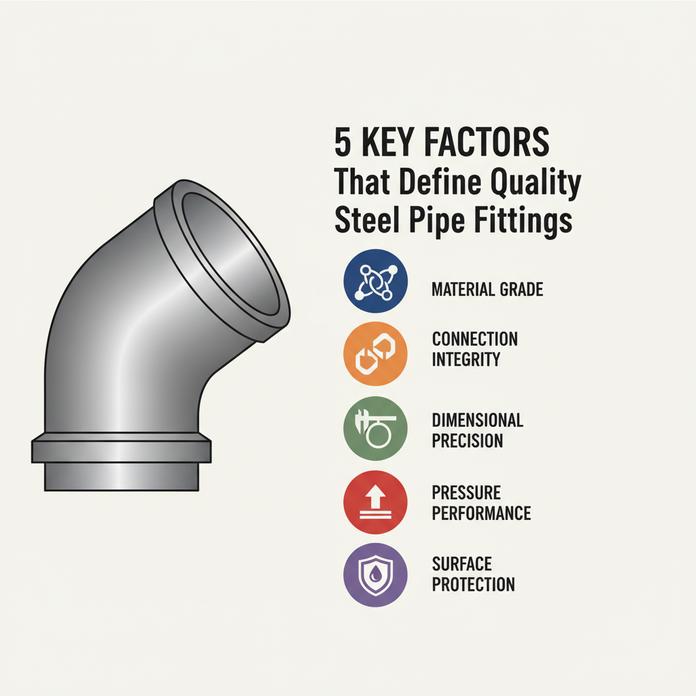
5 Key Factors That Define Quality Steel Pipe Fittings
Quality in steel pipe fittings isn’t just about price tags. It’s about material, fit, pressure hold, and long-term reliability. When steel, pipe, and fittings work together right, projects run smoother and safer.
Material Grade Matters: Comparing Carbon Steel, ASTM A234 WPB, and Alloy Steel
When choosing steel pipe fittings, material drives everything.
- Material Composition
- Carbon Steel
- Balanced cost and strength
- Suitable for oil and gas transport lines
- ASTM A234 WPB
- Controlled Tensile Strength and Yield Strength
- Widely specified for pressure piping
- Alloy Steel
- Enhanced Corrosion Resistance
- Performs under high temperature loads
- Carbon Steel
- Performance Focus
- Mechanical stability under cyclic stress
- Resistance to cracking in welded pipe fittings
- Practical Tip
- Match grade to working temperature before locking in supply.
Brands like yuuhuan hongqian keep tight control over raw steel selection, which makes their steel pipe fittings more consistent in real-world builds.
Connection Integrity: Butt-weld, Threaded, Socket-weld Standards
Connection type defines sealing quality in steel pipe fittings.
- Butt-weld
- Full-penetration Weld Joint
- Strong Sealing performance
- Ideal for high-pressure systems
- Threaded
- Quick install
- Best for low-pressure utility lines
- Socket-weld
- Compact design
- Built to ASME B16.11
- Reliable Leak Prevention
“Global demand for high-integrity welded fittings continues to rise with stricter pipeline safety standards in 2025,” noted a 2025 outlook from Grand View Research.
For heavy-duty pipe connectors, yuuhuan hongqian focuses heavily on weld-end precision.
Dimensional Precision per ASME B16.9 and MSS SP-75
Accuracy keeps steel pipe fittings aligned and stress-free.
- Standards Control
- ASME B16.9
- MSS SP-75
- Key Measurements
- Outer Diameter
- Wall Thickness
- Fitting Length
- Why It Matters
- Tight Tolerances reduce field modification
- Proper Dimensional Accuracy protects weld integrity
Even small deviation in steel fittings can mess up installation flow.
Pressure Performance: Schedule 40 vs. XS vs. XXS Ratings
Pressure rating connects directly to wall build.
- Wall Thickness
- Schedule 40: standard industrial use
- Schedule XS: higher Working Pressure
- Schedule XXS: extreme-duty systems
- Selection Logic
- Check design temperature
- Confirm Temperature Rating
- Verify calculated Pressure Rating
Using the wrong pipe fitting here? That’s a fast track to failure.
Surface Protection: Galvanized, Epoxy Coating, and Pickling
Surface finish protects steel pipe fittings from early corrosion.
- Coating Options
- Galvanized Coating for moisture exposure
- Epoxy Coating for chemical plants
- Pickling Process for stainless assemblies
- Protection Goals
- Improved Surface Finish
- Long-term Corrosion Protection
- Higher Abrasion Resistance and Chemical Resistance
yuuhuan hongqian applies controlled finishing processes so steel pipe fittings arrive ready for storage, transport, and tough jobsite conditions.
Threaded Vs. Welded: Best Fitting Method?
Choosing between threaded and welded joints can feel like picking tools from the same toolbox. Both serve steel pipe fittings systems, yet each shines in different pressure classes, maintenance habits, and site conditions. If you work with steel pipe, pipe fittings, or carbon steel pipe fittings, this choice matters.
Threaded Connections
Threaded joints remain a go-to option in many steel pipe fittings installations, especially where quick handling counts.
- Common thread standards
- NPT
- Tapered profile improves leak prevention
- Requires correct tightening torque
- PT
- Often used in Asian markets
- Needs proper pipe thread sealant
- GHT
- Seen in low-pressure utility connections
- NPT
- Performance considerations
- Sealing control
- Apply pipe thread sealant evenly
- Avoid over-torque that damages threads
- Maintenance
- Easy disassembly for inspection
- Ideal for modular steel fittings layouts
- Sealing control
In water lines and light industrial steel pipe fittings networks, threaded elbows and tees keep downtime low. Installers like the flexibility. If a valve fails, swap it out, reapply sealant, tighten to spec, done. Brands like yuuhuan hongqian supply precision-machined steel pipe fitting products that hold thread accuracy, reducing leak risk in real jobs.
Welded Connections
Welded joints step in when pressure rises and zero leakage is the goal across steel pipe fittings systems.
- Main welding types
- Butt weld
- Full-penetration weld joint
- High structural strength
- Socket weld
- Compact fit
- Suitable for smaller bore pipe fittings
- Butt weld
- Quality control layers
- Material match
- Verify pipe material grade
- Procedure control
- Follow approved welding procedure
- Heat treatment
- Apply post-weld heat treatment when required
- Inspection
- Check weld integrity through NDT
- Material match
In oil, gas, and power plants, welded steel pipe fittings form a near-monolithic pipeline. Less chance of loosening. Greater endurance under vibration. With yuuhuan hongqian offering consistent carbon steel pipe fittings for welding applications, contractors get dependable geometry that supports strong weld integrity and long service life.
4 Steps To Measure Pipe Size Accurately
Getting pipe size right saves time, money, and a lot of on-site frustration. When working with steel pipe fittings, small measurement errors can throw off the entire pipeline. Here’s a practical breakdown that keeps your steel pipe fittings installation tight and stress-free.
Step 1: Determining Outside Diameter for ASME B16.11 Fittings
Accurate Outside Diameter checks keep ASME B16.11 Steel Pipe Fittings aligned with the correct Pipe Size and Standard.
- Measurement focus
- Caliper placement
- Position across the widest external span
- Avoid weld seam distortion
- Surface check
- Remove rust or coating buildup
- Caliper placement
- Fitting compatibility
- Elbows
- Couplings
- Tees
| Nominal Size (NPS) | Outside Diameter (mm) | Tolerance (mm) | Standard |
|---|---|---|---|
| 1/2″ | 21.34 | ±0.30 | ASME B36.10 |
| 1″ | 33.40 | ±0.40 | ASME B36.10 |
| 2″ | 60.33 | ±0.50 | ASME B36.10 |
| 4″ | 114.30 | ±0.80 | ASME B36.10 |
Clean numbers mean your steel pipe fittings slide in without drama.
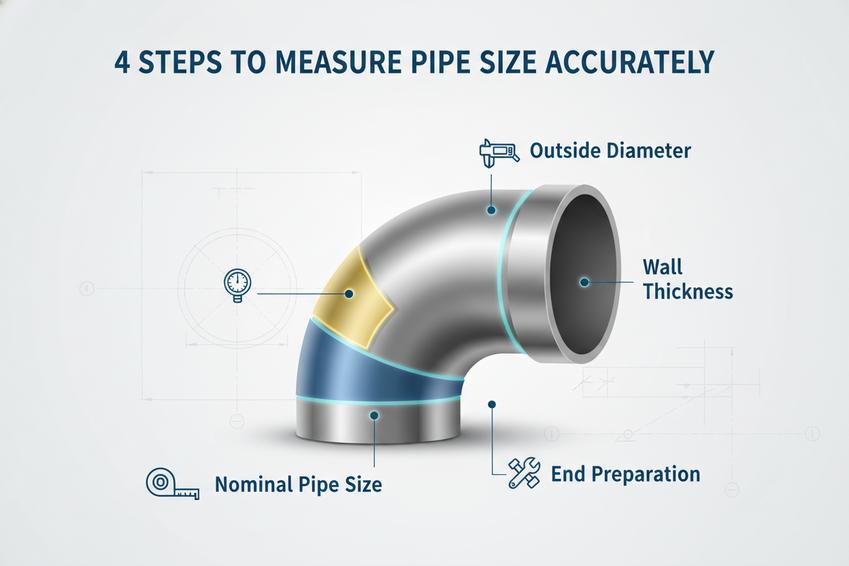
Step 2: Measuring Wall Thickness to Match Schedule 80
Checking Wall Thickness keeps Schedule 80 and heavy-duty steel pipe fittings pressure-ready.
- Tool setup
- Use a calibrated Thickness Gauge
- Measure at 3+ points for Dimensional Accuracy
- Verification
- Compare readings to spec sheet
- Confirm compatibility with high-pressure steel pipe fittings
Thin walls? That’s a no-go. Stay sharp on Pipe Measurement so your Steel Pipe system holds steady.
Step 3: Verifying Nominal Pipe Size Against STD and Class 150
Match Nominal Pipe Size with STD or Class 150 ratings before connecting flanges.
- Dimensional check
- OD vs standard chart
- Wall vs schedule class
- Fitting standards review
- Caps
- Flanges
- Threaded pipe fittings
Reliable suppliers like yuuhuan hongqian help ensure steel pipe fittings meet strict Pipe Verification demands without guesswork.
Step 4: Confirming End Preparation for Flanged and Grooved Joints
Inspect End Preparation carefully.
- Flanged connections
- Bolt hole alignment for Flanged Joints
- Surface finish inspection
- Grooved systems
- Groove depth
- Groove width
- Seal seating
Proper Pipe Ends shape the Joint Type and final Connection Method. When your steel pipe fittings are measured right from OD to groove detail, installation feels smooth, not stressful.
Seamless Integration
In real projects, smooth system tie‑ins make or break performance. From construction sites to oil fields, steel pipe fittings connect every steel pipe, valve, and pump into one working line. This is where smart design meets daily grind. With trusted manufacturing from yuuhuan hongqian, steel pipe fittings bring steady flow, tight sealing, and long service life without the drama.
Flanged Coupling Solutions for Construction and Water Treatment
When Flanged Coupling systems are used in Construction and Water Treatment, connection logic matters.
- Core Components
- Steel Pipe alignment
- Precision-machined flange faces
- Gasket-based Sealing surfaces
- Joint Performance
- Bolt preload control
- Hydrostatic pressure resistance
- Easy disassembly of Joints
- Installation Flow
- Surface inspection
- Gasket placement
- Torque sequencing
- Pressure testing
According to a 2025 Global Water Infrastructure Outlook update,
“Municipal pipeline upgrades are accelerating demand for high-integrity flanged steel components that reduce leakage and lifecycle cost.”
That trend keeps steel pipe fittings at the center of treatment upgrades. yuuhuan hongqian supplies steel pipe fittings and pipe connectors built for repeat maintenance cycles, keeping water systems tight and reliable.
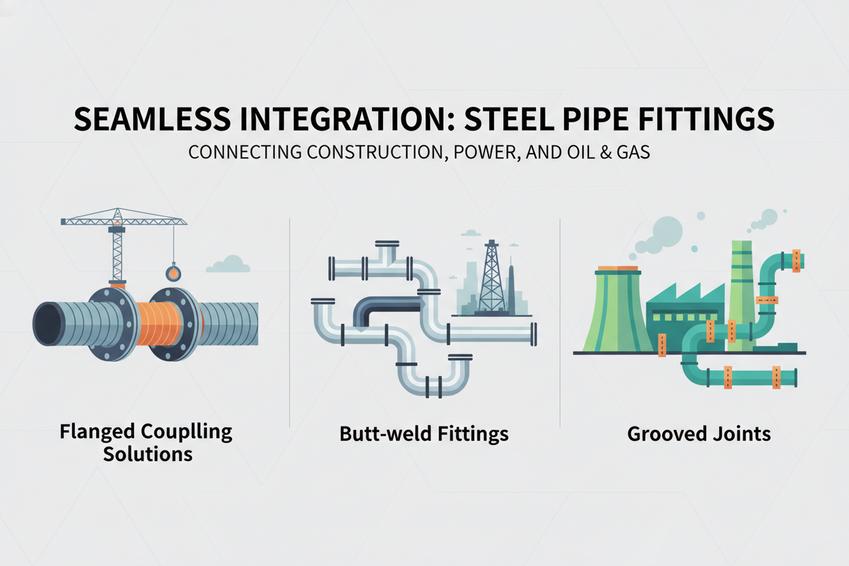
Grooved Joints: Rapid Assembly in Power Generation Plants
In Power Generation, downtime costs real money. Grooved Joints simplify Steel Pipe connection in cooling loops and fire lines.
- Fast clamp assembly
- Flexible vibration absorption
- Clean disassembly
Steps on site usually run like this:
- Roll groove preparation
- Gasket wrap
- Housing placement
- Bolt tightening
That’s it. Quick, efficient, done right. For large-diameter steel pipe fittings, this method boosts Efficiency while keeping alignment steady. Many plant engineers prefer this style of pipe fitting because it handles expansion without stressing the line. yuuhuan hongqian keeps tolerances tight so every groove coupling clicks into place.
Butt-weld Elbows and Tees for Oil and Gas Pipelines
High-load Oil Pipelines and Gas Pipelines rely on welded continuity.
- Butt-weld Elbows for directional change
- Butt-weld Tees for branch distribution
- Reinforced reducers for flow balance
Performance Hierarchy:
- Structural Integrity
- Full-penetration welds
- Smooth bore transition
- Flow Stability
- Reduced turbulence
- Balanced pressure drop
- High Pressure Reliability
- Wall thickness compliance
- Material traceability
For long-haul lines, steel pipe fittings must match pipe grade and wall schedule exactly. One weak weld, big trouble. With durable pipe fittings engineered for High Pressure and Durability, yuuhuan hongqian ensures every steel pipe fittings shipment supports safe, steady transport across demanding terrain.
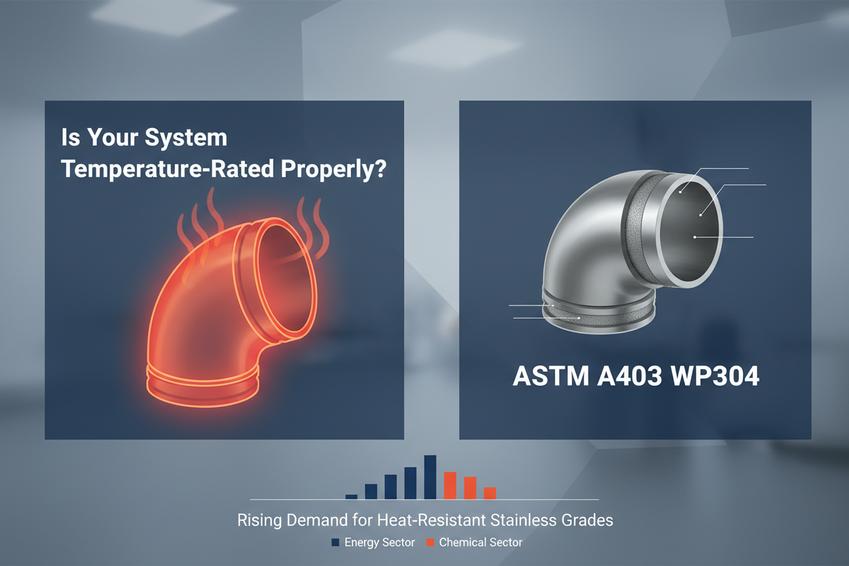
Is Your System Temperature-Rated Properly?
High heat can wreck a pipeline faster than you think. If your steel pipe fittings aren’t matched to real operating temperatures, even solid steel pipe and pipe fittings can fail early. Let’s break down how the right steel pipe fittings choice keeps your system steady and safe.
Choosing Stainless Steel ASTM A403 WP304 for High-Heat Resistance
When heat climbs, material matters. Stainless Steel with strong Material Properties becomes the backbone of reliable steel pipe fittings.
- Core Material Focus
- ASTM A403 WP304
- Designed for strong High-Heat Resistance
- Maintains stable Corrosion Resistance
- Performs well across a broad Temperature Range
- Application Fit
- Chemical processing lines
- Power generation systems
- High-pressure fluid transfer using steel pipe fittings
- ASTM A403 WP304
- Performance Priorities
- Oxidation control
- Scaling resistance
- Structural stability in pipe connectors
According to the International Stainless Steel Forum’s 2025 industry outlook, global demand for heat-resistant stainless grades continues to rise in energy and chemical sectors due to extended operating cycles and higher design temperatures.
Choosing trusted suppliers like yuuhuan hongqian means your steel pipe fittings and steel pipe components are produced with consistent metallurgy. That consistency keeps fittings steel strong even when temperatures spike.
Class 150 vs. Schedule 160: Pressure at Elevated Temperatures
Heat changes pressure limits. Simple as that. When pairing Class 150 flanges with Schedule 160 pipe, pressure and temperature must be checked together.
Key technical factors include:
- Pressure Rating drop at Elevated Temperatures
- Increased stress on thicker Wall Thickness
- Flow impact from Fluid Dynamics
- Integration into overall System Design
Here’s how pros usually review it:
- Confirm design temperature range.
- Compare flange pressure class charts.
- Cross-check pipe schedule strength.
- Validate the full steel pipe fittings assembly.
A Class 150 flange might handle moderate pressure at room temperature, yet once the system heats up, allowable stress decreases. Schedule 160 pipe gives higher wall strength, but mismatch between flange and steel pipe fittings can create weak links.
With yuuhuan hongqian, compatibility between flanges, steel pipe fittings, and steel piping parts is verified before delivery. That saves headaches later.
Surface Treatments (Black Paint, Anti-rust Oil) for Thermal Stability
Surface protection isn’t just about looks. It’s about Thermal Stability and long-term Durability of carbon steel pipe fittings.
- Protection Layers
- Surface Treatments
- Black Paint
- Shields against oxidation
- Adds light environmental buffering
- Anti-rust Oil
- Guards during storage
- Reduces moisture-driven Corrosion Protection risks
- Surface Treatments
- Environmental Considerations
- Humidity
- Coastal air
- Storage duration
For high-temperature installation, steel pipe fittings often arrive pre-coated. Once installed and heated, the base material carries the load, but early-stage protection prevents hidden rust that could weaken pipe connectors.
Choosing steel pipe fittings from yuuhuan hongqian ensures proper coating control before shipment. From steel pipe to final pipe fittings, every detail supports longer service life under real-world Environmental Factors.
Chemical Plants: Selecting Compatible Fitting Alloys
Chemical plants push steel pipe fittings hard. Heat, pressure, and corrosive media don’t cut corners. Picking the right steel pipe fittings, pipe connectors, and alloy components keeps process lines steady and avoids surprise shutdowns. From heavy-duty steel pipe fittings to precision weld fittings, material choice makes or breaks long-term reliability.
Alloy Steel Reducers and Tees for Corrosive Process Lines
When specifying Alloy Steel, Reducers, and Tees for Corrosive Process Lines, selection usually follows layered checks:
- Material Compatibility
- Base metal chemistry
- Chromium (Cr) ≥ 1% for oxidation resistance
- Molybdenum (Mo) improves pitting resistance
- Weldability with existing steel pipe systems
- Base metal chemistry
- Chemical Resistance
- Acid service
- Sulfuric < 50% concentration
- Temperature below 200°C
- Alkaline transfer lines
- Acid service
- Pressure Rating
- ASME B16.9 compliance
- Wall thickness matched to pipe fittings schedule
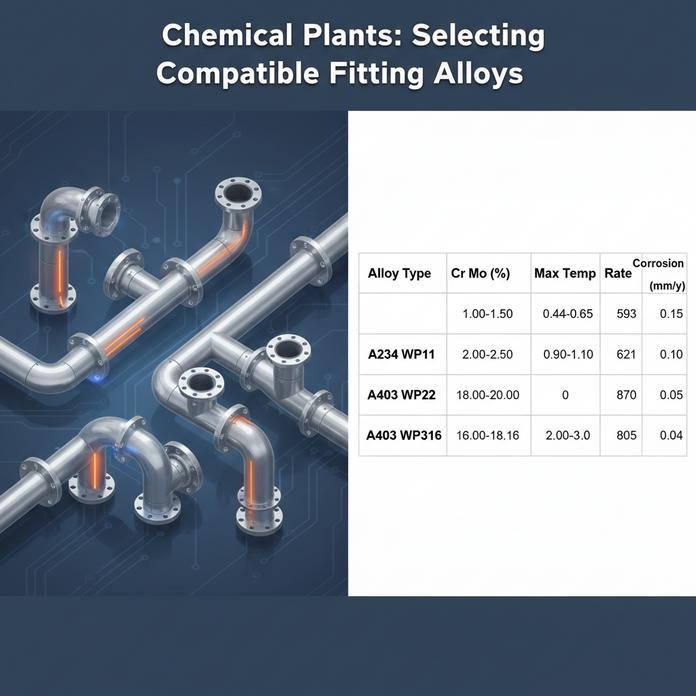
Typical comparison data used in plant audits:
| Material Grade | Cr (%) | Mo (%) | Max Temp (°C) | Corrosion Rate (mm/y) |
|---|---|---|---|---|
| A234 WP11 | 1.0–1.5 | 0.44–0.65 | 550 | 0.12 |
| A234 WP22 | 2.0–2.5 | 0.87–1.13 | 600 | 0.09 |
| A403 WP304 | 18–20 | — | 870 | 0.18 |
| A403 WP316 | 16–18 | 2–3 | 870 | 0.05 |
For stable supply and tight tolerance pipe fittings, many buyers turn to yuuhuan hongqian, known for consistent alloy control.
ASTM A403 WP316 Elbows: Chloride Stress-Crack Prevention
ASTM A403 WP316 Elbows are common in saline transfer. High chloride? That’s where Stainless Steel with molybdenum shines.
Key checks include:
- Chloride concentration below 200 ppm for long service life
- Smooth internal finish to limit crevice attack
- Proper post-weld heat treatment on weld fittings
In coastal plants, small upgrades matter. Switching from 304 to WP316 in steel pipe fittings often cuts stress-related cracking fast. Good fabrication, tight radii, and certified pipe connectors keep corrosion resistance steady. yuuhuan hongqian supplies WP316 elbows aligned with ASME specs, fitting both chemical reactors and marine skid systems.
Corrosion-Resistant Nipples and Caps: Marine vs. Chemical Processing Standards
Selecting Corrosion-Resistant Nipples and Caps depends on service context.
A. Marine Standards
- Salt spray exposure
- ASTM B117 testing
- Material Selection
- 316 stainless preferred
- Galvanized only for low-splash zones
B. Chemical Processing
- Media Type
- Acidic → stainless steel pipe fittings
- Caustic → alloy steel options
- Environmental Factors
- Indoor dry
- Outdoor humid
Quick checklist engineers like:
- ✓ Confirm DIN or ASME rating
- ✓ Match pipe fittings schedule
- ✓ Verify traceability
For consistent steel pipe fittings supply across both marine and plant standards, yuuhuan hongqian keeps specs tight and delivery practical.
FAQs about Steel Pipe Fittings
What defines high-quality steel pipe fittings for industrial systems?
Quality in steel pipe fittings shows up long before installation.
1) Material strength
- Carbon Steel and ASTM A234 WPB for heavy-duty lines
- Stainless Steel such as ASTM A403 WP304 / WP316 for corrosion control
2) Dimensional discipline
- ASME B16.9 for Butt-weld Elbow and Tee
- ASME B16.5 for Flange connections
- MSS SP-75 or DIN Standard for large-diameter pipelines
3) Pressure alignment
- Schedule 40 for general service
- XS or XXS for extreme loads
- Class 150 Flanged systems in controlled environments
When Elbow, Reducer, or Cap dimensions drift even slightly, misalignment spreads through the entire line. Precision keeps welds tight, flow stable, and downtime low.
How do connection types impact performance in different industries?
Connection choice shapes safety, speed, and future maintenance.
- Butt-weld → Permanent strength for Oil and Gas and Power Generation
- Threaded / Socket-weld → Flexible assembly in Water Treatment and Construction
- Flanged or Grooved → Fast disassembly in Marine and Chemical Processing plants
In high-pressure lines using Schedule 80 or Schedule 160, a Butt-weld Tee or Nipple reduces leak risk.
For smaller-diameter Coupling installations, Threaded fittings allow quick replacement without cutting pipe.
The tension lies between permanence and flexibility—choose based on pressure, temperature, and access for service crews.
How can buyers match material and surface treatment to harsh conditions?
Material and coating work together; one without the other can fail under stress.
| Application Industry | Recommended Material | Surface Treatment |
|---|---|---|
| Oil and Gas | ASTM A234 WPB | Black Paint or Anti-rust Oil |
| Chemical Processing | ASTM A403 WP316 | Epoxy Coating |
| Marine | Stainless Steel | Galvanized or Epoxy Coating |
| Construction | Carbon Steel | Galvanized |
For Stainless Steel systems, Pickling and Passivation clean the surface before operation begins.
In corrosive zones, a Reducer or Flange without coating may pit quickly, even if the base material meets ASME B16.11 standards.
The right pairing protects not just a single Elbow or Cap—but the life of the entire pipeline.