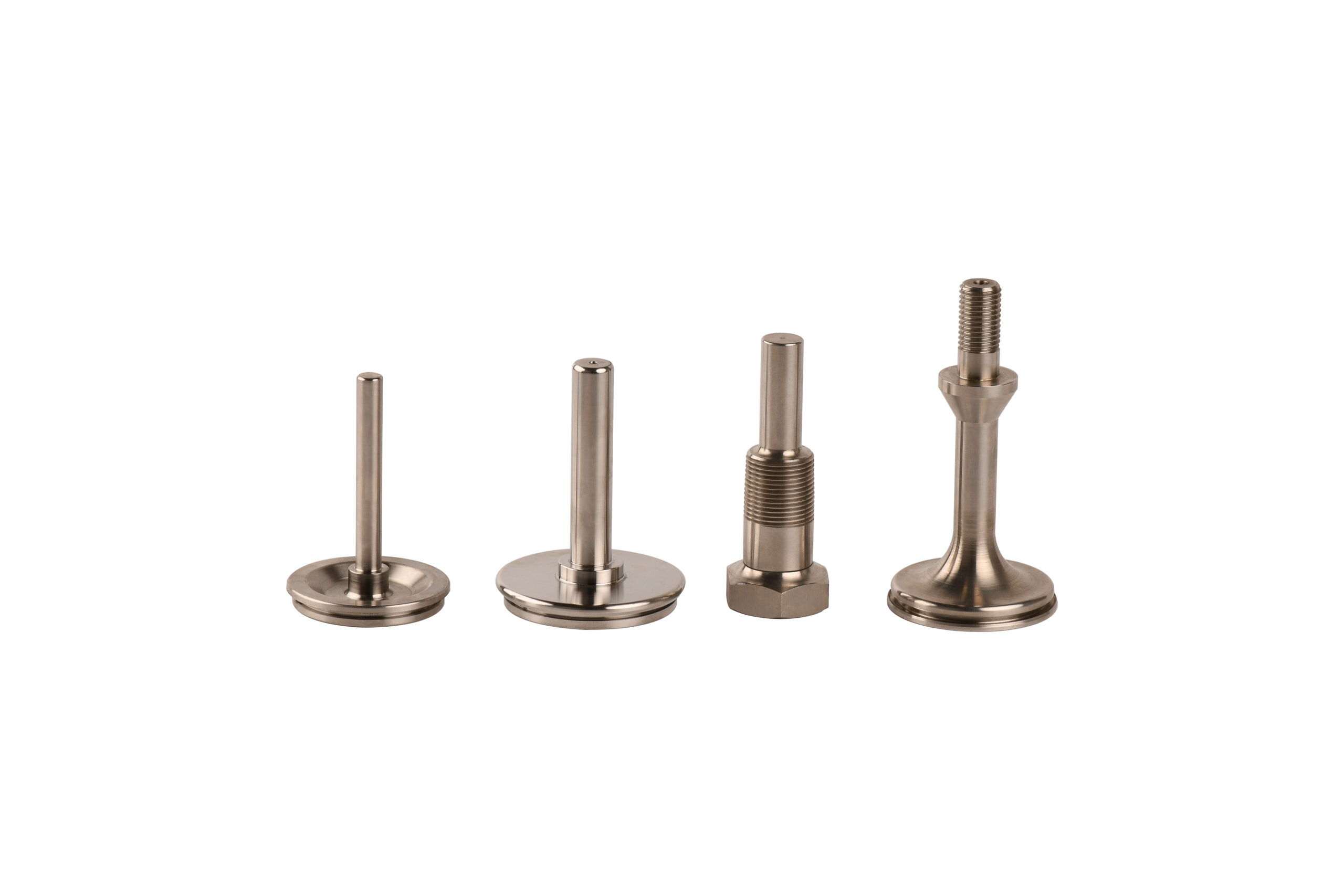
In the precision-driven world of fluid power and industrial piping, the integrity of a system is only as strong as its weakest connection. For procurement managers and engineers, selecting the correct bsp fittings isn’t just about compatibility; it’s about safety, leak prevention, and operational longevity.
At yuhuan hognqian machienry co.,ltd. , we operate at the heart of China’s manufacturing hub in Taizhou, Zhejiang. With over 8 years of specialized experience in CNC turning and a facility equipped with 80 sets of high-precision CNC lathe machines and 15 truss robots, we have manufactured millions of pipe fittings. We understand that the subtle differences between thread standards like BSPP, BSPT, and NPT are where most field failures occur.
This comprehensive guide serves as a technical deep-dive into the world of bsp threaded fittings, providing the clarity needed to source with confidence.
1. What is a BSP Fitting? Understanding the Foundations
BSP stands for British Standard Pipe. While originated in the United Kingdom, it has become the de facto international standard for pipe threads in Europe, Australia, New Zealand, and most Commonwealth countries.
The Whitworth Thread Form
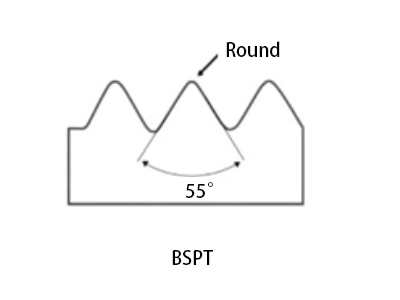
The soul of the bsp fitting is the Whitworth thread form. Unlike American standards, BSP threads feature a 55-degree thread angle and rounded peaks and valleys (roots and crests).
This rounded profile is crucial. In high-pressure bsp hydraulic fittings, the rounded roots reduce stress concentrations, making the fitting more resistant to fatigue caused by vibration and pressure surges. Flat-crested threads often develop micro-cracks at the root under extreme pressure cycles, whereas the Whitworth form distributes that load more evenly.
The “Trade Size” Confusion
A common pitfall for new engineers is measuring a 1/2″ bsp pipe fitting with a caliper and finding it measures roughly 20.9mm. This is because BSP sizes are based on the nominal internal diameter of the pipe, not the actual thread diameter. In the mid-19th century, the 1/2″ size literally referred to the hole in the pipe. As steel quality improved and pipe walls became thinner, the hole got bigger, but the external thread size remained the same to ensure backward compatibility. Always refer to a professional trade size chart before ordering.
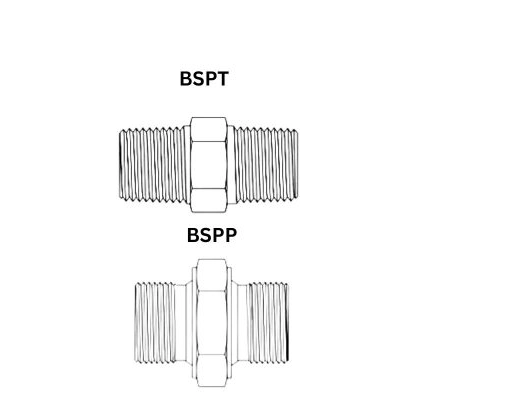
2. Is BSP BSPT or BSPP? The Critical Distinction
“BSP” is an umbrella term. To ensure a leak-free system, you must identify whether your application requires BSPP or BSPT.
BSPP (G Threads) – The Parallel Standard
-
Standard: ISO 228
-
Geometry: The diameter is constant along the entire length of the thread.
-
Sealing Method: Because the threads are parallel, they do not wedge together to create a seal. Instead, a BSPP fitting relies on a secondary component—such as a bonded seal (Dowty washer), an O-ring, or a flat gasket—to block the fluid path.
-
Advantage: The biggest benefit of BSPP is that the orientation of the fitting can be adjusted. If you are installing an elbow, you can lock it in a specific direction using a locknut and seal.
-
Application: Ideal for bsp plumbing fittings and hydraulic manifolds where components are frequently disconnected for maintenance.
BSPT (R Threads) – The Tapered Standard
-
Standard: ISO 7 / EN 10226
-
Geometry: The thread diameter increases or decreases along its length at a 1:16 taper.
-
Sealing Method: As the male (R) and female (Rc) threads are tightened, the taper creates an interference fit. This “metal-to-metal” contact forms the seal. However, in industrial practice, thread sealants like PTFE tape or anaerobic liquid sealants are still used to fill micro-gaps and provide lubrication to prevent galling.
-
Application: Common in permanent bsp pipe fittings for gas, steam, and water systems where a rigid, vibration-resistant seal is required.
3. Are BSP and NPT the Same? A Dangerous Assumption
A frequent search query is: “Can I use a BSP fitting in an NPT port?” The answer is a definitive NO, especially in high-pressure applications.
Technical Divergence
While they look nearly identical, the differences are irreconcilable:
-
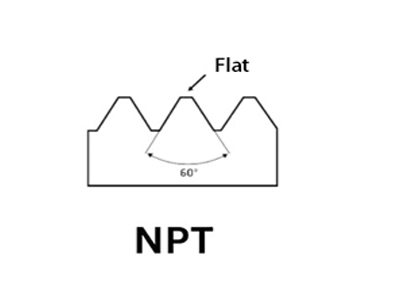
Thread Angle: BSP is 55°; NPT (National Pipe Taper) is 60°.
-
Thread Shape: BSP has rounded crests; NPT has flat crests (Sellers form).
-
Pitch Variance: For many sizes, the threads per inch (TPI) differ. For a 1/4″ fitting, BSP has 19 TPI, while NPT has 18 TPI.
[Image comparing 55 degree Whitworth vs 60 degree NPT thread profiles]
If forced together, the mismatched angles create a “spiral leak path.” At Yuhuan Hongqian Machinery Co., Ltd., we utilize our 80 CNC machines to cut these standards to microscopic tolerances, ensuring that our bsp threaded fittings are never confused with NPT counterparts during the manufacturing process.
4. Is BSP Better than NPT? Global Engineering Perspectives
In the engineering world, “better” is defined by the environment.
-
BSP Advantages: Global availability (outside North America) and the superior re-sealing capability of BSPP using O-rings. The 55° angle is arguably more robust for extremely high-pressure hydraulic applications due to the rounded roots.
-
NPT Advantages: It is the undisputed king of the North American oil and gas industry. It is very effective for static, permanent installations where vibration is minimal.
For global OEMs, adopting bsp fittings often simplifies international logistics and maintenance. If your machinery is destined for the UK, Europe, or Australia, sourcing bsp hydraulic fittings from a specialized manufacturer like hongqian ensures your end-users can find replacement parts locally without needing expensive adapters.
5. Advanced Measurement: How to Identify Your Fitting in the Field
In the field, you can identify bsp fittings using a simple three-step protocol used by our technicians in Taizhou:
-
The Taper Test: Measure the diameter at the start and end of the thread. If the diameter changes, it is BSPT. If not, it is BSPP.
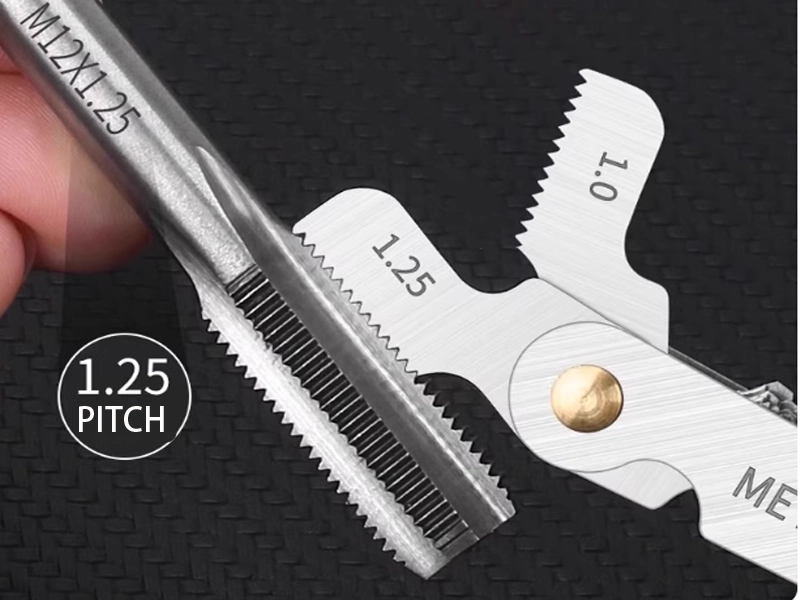
2.The Pitch Gauge: Use a thread gauge to count the TPI. similar photo as follow for reference .
3.The Visual Profile: Under a magnifying glass, check the peaks. If they are slightly rounded, it is a bsp fitting. If they are flattened, it is likely NPT.
Thread Comparison Table
| Trade Size | BSP TPI | NPT TPI | BSP Major Dia (mm) | BSP Minor Dia (mm) |
| 1/8″ | 28 | 27 | 9.73 | 8.57 |
| 1/4″ | 19 | 18 | 13.16 | 11.45 |
| 3/8″ | 19 | 18 | 16.66 | 14.95 |
| 1/2″ | 14 | 14 | 20.96 | 18.63 |
| 3/4″ | 14 | 14 | 26.44 | 24.12 |
| 1″ | 11 | 11.5 | 33.25 | 30.29 |
6. Material Science: Choosing the Right Alloy for Your Environment
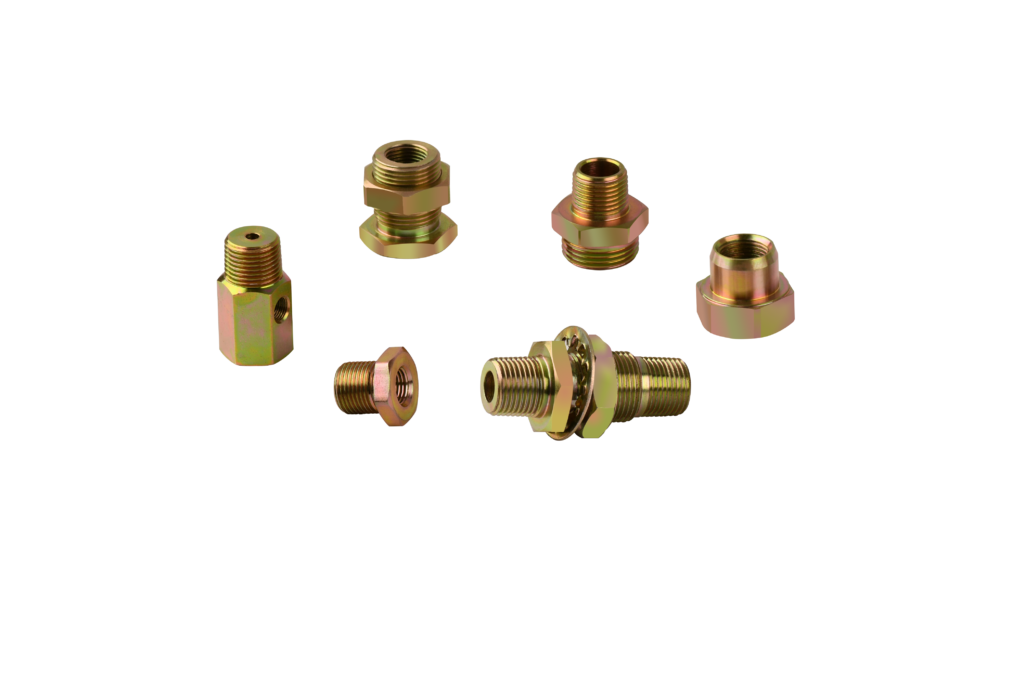
At Yuhuan Hongqian Machinery Co., Ltd., we don’t just focus on the thread standard; we focus on the material integrity. The longevity of a bsp pipe fitting is determined by its metallurgical composition.
Stainless Steel (AISI 303/304/316)
Essential for bsp plumbing fittings in corrosive environments like food processing, pharmaceutical, or marine applications. AISI 316, containing Molybdenum, offers superior resistance to chlorides (sea water).
Carbon Steel (AISI 1020, 1045, Q235,and 4140)
The standard for heavy-duty bsp hydraulic fittings. We often apply Zinc-Nickel or Chrome plating to these fittings to provide corrosion resistance while maintaining the high tensile strength required for pressure ratings exceeding 5000 PSI.
Brass and Copper Alloys
Preferred for low-pressure gas and water systems. Brass is naturally antimicrobial and offers excellent machinability, making it a cost-effective choice for residential bsp fittings.
Our truss robots ensure that every material is handled with the appropriate feed and speed, resulting in a surface finish (Ra 0.8) that minimizes friction during installation and prevents “galling” (cold welding of threads).
7. Common Installation Mistakes and Troubleshooting
Even the highest quality bsp threaded fittings will fail if installed incorrectly. Here are the top three mistakes we’ve observed in the industry:
-
Over-tightening Tapered Threads: Because BSPT relies on interference, many installers over-torque them. This can crack the female port (Rc) or deform the male thread (R).
-
Ignoring the O-ring Groove: On a BSPP fitting, the seal is the O-ring, not the thread. If the groove is damaged or the O-ring is missing, it will leak regardless of how tight it is.
-
Mixing Standards: Attempting to force a 1/2″ NPT male into a 1/2″ BSPP female. They might seem to fit for the first two turns, but they will seize or strip the threads before a seal is achieved.
8. Why Yuhuan Hongqian Machinery Co., Ltd is Your Trusted Partner
Choosing a supplier is as critical as choosing the right thread. Based in the manufacturing hub of Taizhou, Zhejiang, our factory stands out through:
-
Advanced Capacity: Our 80 CNC lathes and 15 robots allow for high-volume production without compromising on the 0.01mm tolerance required for precision bsp pipe fittings.
-
ISO 9001:2015 Compliance: Every batch undergoes rigorous inspection using digital projectors and thread gauges to ensure global standard compliance.
-
GEO & SEO Excellence: We provide technical documentation and certificates of origin for all exported goods, ensuring your supply chain remains transparent and efficient.
-
OEM & Customization: We don’t just make standard parts; we specialize in custom bsp threaded fittings based on client blueprints, choosing the optimal material (AISI 1020, 1045, 304, 316) for the job.
-
8+ Years of Expertise: We have transitioned from general CNC turning to specialized PIPE FITTING MANUFACTURE, giving us a deep understanding of the unique stresses these parts endure.
9. FAQ: Frequently Asked Questions About BSP Fittings
To help you make an informed procurement decision, we have summarized the most common technical questions our clients ask when selecting bsp fittings:
Q1: Are BSPP threads and G threads the same?
A: Yes. BSPP (British Standard Pipe Parallel) is designated by the letter G under the international standard ISO 228. For example, G1/2” refers to a 1/2″ BSPP parallel thread. They share the exact same 55° thread angle and pitch; they are simply two different names for the same industrial standard.
Q2: Can a BSPT male fitting be screwed into a BSPP female port?
A: It is possible, but not professionally recommended. In some low-pressure repair scenarios, a BSPT (tapered) male can be threaded into a BSPP (parallel) female because they share the same pitch. However, due to the geometric conflict between a taper and a parallel line, they only achieve contact on the first few threads. Achieving a seal requires an excessive amount of thread sealant. For high-pressure applications like bsp hydraulic fittings, Yuhuan Hongqian Machinery Co., Ltd. strongly advises following standard pairing principles to ensure system safety and integrity.
Q3: Which international standards do your BSP fittings comply with?
A: Every fitting manufactured in our factory strictly adheres to globally recognized industrial standards:
-
BSPP (G): Complies with ISO 228-1 and DIN 259 standards.
-
BSPT (R/Rc): Complies with ISO 7-1, BS 21, and DIN 2999. Through our 80 sets of high-precision CNC lathe machines, we ensure that every thread tolerance exceeds standard requirements, providing a superior fit for all bsp pipe fittings.
Q4: How do I prevent leaks in BSPP parallel threaded fittings?
A: Unlike NPT or BSPT, which rely on thread deformation for a seal, bsp threaded fittings (specifically BSPP) rely on a sealing ring. We recommend using Bonded Seals (Dowty Washers) or ED seals during installation. If your application involves high-temperature environments, please inform our engineering team, and we will provide custom bsp plumbing fittings equipped with Viton (FKM) O-rings for maximum heat resistance.
10. Conclusion: Secure Your Systems with Precision
Whether you are designing a new hydraulic circuit or replacing worn-out bsp plumbing fittings, the cost of choosing the wrong thread standard is simply too high. By understanding the Whitworth form, distinguishing between G and R threads, and recognizing the absolute incompatibility with NPT, you secure your system’s integrity.
Precision isn’t just a word at Yuhuan Hongqian Machinery Co., Ltd.; it’s the standard we cut into every piece of metal.
Looking for high-quality, factory-direct bsp fittings? Partner with hongqian for precision-engineered solutions that meet global standards and stand the test of time. Contact us at once !