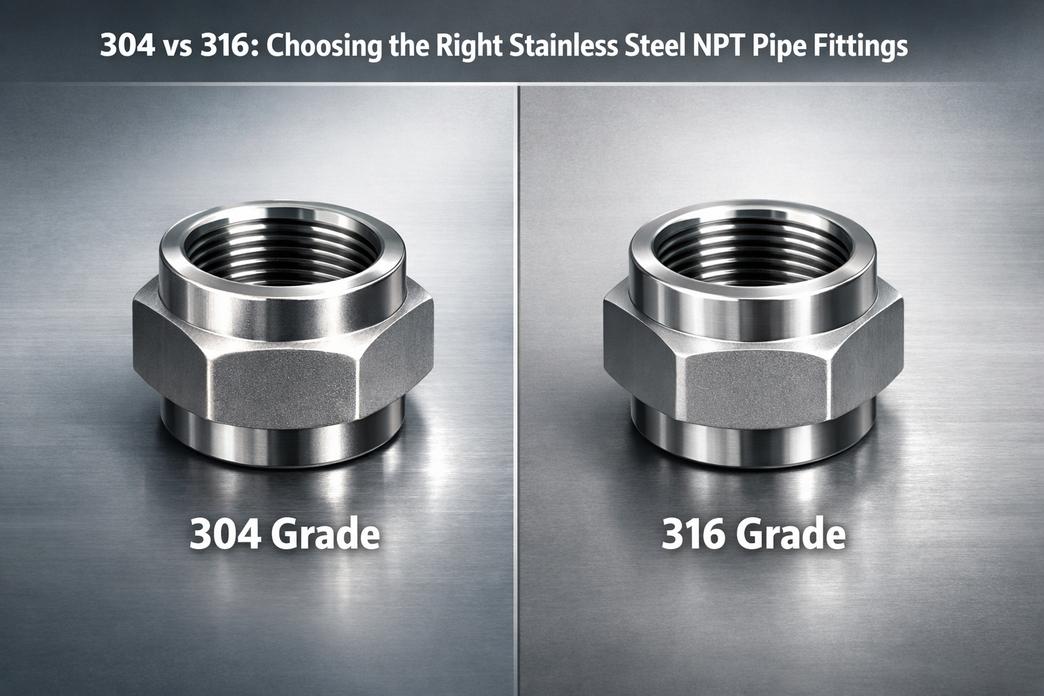
Selecting the right stainless steel fittings 304 vs 316 is the critical engineering decision that determines whether an industrial fluid handling system maintains long-term structural integrity or fails prematurely from localized chemical corrosion. Both alloys belong to the 300-series austenitic family, yet their distinct chemical compositions make choosing between 304 stainless steel fittings and marine-grade 316 stainless steel fittings a direct trade-off between upfront material costs and long-term operating reliability.
Understanding the metallurgical differences, fabrication considerations, and specification standards behind these stainless steel fittings ensures engineers, system integrators, and procurement teams match the correct metal to the application without overspending.
Chemical Composition: What Distinguishes SS 304 Fittings from 316?
The core performance difference between ss 304 fittings and 316-grade components lies in their underlying chemistry, specifically the inclusion of molybdenum:
| Chemical Element | 304 Stainless Steel (wt %) | 316 Stainless Steel (wt %) | Primary Functional Impact |
| Chromium (Cr) | 18.00% – 20.00% | 16.00% – 18.00% | Forms passive chromium-oxide (Cr2O3) barrier to resist general oxidation. |
| Nickel (Ni) | 8.00% – 10.50% | 10.00% – 14.00% | Stabilizes the non-magnetic austenitic crystal lattice; enhances ductility. |
| Molybdenum (Mo) | None (Trace only) | 2.00% – 3.00% | Dramatically elevates resistance to chlorides, pitting, and crevice attack. |
| Carbon (C) | ≤ 0.08% (≤ 0.03% in 304L) | ≤ 0.08% (≤ 0.03% in 316L) | Lower levels prevent harmful chromium carbide precipitation during welding. |
The 2% to 3% molybdenum in 316 stainless steel fittings provides a significant boost in Pitting Resistance Equivalent Number (PREN). While 304 has an average PREN of roughly 18 to 20, 316 achieves a PREN between 23 and 25, delivering superior protection against high-chloride media like saltwater, de-icing salts, and industrial chemical solvents.
304 Stainless Steel Pipe Fittings: Performance and Ideal Applications
Type 304 is the most versatile and globally specified austenitic stainless steel. For projects operating in controlled environments without direct exposure to harsh acids or marine atmospheres, 304 stainless steel pipe fittings represent the most cost-effective and dependable piping hardware on the market.
Key Advantages:
-
Broad Media Resistance: Resists oxidation from atmosphere, potable water, and mild acids.
-
Excellent Machinability and Formability: Ideal for threading, cold heading, and precision CNC turning.
-
Cost Efficiency: Avoiding molybdenum keeps the raw material cost significantly lower than 316.
Typical Applications for 304 SS Pipe Fittings:
-
Commercial plumbing and municipal potable water supply networks
-
Dairy, food, and beverage processing equipment requiring hygienic sanitation
-
Low-pressure hydraulic fluid lines and indoor architectural piping
-
Storage tanks and general industrial transfer lines
Where harsh chlorides are absent, 304 ss pipe fittings deliver decades of dependable, corrosion-free service.
316 Stainless Steel Fittings: Engineered for Severe Environments
When fluid processing systems encounter aggressive chemicals, marine salt air, or harsh cleaning protocols, relying on 304 leads to rapid pitting and micro-leaks. In these challenging operational envelopes, deploying 316 stainless pipe fittings is essential for plant safety.
Key Advantages:
-
Superior Resistance to Pitting and Crevice Corrosion: Molybdenum prevents localized passive film breakdown in chloride-rich environments.
-
Resistance to Chemical Attack: Withstands exposure to sulfuric acid, acetic acid, bromides, iodides, and fatty acids at elevated temperatures.
-
Cryogenic Toughness: Maintains excellent impact strength and ductility down to deep cryogenic temperatures.
Common Applications for 316 Stainless Steel Fittings:
-
Offshore drilling rigs, marine hardware, and coastal seawater intake lines
-
Pharmaceutical cleanroom fluid networks and active pharmaceutical ingredient (API) processing
-
Chemical manufacturing, pressure vessels, and acidic transfer piping
-
High-salinity food production lines (such as brine and soy sauce processing)
When specifying a stainless steel fitting for marine exposure or aggressive chemical transport, upgrading to 316 prevents costly downtime and unexpected pipe failures.
Material Grades: Straight, Low Carbon (L), and Dual Grades
When engineering stainless pipe and fittings, you will encounter specific grade designations on material certifications:
-
Straight Grade (304 / 316): Standard formulation with up to 0.08% carbon. Suitable for high-temperature service where mechanical creep resistance is required, but susceptible to carbide precipitation along weld heat-affected zones (HAZ).
-
Low Carbon Grade (304L / 316L): Restricts carbon to ≤ 0.03%. This prevents chromium carbide formation during welding, preserving the chromium-oxide protective film without requiring post-weld solution annealing.
-
Dual Grade (304/304L and 316/316L): Modern steelmaking practices allow the chemical composition to satisfy the ≤ 0.03% low-carbon limit of the L-grade while meeting the higher mechanical tensile and yield strength requirements of straight grades. Dual-certified stock is the industry standard for precision CNC turned stainless pipe fittings.
Quality Assurance & Material Traceability for Stainless Steel Pipes Fittings
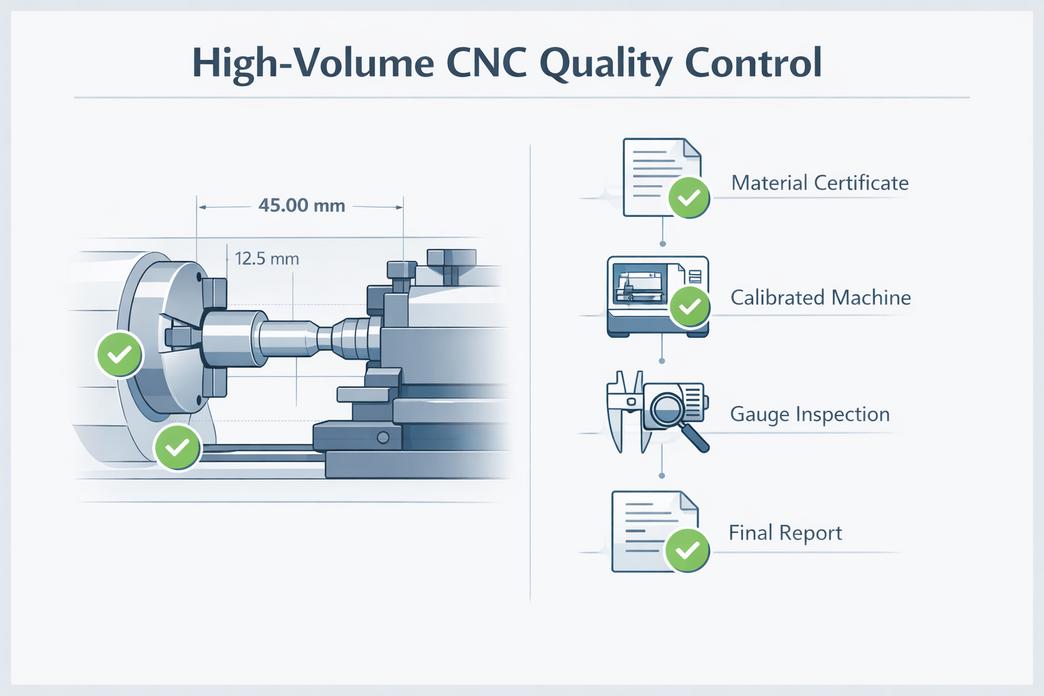
Because 304 and 316 look identical to the naked eye, material mix-ups during production can lead to catastrophic site failures. Reputable manufacturing facilities enforce rigid quality protocols across all stainless steel pipes fittings:
-
Positive Metal Identification (PMI): Handheld X-ray fluorescence (XRF) analyzers measure the exact elemental percentages of incoming raw bar stock and finished components. Verifying the 2.0% to 3.0% molybdenum content ensures that 304 and 316 are never cross-contaminated on the shop floor.
-
Material Test Reports (MTRs): Certified EN 10204 3.1 mill test certificates document the precise chemical analysis, tensile strength, yield strength, elongation, and heat-treatment batch data. This documentation guarantees that components fully conform to ASTM, ASME, and ANSI piping codes.
Frequently Asked Questions (FAQ)
Can you tell 304 and 316 stainless steel fittings apart by appearance or weight?
No. Both alloys have identical densities (approximately 8.0 g/cm³), identical luster, and identical surface textures after CNC machining. The only reliable method to differentiate them is through chemical spot tests, laboratory spectrometry, or non-destructive Positive Metal Identification (PMI).
Are 304 and 316 stainless steel pipe fittings magnetic?
In their annealed state, both 304 and 316 are austenitic and completely non-magnetic. However, aggressive cold working (such as cold heading, thread rolling, or heavy CNC turning) can transform a portion of the austenite into deformation martensite, inducing slight magnetic permeability. This magnetic response does not compromise corrosion resistance and can be eliminated through solution annealing.
Can 304 stainless steel fittings be welded to 316 stainless steel pipe?
Yes. Dissimilar welding between 304 and 316 is common in industrial fabrication. It is typically performed using an over-alloyed filler metal, such as 309L or 316L wire, to maintain joint ductility and prevent localized galvanic acceleration across the weld seam.
Why did my 304 stainless pipe fittings develop rust spots outdoors?
While 304 resists general weather conditions, airborne chlorides (from coastal winds or winter road de-icing salts) break down its passive layer, causing localized pitting known as “tea staining.” For outdoor installations within 10 km of the coastline, 316 stainless pipe fittings should always be specified.
Source Precision-Turned Stainless Pipe Fittings Direct from the Factory
Choosing between 304 and 316 depends on operating chemistry, temperature, and environmental exposure. Matching the correct alloy to your fluid handling specifications prevents premature component failure and avoids unnecessary raw material costs.
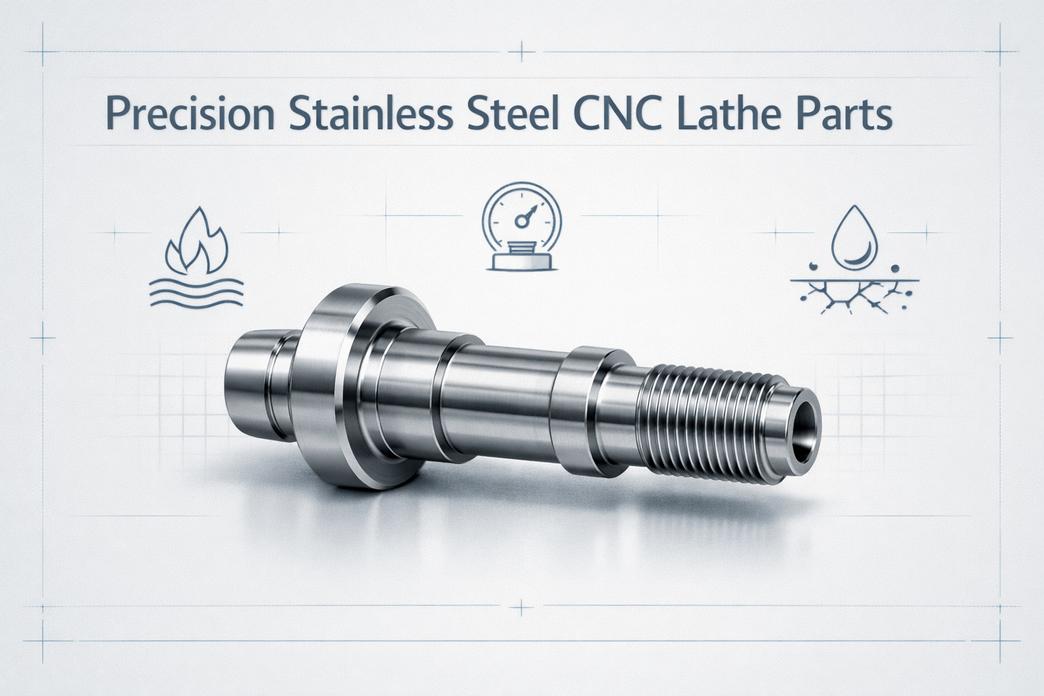
As an experienced OEM/ODM manufacturer specializing in precision CNC machining, we produce custom and standard 304 stainless steel fittings, high-pressure 316 stainless steel fittings, and complex threaded connectors. Our workshop maintains 100% material traceability with full MTR documentation, rigorous in-house PMI inspections, and dimensional tolerances down to ± 0.01 mm.
We sign mutual Non-Disclosure Agreements (NDAs) prior to evaluating proprietary designs. Upload your 2D blueprints and 3D CAD files today for an immediate DFM manufacturability review and a competitive factory quotation.