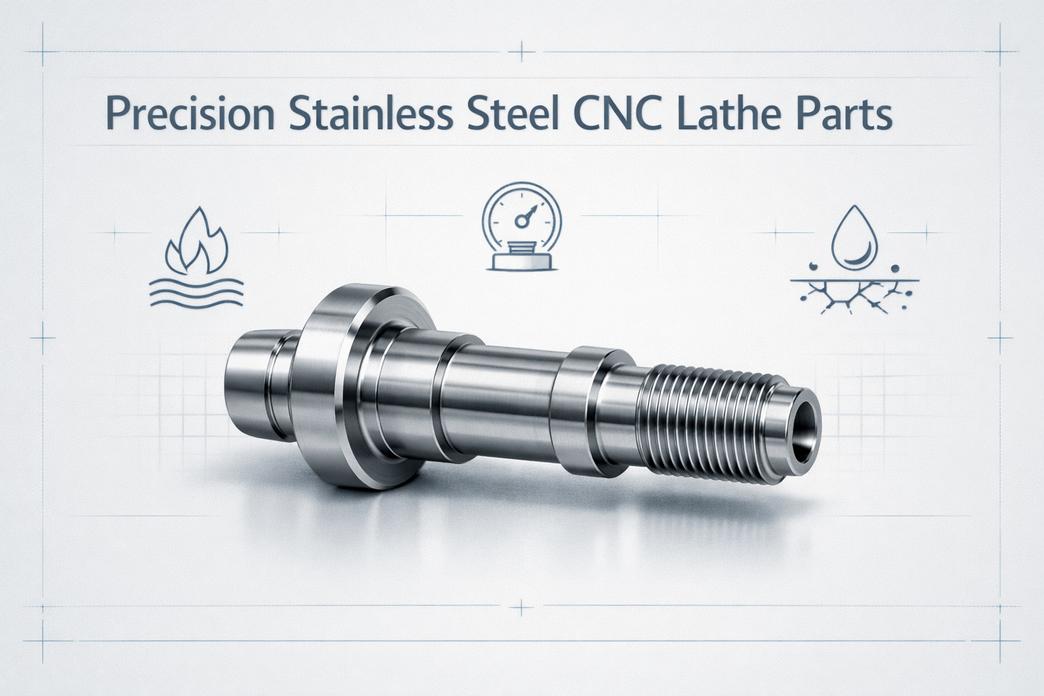
When production lines start groaning and cheap components tap out early, lathe cnc parts step in like the steady-handed mechanic who never misses a beat. In heavy industry, stainless steel isn’t just metal—it’s peace of mind spun on a precision axis. Corrosion, pressure, heat? Bring it on.
Factories don’t lose money in dramatic explosions. It’s the slow drip—misalignment, surface wear, downtime at 2 a.m. That’s where custom CNC-turned parts earn their keep: tight tolerances, smooth finishes, zero guesswork.
This isn’t about shiny hardware. It’s about parts that show up, hold steady, and keep your operation humming.
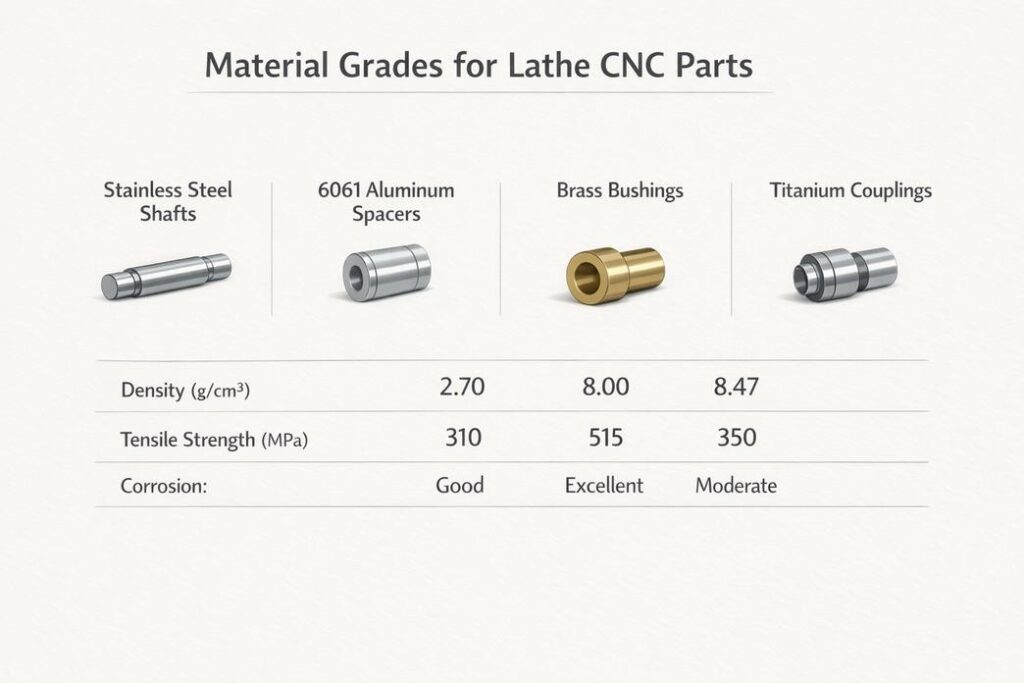
Material Grades Explained For Lathe CNC Parts
Choosing the right material for lathe cnc parts can feel like picking the right tires for a race car—get it wrong, and performance drops fast. From cnc lathe components to custom turned parts, material grade shapes strength, lifespan, and cost.
Why Stainless Steel Shafts Excel in High-Corrosion Environments
When producing lathe cnc parts like shafts, material choice directly affects service life in high-corrosion environments.
- Core Material Advantage
- Stainless steel stands out for its strong corrosion resistance.
- Passive chromium oxide layer blocks moisture and chemical attack.
- Stable material properties reduce distortion during precision turning.
- Stainless steel stands out for its strong corrosion resistance.
- Design Performance in CNC Lathe Parts
- Cylindrical and tapered shafts maintain:
- Concentricity
- Surface runout control
- Dimensional stability
- Cylindrical and tapered shafts maintain:
- Industrial Applications
- Marine drive systems
- Energy sector pumps
- Hydraulic actuators
For mechanical components exposed to salt spray or acidic media, stainless steel cnc turned parts simply last longer. Shops producing lathe cnc parts for these uses often prioritize surface finishing and passivation. Brands like yuhuan hongqian fine-tune machining allowances to keep tolerances tight while protecting surface integrity.
Aluminum Alloy Spacers: Lightweight yet Durable Solutions
In high-speed assemblies, weight matters. That’s where aluminum alloy earns its reputation in lathe cnc parts.
- High strength-to-weight ratio
- Excellent machinability on cnc lathe machines
- Reliable corrosion resistance after anodizing
For spacers used in robotics or automotive modules, lighter mass reduces vibration and energy loss. Anodized layers also improve durability, especially in humid conditions.
| Property | 6061 Aluminum | 304 Stainless | Brass C360 |
|---|---|---|---|
| Density (g/cm³) | 2.70 | 8.00 | 8.47 |
| Tensile Strength (MPa) | 310 | 515 | 350 |
| Corrosion Resistance | Good | Excellent | Moderate |
Compared with heavier cnc machining parts, aluminum spacers cut load without sacrificing positioning accuracy. For buyers sourcing bulk lathe cnc parts, this balance keeps costs and performance aligned.
Brass Bushings Balancing Conductivity with Wear Resistance
In rotating assemblies, bushings handle constant motion.
- Functional Requirements
- Smooth shaft support
- Stable internal diameter
- Consistent Ra finish
- Why brass Works
- Strong electrical conductivity
- Natural friction reduction
- Reliable wear resistance
- Material Behavior in Bearing Components
- Absorbs minor misalignment
- Reduces galling
- Protects mating shafts
For bearing components inside motors or control units, brass cnc lathe parts deliver steady performance. Reamed bores maintain roundness, which keeps rotating systems quiet and efficient. In many cnc lathe parts catalogs, brass remains a go-to option when both conductivity and mechanical stability matter.
Titanium Couplings Meeting Aerospace and Defense Standards
When loads spike and weight limits tighten, titanium changes the game for advanced lathe cnc parts.
- Material Strength
- Exceptional high strength
- Superior fatigue resistance
- Environmental Stability
- Handles extreme conditions
- Resists corrosion in aerospace fuel systems
For couplings in the aerospace industry and defense sector, precision boring ensures profile tolerance and concentric alignment. Titanium cnc machining parts cost more, sure—but the payoff comes in lighter aircraft structures and longer service cycles.
Manufacturers like yuhuan hongqian apply strict inspection protocols to titanium cnc lathe components, ensuring each coupling meets demanding aerospace load standards. In critical systems, material grade isn’t just a spec on paper—it’s peace of mind built into every lathe cnc part.
Lathe CNC Parts Cost-Saving Strategies Revealed
Precision matters, but so does cost. When producing lathe cnc parts, smart planning around materials, tolerances, and machining flow keeps budgets under control. Here’s how shops cut waste while keeping CNC lathe parts reliable and consistent.
Bulk Purchasing Stainless Steel Flanges for Volume Discounts
Managing stainless steel flanges for lathe cnc parts becomes far cheaper when purchasing focuses on volume discounts and stable materials sourcing.
- Material Planning
- Raw components standardization
- Unified outer diameter for easier chucking
- Pre-defined facing allowance
- Surface prep
- Passivation batch processing
- Shared polishing cycles
- Raw components standardization
- Supplier Strategy
- Long-term pricing tiers
- 500–1,000 pcs
- 1,000–5,000 pcs
- 5,000+ pcs
- Locked steel grade for repeat CNC turning parts
- Long-term pricing tiers
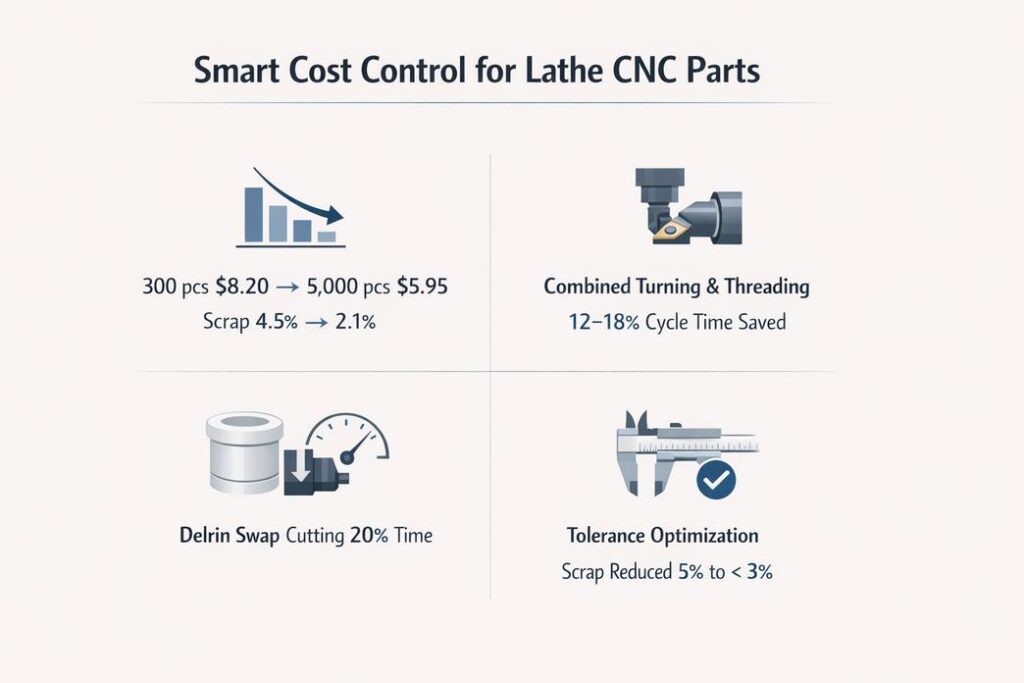
| Order Volume (pcs) | Unit Cost (USD) | Setup Cost (USD) | Scrap Rate (%) |
|---|---|---|---|
| 300 | 8.20 | 420 | 4.5 |
| 800 | 7.40 | 420 | 3.8 |
| 2,000 | 6.60 | 420 | 2.9 |
| 5,000 | 5.95 | 420 | 2.1 |
For suppliers like yu
huan hongqian, consolidating stainless batches means fewer tool swaps and smoother lathe runs. Less downtime. More stable lathe cnc parts output.
Combining Turning and Threading to Minimize Setup Costs
When turning and threading are merged in one machining cycle, setup costs drop fast and manufacturing processes gain real efficiency.
- Process Integration
- Single clamping strategy
- Rough turning
- Finish turning
- Internal or external threading
- Tool turret sequencing
- Single clamping strategy
- Clamp raw bar.
- Complete diameter control.
- Cut thread profile without re-positioning.
- Inspect concentricity inline.
This approach improves shaft accuracy for lathe cnc parts and reduces operator hours. Shops producing CNC lathe components for hydraulics or automotive lines often save 12–18% in total cycle time. yuhuan hongqian applies this flow to carbon steel fittings, keeping cnc turning parts consistent and cost-friendly.
When Delrin Sleeves Can Replace Aluminum Alloy Alternatives
Switching from aluminum alloy to Delrin sleeves in non-load engineering components can be a smart move.
- Application Fit
- Electronics spacers
- Robotics bushings
- Light-duty housings
- Cost Comparison
- No anodizing
- Reduced tool wear
- Faster feed rates
Lower weight. Lower friction. Lower post-processing.
For certain lathe cnc parts, plastic machining shortens cycle time by up to 20%. CNC lathe parts used as insulating collars benefit from Delrin’s dimensional stability. That swap trims both machining hours and finishing steps without hurting performance.
Tightening Tolerance Windows to Cut Scrap and Rework
Overly strict tolerances drive scrap and rework. Smart quality control balances precision with real-world fit, cutting waste reduction costs in manufacturing.
- Tolerance Mapping
- Functional surfaces
- Bearing seats: ±0.01 mm
- Thread pitch: ISO grade aligned
- Non-critical faces
- Relaxed to ±0.05 mm
- Functional surfaces
- Inspection Planning
- In-process gauging
- Final sampling instead of 100% checks
Shops producing high-volume lathe cnc parts often see scrap drop from 5% to under 3% once drawings match actual load demands. CNC turning parts don’t need aerospace-level tightness for every face.
Working with experienced suppliers like yuhuan hongqian helps customers align tolerance grades with application reality. The result? Fewer rejected cnc machined parts, faster delivery, and margins that don’t get eaten alive by unnecessary perfection.
4 Steps To Optimize Turn-Around For Bulk CNC Orders
Bulk orders for lathe cnc parts can move fast—or drag forever. It really comes down to planning, coordination, and tight quality checks. When machining lathe cnc parts, CNC lathe components, and precision turned parts at scale, small delays stack up quickly. Here’s how smart shops like yuhuan hongqian keep things smooth and predictable.
Streamlining Drawing Reviews to Define Critical Features
- Core review focus
- design specifications
- engineering drawings
- feature identification
- Technical validation layer
- tolerance analysis for concentric shafts
- dimensional accuracy checks on stepped diameters
- Surface finish Ra confirmation
- Cross-check with quality control standards
- Risk control mapping
- Critical-to-function zones
- Bearing seats
- Thread roots
- Alignment-critical features
- Perpendicular shoulders
- Taper transitions
- Critical-to-function zones
Clear review process alignment prevents rework on custom lathe CNC machining runs. For high-volume cnc lathe parts, locking these points early keeps lathe machining parts flowing without engineering back-and-forth.
Scheduling Turning, Grooving, and Chamfering in Parallel
- Machine allocation strategy
- Primary spindle for turning operations
- Secondary stations for grooving operations
- Dedicated cells for chamfering operations
- Production control framework
- production scheduling dashboard
- Real-time machine utilization tracking
- Shift-based workflow optimization
- Output comparison table
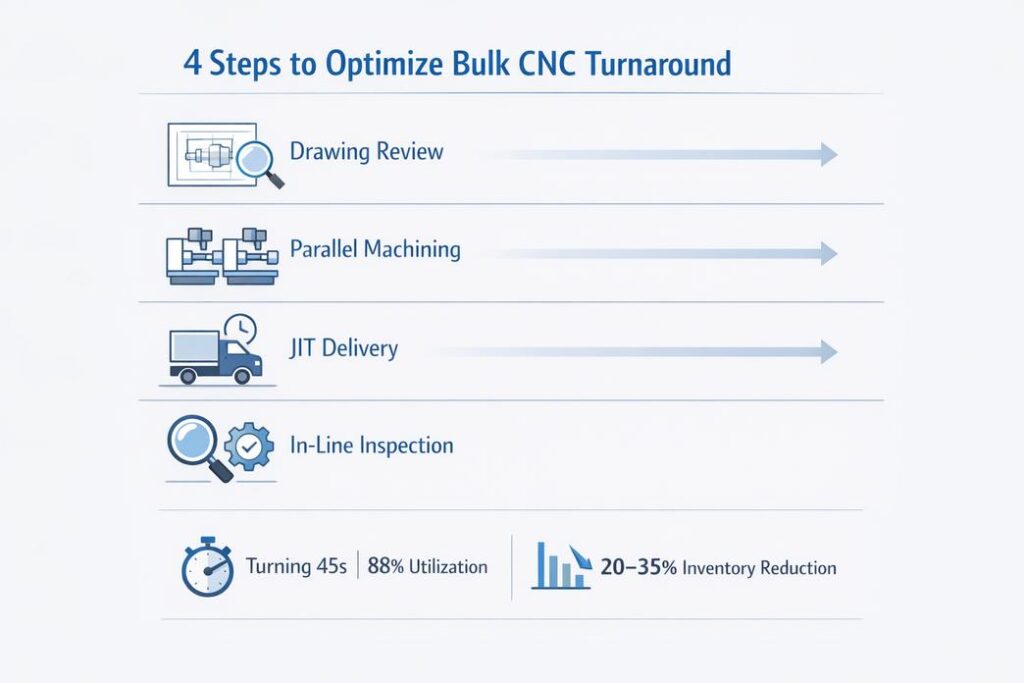
| Operation Type | Avg Cycle Time (sec) | Parallel Machines | Utilization Rate (%) |
|---|---|---|---|
| Turning | 45 | 6 | 88 |
| Grooving | 30 | 4 | 82 |
| Chamfering | 18 | 3 | 79 |
| Parting | 22 | 3 | 84 |
Balanced CNC machining flow keeps bulk lathe cnc parts moving without idle time. Shops like yuhuan hongqian often split precision turned parts across synchronized cells to avoid bottlenecks.
Implementing Just-in-Time Delivery for Carbon Steel Shafts
- Supply coordination
- Forecast-driven JIT delivery
- Tight delivery schedules
- Vendor-linked supply chain management
- Inventory discipline
- Raw carbon steel batching
- Controlled WIP
- Finished shaft components staged by dispatch window
- Performance targets
- 20–35% inventory reduction
- Lower holding costs
- Faster assembly integration
For shaft-style lathe CNC parts, this rhythm keeps machining CNC lathe parts aligned with real demand. yuhuan hongqian applies logistics optimization so carbon steel precision turned parts arrive ready for install—no warehouse pileups.
Automated In-Line Inspection to Prevent Bottlenecks
- Embedded control system
- On-machine probes for automated inspection
- Real-time measurement systems
- SPC-based process control
- Quality defense layers
- In-cycle defect detection
- Continuous in-line quality verification
- Final quality assurance confirmation
- Bottleneck safeguards
- Instant deviation alerts
- Offset auto-correction
- Scrap isolation before batch spread
When producing aerospace-grade lathe cnc parts, roundness and runout errors can snowball fast. Smart bottleneck prevention keeps CNC turned components consistent. That’s how large runs of lathe machining parts stay on spec—and on schedule.
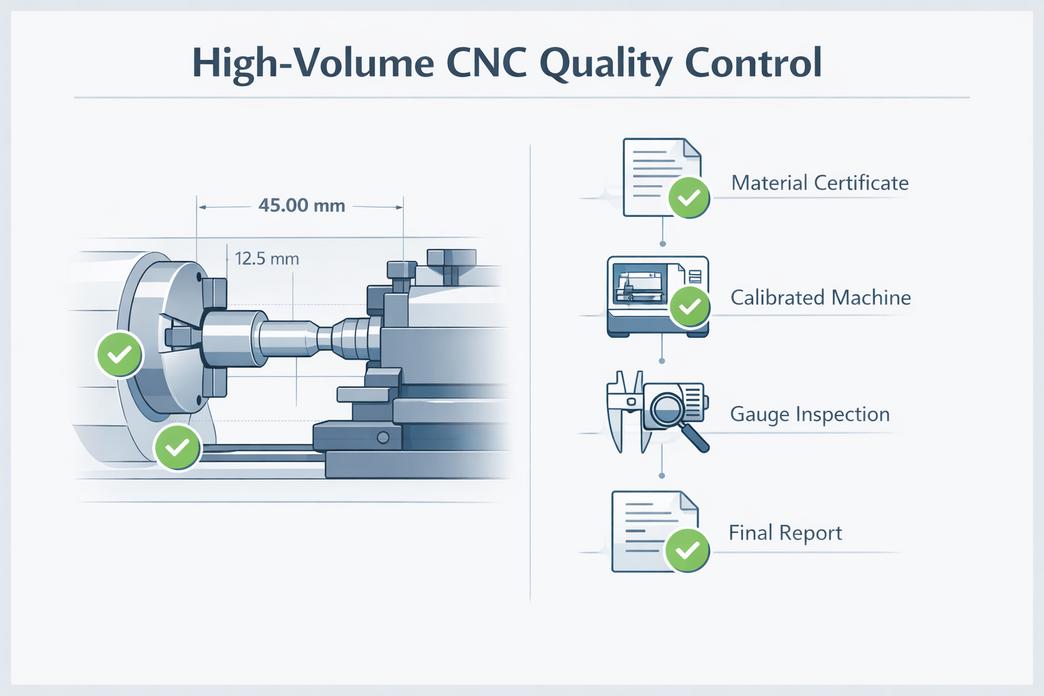
Quality Control: Checklist For CNC-Turned Components
Quality control for lathe cnc parts is not just paperwork; it’s the real proof that machining was done right. From tight tapers to mirror-like finishes, every cnc lathe part must pass inspection before shipping. For manufacturers like yuhuan hongqian, stable quality keeps customers relaxed and repeat orders coming.
Verifying Dimensional Accuracy on Tapered Shafts
For tapered shafts in lathe cnc parts, controlling dimensional accuracy starts with a clear inspection routine built around reliable measurement and verified calibration.
- Diameter Control
- Measure large-end and small-end diameters
- Use calibrated gauge sets
- Cross-check against drawing tolerance
- Measure large-end and small-end diameters
- Taper Angle Validation
- Compare actual taper angle
- Sine bar or CMM reading
- Confirm deviation within ±0.02°
- Compare actual taper angle
- Straightness Check
- Mount between centers
- Run dial indicator
- Record total indicator reading
- Mount between centers
Reference Inspection Data
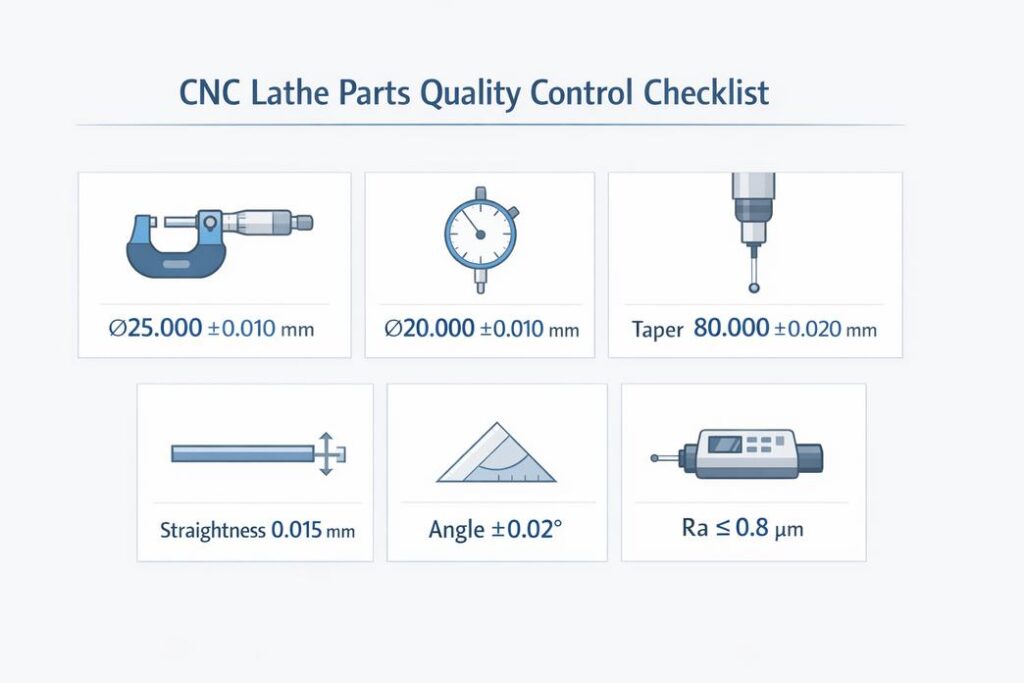
| Feature | Nominal Value | Tolerance (±mm) | Tool Used |
|---|---|---|---|
| Large Diameter | 25.000 mm | 0.010 | Outside micrometer |
| Small Diameter | 20.000 mm | 0.010 | Outside micrometer |
| Taper Length | 80.000 mm | 0.020 | Vernier caliper |
| Straightness | — | 0.015 | Dial indicator |
In cnc lathe parts used for couplings, tiny drift in a taper can cause serious fit issues. That’s why yuhuan hongqian runs repeat checks before approving any batch of lathe cnc parts.
Inspecting Concentricity for High-Speed Rotational Parts
When dealing with high-speed rotational parts, poor concentricity shows up fast as vibration or noise. Nobody wants that.
Key control points in machining lathe cnc parts:
- Mount part on precision spindle.
- Place dial indicator on external diameter.
- Rotate slowly to capture total runout.
- Repeat on internal bore.
Short checks. Clear data. True precision.
If concentricity exceeds drawing limits, the cnc machining parts may require re-turning or grinding. High-speed shafts in robotics and aerospace don’t forgive misalignment.
Surface Finish Requirements: Ra Value and Polished Radii
In many cnc lathe parts, surface finish is more than looks. It controls sealing, fatigue life, and friction.
- Ra Value Verification
- Measure roughness using surface tester
- Compare to drawing specification
- Measure roughness using surface tester
- Polished Radii
- Inspect polished radii at fillets
- Ensure smooth texture transition
- Avoid micro-notches
- Inspect polished radii at fillets
- Measurement Control
- Record multiple points
- Average readings
- Flag outliers
- Record multiple points
Medical fittings and valve connectors often demand Ra ≤ 0.8 μm. That smooth feel you get when touching a finished lathe component? That’s controlled machining, not luck. yuhuan hongqian keeps surface data tied to every batch of lathe cnc parts.
Checking Perpendicularity on Stepped Diameter Features
A stepped shaft looks simple, but bad perpendicularity can mess up assembly fast.
• Confirm shoulder squareness against primary datum
• Mount part and sweep face with dial indicator
• Record measurement at four clock positions
Then compare against tolerance on the drawing.
If the face is tilted, load won’t distribute evenly. Bearings wear early. Flanges leak. In precision cnc machining parts, perpendicular faces keep everything aligned and stress under control.
Documenting Profile Tolerance for Aerospace Valves
Aerospace valves demand tight profile tolerance and clean documentation.
- Drawing Review
- Check blueprint revision
- Confirm GD&T callouts
- Inspection Execution
- CMM scan of conical and curved surfaces
- Evaluate against drawing geometry
- CMM scan of conical and curved surfaces
- Reporting
- Record deviation values
- Attach measurement charts
- Sign off per specification
For aerospace valves, traceability is non-negotiable. Each batch of lathe cnc parts must link inspection records to material heat numbers and machining dates. That level of discipline is how suppliers like yuhuan hongqian stay trusted in high-demand industries.
FAQs about Lathe Cnc Parts
What makes Stainless Steel shafts reliable in high‑corrosion environments?
Stainless Steel Shafts are trusted in Hydraulics, Marine, and the Energy Sector because durability starts at the material and ends at the finish:
- Passivated surfaces resist oxidation and chemical exposure.
- Precision Turning and Grinding maintain Cylindrical or Tapered profiles.
- Tight Concentricity and low Surface Runout protect Bearings and Bushings.
- Controlled Ra Value improves sealing contact in Valves and Couplings.
The result is steady performance under pressure, moisture, and vibration.
How do Aluminum Alloy spacers improve efficiency in lathe cnc parts assemblies?
Aluminum Alloy Spacers support fast, accurate builds in Automotive, Robotics, and Electronics.
- Lightweight structure reduces rotational load on Shafts and Connectors.
- Stepped Diameter design ensures precise Positional Tolerance.
- Anodized finish strengthens corrosion resistance and surface hardness.
- Turning, Facing, and Chamfering shorten secondary processing time.
Less weight, cleaner fits, quicker assembly.
Why are Brass and Bronze bushings widely used in industrial machinery?
Brass and Bronze Bushings quietly carry motion inside Industrial Machinery and Pneumatics systems.
- Smooth Internal Diameter after Boring and Reaming lowers friction.
- Stable Roundness and Cylindricity protect mating Shafts.
- Polished or Honed finish maintains consistent Ra Value.
- Natural wear resistance reduces downtime.
In high-cycle rotation, that balance between conductivity and durability matters.
How can Titanium couplings meet Aerospace and Defense standards?
Titanium Couplings and Connectors are chosen when failure is not an option.
| Material | Key Benefit | Critical Control |
| Titanium | High strength-to-weight ratio, corrosion resistance | Profile Tolerance |
| Alloy Steel | High load stability, hardenability | Straightness |
| Carbon Steel | Cost efficiency, excellent machinability | Perpendicularity |
| Aluminum | Lightweight, high thermal conductivity | Flatness / Thermal Expansion |
| Stainless Steel | Superior corrosion resistance, durability | Surface Finish / Circularity |
Precision Turning, Boring, and Threading maintain Angularity and Concentricity. Vapor Blasted or Polished finishes protect against fuel and hydraulic exposure in Aerospace and Defense systems.
What quality checks are critical for precision lathe cnc parts?
For Shafts, Flanges, Pins, Sleeves, and Valves used in Medical Devices or Aerospace, inspection is constant and disciplined:
- Dimensional Accuracy verified during Turning and Grinding.
- Concentricity and Cylindricity measured after Grooving or Threading.
- Surface Runout tested on Cylindrical and Conical features.
- Black Oxide, Electroplated, or Anodized coatings inspected for uniformity.
Behind every smooth External Diameter or clean Shoulder lies careful measurement—because precision is felt long before it is seen.
Lathe CNC Parts: Precision Engineering for Heavy Industry
When production lines start groaning and cheap components tap out early, lathe cnc parts step in like the steady-handed mechanic who never misses a beat. In heavy industry, stainless steel isn’t just metal—it’s peace of mind spun on a precision axis. Corrosion, pressure, heat? Bring it on.
Factories don’t lose money in dramatic explosions. It’s the slow drip—misalignment, surface wear, downtime at 2 a.m. That’s where custom CNC-turned parts earn their keep: tight tolerances, smooth finishes, zero guesswork. At Yuhuan Hongqian, we back this “zero guesswork” with a fleet of 80+ high-precision CNC lathes and 15 truss robots, ensuring that the precision you see on the drawing is exactly what you feel in the final assembly. This isn’t about shiny hardware. It’s about parts that show up, hold steady, and keep your operation humming.
Material Grades Explained For Lathe CNC Parts
Choosing the right material for lathe cnc parts can feel like picking the right tires for a race car—get it wrong, and performance drops fast. From cnc lathe components to custom turned parts, material grade shapes strength, lifespan, and cost.
Why Stainless Steel Shafts Excel in High-Corrosion Environments When producing lathe cnc parts like shafts, material choice directly affects service life in high-corrosion environments. Stainless steel stands out for its strong corrosion resistance, where a passive chromium oxide layer blocks moisture and chemical attack. Drawing on over 8 years of manufacturing experience, Yuhuan Hongqian fine-tunes machining allowances to keep tolerances tight while protecting surface integrity. For mechanical components exposed to salt spray or acidic media, stainless steel cnc turned parts simply last longer.
Aluminum Alloy Spacers: Lightweight yet Durable Solutions In high-speed assemblies, weight matters. Aluminum alloy earns its reputation in lathe cnc parts through a high strength-to-weight ratio and excellent machinability. Compared with heavier cnc machining parts, aluminum spacers cut load without sacrificing positioning accuracy. Our automated robotic cells allow us to maintain high-volume consistency for these lightweight components, ensuring every spacer meets the same strict dimensional standards.
Titanium Couplings Meeting Aerospace and Defense Standards When loads spike and weight limits tighten, titanium changes the game. For couplings in the aerospace industry and defense sector, precision boring ensures profile tolerance and concentric alignment. In critical systems, we apply strict inspection protocols to titanium cnc lathe components, treating every project as a “rescue mission” where failure is not an option.
Lathe CNC Parts Cost-Saving Strategies Revealed
Precision matters, but so does cost. When producing lathe cnc parts, smart planning around materials, tolerances, and machining flow keeps budgets under control.
Bulk Purchasing and Process Integration Managing stainless steel flanges becomes far cheaper when purchasing focuses on volume discounts. By leveraging our massive production capacity, we consolidate batches to minimize tool swaps and downtime. Furthermore, when turning and threading are merged in one machining cycle, setup costs drop fast and manufacturing processes gain real efficiency. This approach improves shaft accuracy and reduces operator hours, typically saving 12–18% in total cycle time for our clients.
Tightening Tolerance Windows to Cut Scrap and Rework Overly strict tolerances drive scrap and rework. Smart quality control balances precision with real-world fit. Working with experienced suppliers like Yuhuan Hongqian helps customers align tolerance grades with application reality. CNC turning parts don’t need aerospace-level tightness for every face—focusing on functional surfaces like bearing seats while relaxing non-critical faces cuts waste and protects your margins.
Quality Control: The Yuhuan Hongqian Standard
Quality control for lathe cnc parts is not just paperwork; it’s the real proof that machining was done right. From verifying dimensional accuracy on tapered shafts to inspecting concentricity for high-speed rotational parts, every component must pass discipline-heavy checks.
Whether we are checking perpendicularity on stepped diameters or documenting profile tolerance for aerospace valves, our 8-year legacy in pipe fitting manufacturing ensures that every part is traceable and reliable. Behind every smooth external diameter or clean shoulder lies careful measurement—because at Yuhuan Hongqian, precision is felt long before it is seen.
[ Call to Action ] Ready to upgrade your component reliability? Contact Yuhuan Hongqian today for a technical consultation. Whether you need a quote for a new bulk order or need us to take over a challenging “rescue mission” project, our team of 80+ CNC stations and 15 robots is ready to deliver. [Request Your 24-Hour Quote Now]