Ordering a bsp fitting in bulk can feel like buying shoes online after a long flight—looks right on the screen, pinches like crazy in real life. I’ve watched smart procurement teams lose weeks because two threads that seemed close enough decided to fight each other under pressure. In piping, that tiny mismatch loves to show up as leaks, downtime, and angry calls at 6 a.m.
Here’s the rub. BSP and NPT grew up on different sides of the ocean, learned different rules, and never agreed to play nice together. One counts on sealing faces and angles that whisper “precision.” The other bets on muscle and metal-to-metal grit. Mix them up, and the system pushes back.
This is where clarity saves budgets. Knowing how BSP and NPT truly differ keeps projects on schedule, inspectors calm, and warehouses free of the wrong stock. Stick around—the details ahead turn confusion into confidence.
Quick Answers: BSP Fitting Clarity in a Nutshell
➔ Understand Threads: BSP parallel vs NPT taper—one seals with washers, the other with metal deformation.
➔ Match Standards: BSP follows ISO/DIN, NPT uses ASME B1.20.1—don’t mix without adapters.
➔ Check Pressure: PN16/PN40 vs Class 150/Sch80 ratings depend on material and finish.
➔ Prevent Leaks: Use proper gaskets, compounds, or flanged transitions for elbows, tees, unions, and caps.
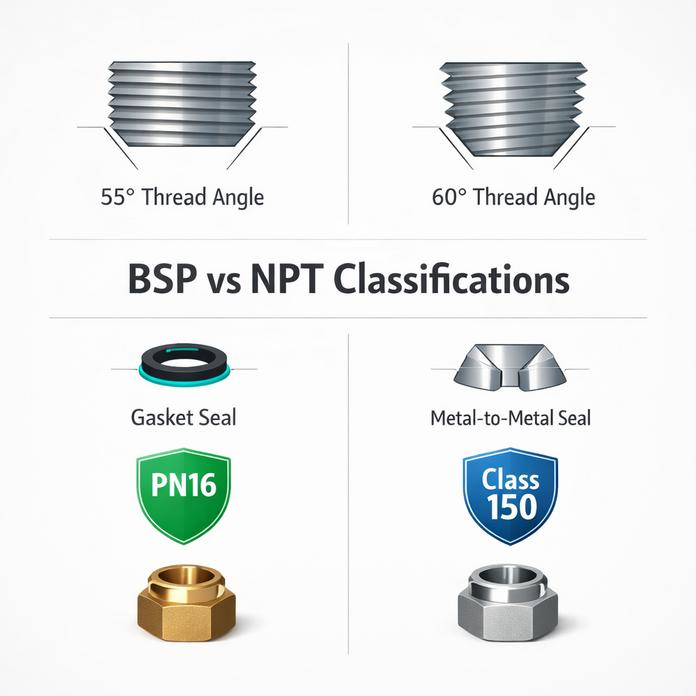
What Are BSP And NPT Classifications?
Choosing the right bsp fitting or NPT option can feel a bit technical at first. Still, once you break down thread type, pressure class, and material, it starts to click. Let’s walk through how bsp, fitting, and NPT systems are classified in real-world piping.
Thread Type Overview: Parallel BSP and Tapered NPT
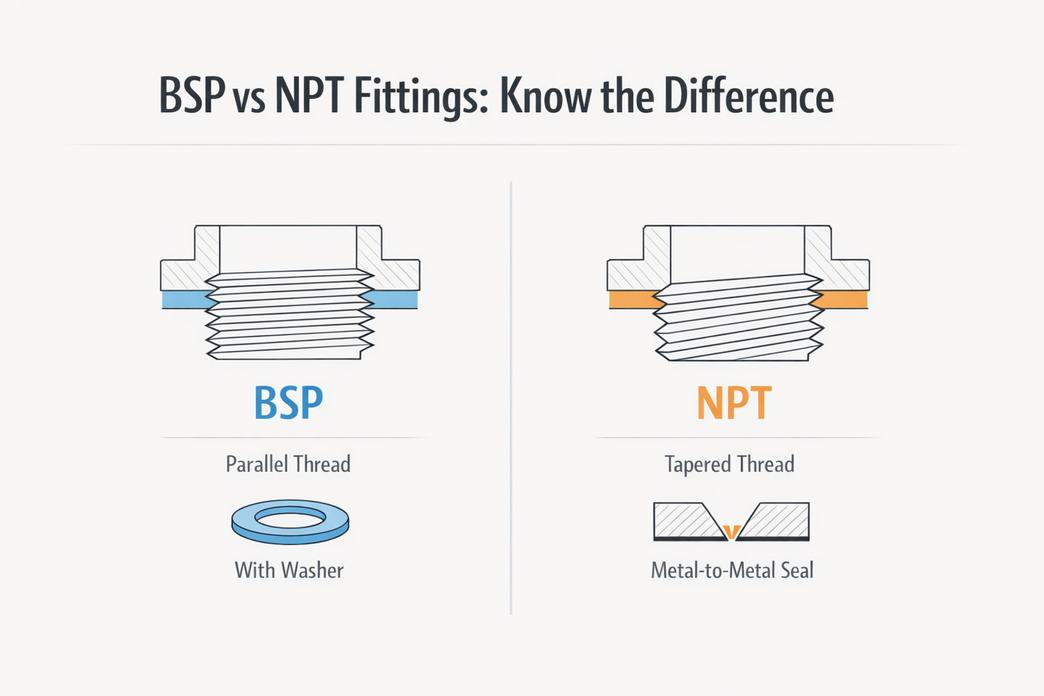
When comparing a BSP Fitting and an NPT Fitting, thread geometry drives the difference.
- BSP System
- Parallel Thread
- Uses constant diameter threads
- Relies on gasket or washer as Sealing Method
- Common in plumbing with visible face seals
- Technical traits
- Defined Thread Pitch
- 55° Thread Angle
- Parallel Thread
- NPT System
- Tapered Thread
- Diameter decreases along thread length
- Metal-to-metal sealing
- Seals tighter as torque increases
- Technical traits
- Different Thread Pitch standard
- 60° Thread Angle
- Tapered Thread
In daily use, a bsp fitting often pairs with flat-faced components, while NPT suits high-vibration lines. Brands like yuuhuan hongqian machine each bsp fitting to precise pitch tolerance, helping prevent leaks when torque is applied correctly.
Pressure Ratings Explained: PN16, Class 150 and Beyond
Pressure class isn’t random; it links design, wall thickness, and testing.
- Metric Standard
- PN16
- Refers to nominal pressure capacity
- Connected to defined Pressure Classification
- Verified by Hydrostatic Test Pressure
- PN16
- Imperial Standard
- Class 150
- Rated under ASME systems
- Defines Working Pressure at temperature
- Limited by Maximum Operating Pressure
- Class 150
In practice:
- Identify fluid type.
- Confirm temperature range.
- Match rating to the correct bsp fitting or tapered thread fitting.
yuuhuan hongqian checks every bsp fitting against rated pressure before shipment, keeping installations safe and steady.
Material Choices: Brass, Stainless Steel and PVC
Material choice changes performance fast.
- Brass
- Good Material Compatibility with water
- Solid Corrosion Resistance in plumbing
- Easy machining for precise bsp fitting threads
- Stainless Steel
- High Chemical Resistance
- Strong Temperature Resistance
- Ideal for oil and gas lines
- PVC
- Lightweight
- Cost-effective
- Suitable for low-pressure water systems
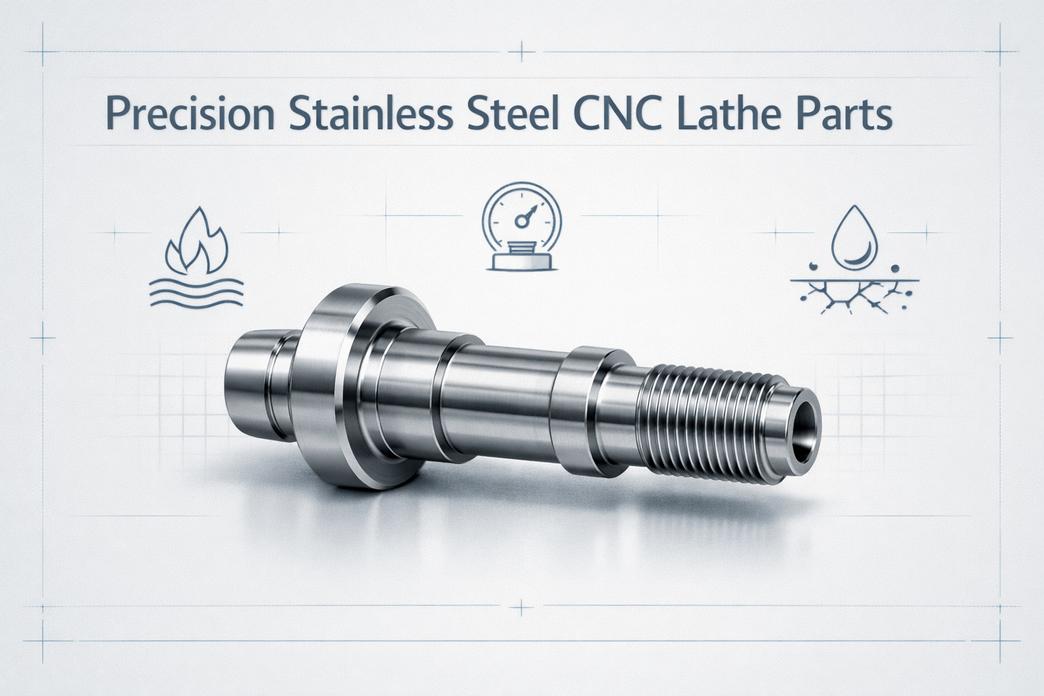
For long-term reliability, matching bsp thread fitting material to media is key. yuuhuan hongqian offers brass and stainless options, giving installers flexibility without sacrificing thread accuracy.
4 Points Comparing BSP And NPT
Choosing the right bsp fitting or NPT connection can save time, money, and a whole lot of frustration on site. Small differences in thread angle, tapered thread form, and pressure rating often decide if your joint seals tight or leaks under stress.
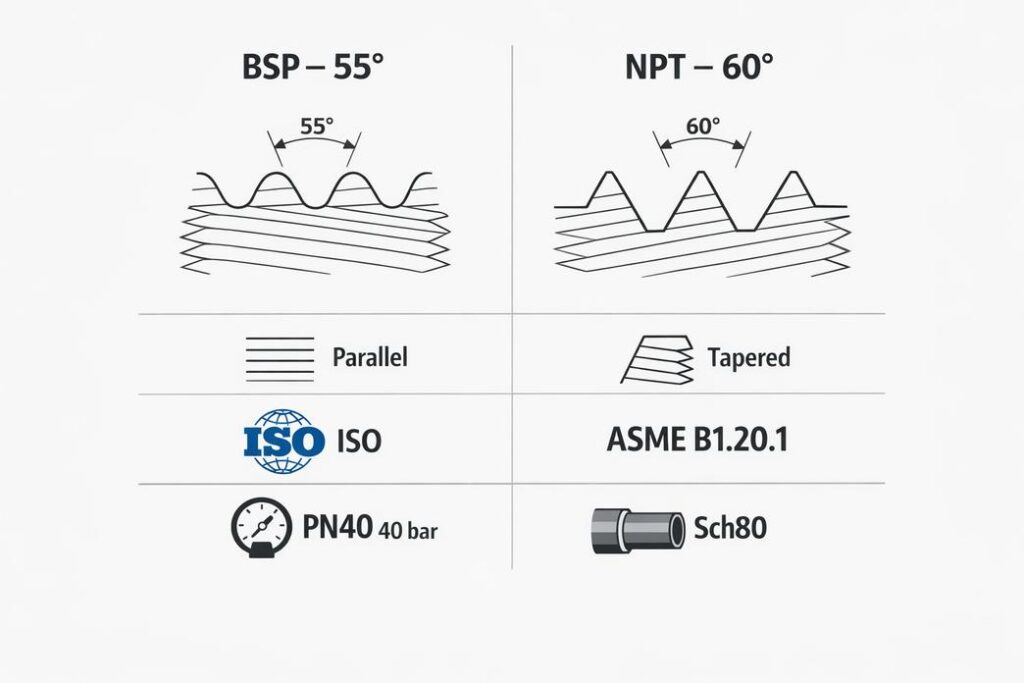
Thread Angle Differences
The core contrast starts with thread angle geometry:
- BSP uses 55 degrees
- NPT uses 60 degrees
That small change affects how a tapered thread or parallel thread sits inside a joint.
- Geometry
1.1 BSP profile
- 55° flank angle
- Rounded root and crest
1.2 NPT profile
- 60° flank angle
- Sharp crest and root
- Sealing impact
2.1 BSP parallel thread
- Requires gasket, washer, or bonded seal
2.2 NPT tapered thread
- Metal-to-metal compression creates the seal
- Application effect in a bsp fitting
- In a Reducer or Union, angle mismatch ruins engagement
- Mixing standards often damages threads
When installing a BSP fitting, always match the degrees. A 55° and 60° pairing just won’t play nice.
Tapered vs Parallel Design
The shape of the thread changes how the joint behaves under load and vibration.
- Structural principle
1.1 Tapered thread
- Creates interference fit
- Seals through deformation
1.2 Parallel thread
- Maintains constant diameter
- Depends on gasket compression
- Performance factors
- Seal reliability under vibration
- Risk of leakage in thin pipe material
- Joint stability during thermal change
- In real projects
3.1 Hydraulic lines
- NPT common for self-sealing action
3.2 Water systems
- BSP fitting with bonded washer preferred
Many contractors choose bsp threaded fitting types from yuuhuan hongqian because machining accuracy keeps the joint aligned, especially in parallel-thread applications.
ISO/BSP vs ASME B1.20.1 Standards
Standardization drives compatibility across borders.
- Governing systems
1.1 ISO standard / DIN
- Covers BSP
- Defines thread specification and dimensional tolerance
1.2 ASME standard B1.20.1
- Covers NPT
- Sets U.S. taper requirements
- Technical comparison
| Item | BSP (ISO 7/1) | NPT (ASME B1.20.1) | Impact on Compatibility |
|---|---|---|---|
| Thread Angle | 55° | 60° | Direct mismatch risk |
| Thread Form | Parallel / Taper | Taper only | Seal method differs |
| Tolerance Class | ISO defined | ASME defined | Affects fit tightness |
| Global Use | Europe, Asia | USA, Canada | Limits interchange |
- International compatibility
- Mixing a bsp fitting with NPT threads reduces system integrity
- Certification often demands strict adherence
yuuhuan hongqian manufactures BSP pipe fitting lines strictly under ISO metrics, helping contractors avoid tolerance headaches.
Pressure Capacity: PN40 vs Sch80
Pressure ratings often get confused, but pressure rating and wall designation are not the same thing.
- Definition differences
1.1 PN40
- Nominal pressure rating (40 bar reference)
1.2 Sch80
- Refers to wall thickness, not direct pressure value
- Technical relationship
- Higher wall thickness improves resistance
- Final pressure rating depends on material strength, temperature, and fluid pressure
- Practical comparison
| Parameter | PN40 System | Sch80 Pipe | Key Variable | Effect on System Integrity |
|---|---|---|---|---|
| Reference Standard | EN 1092 | ASME B36.10 | Code basis | Design alignment |
| Nominal Pressure | 40 bar | Varies by size | Pipe OD | Safety margin |
| Wall Thickness | Standardized | Thicker than Sch40 | Schedule | Burst resistance |
| Material | Brass / Steel | Carbon Steel | Yield strength | Long-term durability |
In real builds, a brass bsp fitting rated PN40 may outperform thinner steel systems if the material strength matches service demands. That’s why many buyers stick with precision-machined products from yuuhuan hongqian, especially when pressure consistency matters.
At the end of the day, understanding angles, taper type, standards, and rating logic keeps your BSP pipe fitting setup tight, safe, and built to last.
Can BSP And NPT Mate Safely?
Mixing standards in piping can get tricky fast. A bsp fitting may look close to NPT, yet tiny angle and pitch differences change everything. In daily plant work, choosing the right BSP thread fitting keeps leaks away and pressure steady.
Elbow and Tee Misalignment Hazards
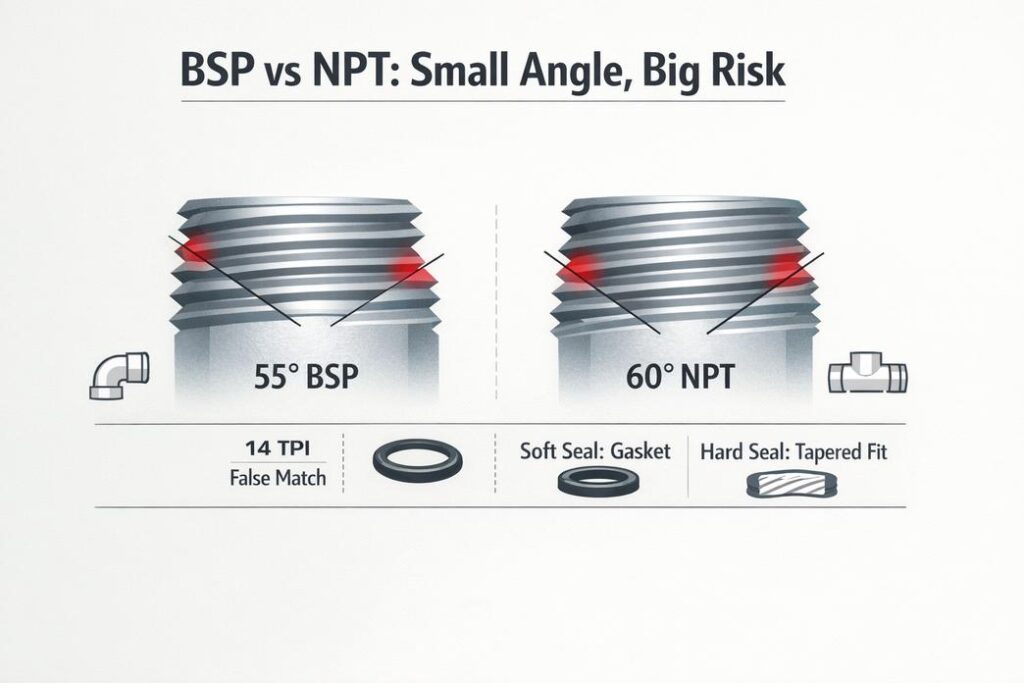
When a bsp fitting meets an NPT port inside an Elbow fitting or Tee fitting, trouble often starts quietly.
- At the connection level
- Thread angle mismatch leads to Thread misalignment
- Partial engagement increases Installation error risk
- At the stress level
- Uneven load on the shoulder
- Local cracking near the root
- Gradual Sealing failure
- Misaligned threads reduce contact surface.
- Reduced contact triggers Pressure loss.
- Pressure fluctuation harms overall System integrity.
In real workshops, a BSP pipe fitting forced into NPT feels “almost right,” yet that almost costs downtime. A proper bsp fitting matched to its standard avoids that drama and keeps flow stable.
Coupling Compatibility with Thread Gauges
Checking a Coupling with a Thread gauge is not overkill; it is basic survival for any bsp threaded fitting.
- Measurement focus
- Thread pitch
- Thread diameter
- Engagement length
| Item | BSP Standard | NPT Standard | Risk if Mixed |
|---|---|---|---|
| Thread angle | 55° | 60° | Surface gap |
| Pitch example 1/2″ | 14 TPI | 14 TPI | False match |
| Seal method | Gasket/face | Taper seal | Leak path |
| Gauge type | BSP gauge | NPT gauge | Misread fit |
- Testing logic
- Confirm Measurement accuracy
- Record Compatibility testing results
- Approve only full Interchangeability
Suppliers like yuuhuan hongqian stress gauge checks before shipping any bsp fitting, because guessing is never smart.
Preventing Leaks in Union and Cap Connections
Leak control in a Union connection or Cap connection using a bsp fitting depends on disciplined practice.
- Connection preparation
- Clean threads
- Verify Material compatibility
- Assembly control
- Apply proper Sealant application
- Follow exact Torque specification
- Final validation
- Inspect for micro seepage
- Confirm long-term Joint integrity
A BSP thread fitting paired with the right adapter beats forcing a mismatch. Many chemical plants now source from yuuhuan hongqian to ensure each bsp fitting arrives correctly machined, reducing rework and keeping maintenance crews relaxed instead of scrambling.
FAQs about Bsp Fitting
What makes BSP different from NPT in threaded connections?
BSP and NPT may look similar, yet the fit tells another story.
- Thread angle
- BSP: 55° (ISO / DIN standard)
- NPT: 60° (ASME B1.20.1)
- Thread form
- BSP: Parallel or tapered
- NPT: Always tapered
- Practical impact in fittings
- Mixing them in a Threaded Elbow or Tee often causes poor sealing.
- Under PN40 or Class 300 pressure, even slight mismatch can lead to leakage or cracked Coupling threads.
In Plumbing or Industrial Piping, using the correct standard is not optional—it protects both equipment and reputation.
Which materials are best for bsp fitting in different applications?
Material choice shapes durability, cost, and safety.
- Brass / Copper → Popular in Plumbing and HVAC, corrosion-resistant and easy to install.
- Stainless Steel → Trusted in Oil & Gas and Chemical Processing, suitable for Sch 40 or Sch 80 systems.
- Carbon Steel (ASTM A234) → Strong for high-pressure lines; often Black Oxide or Galvanized finish.
- PVC → Lightweight solution for low-pressure Water Treatment.
- Galvanized Iron → Practical for general utility pipelines.
Selecting the wrong material for a Union or Reducer can shorten service life dramatically.
How do pressure ratings affect bsp fitting selection?
Pressure class defines the safety boundary of a fitting.
| Pressure Rating | Typical Use | Common Context |
|---|---|---|
| PN16 / Class 150 | Light–medium duty | Plumbing, HVAC |
| PN40 / Class 300 | High pressure | Oil & Gas |
| Sch 40 | Standard wall | Industrial Piping |
| Sch 80 | Thick wall | Chemical Processing |
A Stainless Steel Threaded Plug rated PN16 in a PN40 line is a risk waiting to happen. Match rating with temperature, material, and connection type—Threaded, Flanged, or Socket Weld.
How can leaks be prevented in bsp fitting installations?
Leaks often start small—at a Cap, Elbow, or Coupling—and grow under pressure.
Key control points:
- Use correct BSP standard (ISO / DIN).
- Apply PTFE tape or approved sealant to Threaded joints.
- Avoid over-tightening Stainless Steel or Brass fittings.
- For critical lines, consider Flanged or Welded (Butt Weld / Socket Weld) transitions instead of mixed threads.
- Choose proper surface finish:
- Galvanized or Coated for Carbon Steel
- Polished or Pickled for hygienic systems
A careful installation today prevents emergency shutdown tomorrow.
4. Is BPT the same as NPT?
No. While both are tapered pipe threads, they are “cousins” from different standards. BSPT (often referred to as BPT in some shorthand) follows the British Standard with a 55° thread angle, while NPT follows the American Standard with a 60° thread angle. They are not interchangeable and forcing them together will compromise the seal.
5. What is a 1/4 BSP thread?
A 1/4 BSP thread refers to a fitting designed for a pipe with a nominal internal diameter of 1/4 inch. However, the actual outside diameter (OD) of the thread is approximately 13.16 mm. It features 19 threads per inch (TPI). Depending on your system, it will either be BSPP (parallel/G) or BSPT (tapered/R).
6. What is a BSPT fitting?
A BSPT (British Standard Pipe Taper) fitting is a threaded connector where the diameter of the threads decreases along the length of the fitting at a 1:16 ratio. This taper creates a mechanical “interference fit” that, when combined with a sealant like PTFE tape, provides a pressure-tight joint. It is common in China, Europe, and much of the Commonwealth.
7. Is 1/4 NPT the same as BSPT?
Definitely not. This is a common field error. While a 1/4 NPT and 1/4 BSPT look nearly identical to the naked eye, the NPT has 18 TPI and a 60° angle, whereas the BSPT has 19 TPI and a 55° angle. Trying to mate them will result in cross-threading and high-pressure leaks.
Final Choice: Precision Over Guesswork
Still Unsure About Your Thread Specifications?
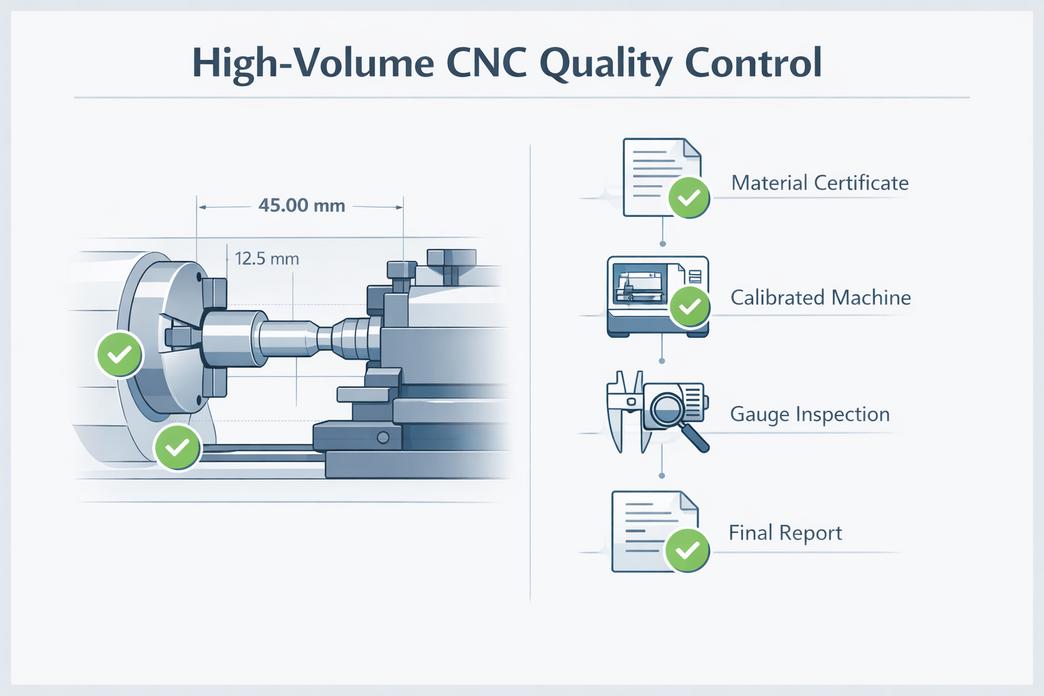
Don’t let a 5° angle difference or a mismatched TPI stall your project. At Yuhuan Hongqian Machinery, we eliminate the guesswork. With over 10 years of export expertise to the US and Europe and a facility equipped with 80+ high-precision CNC machines, we guarantee thread accuracy within ±0.01mm.
Whether you need 304/316 Stainless Steel or Brass BSP/NPT fittings, our engineering team is ready to audit your technical drawings.