In job sites and boiler rooms, bsp threaded fittings act like the unsung handshake of industry—quiet, precise, and trusted to hold pressure without drama. Buyers feel the sting when mismatched threads leak time and money, so standards and fit matter as much as price.
Procurement pros know a bad connector can tank a schedule overnight.
This guide cuts through shop-floor chatter, showing how BSPP and BSPT choices, materials, and pressure classes keep projects humming and crews smiling.
Melodic Key Points for bsp threaded fittings
- Choose BSPP for parallel threads and washer seals, BSPT for tapered mechanical seals
- Match material to application: brass for water, stainless for oil & gas, carbon steel for high pressure, PVC for low-pressure
- Verify pressure class: PN16 for light duties, Class 150 for medium, high-pressure ratings for hydraulics
- Follow EN/ASTM/ISO standards and torque specs to ensure leak-free, durable connections
- Opt for elbows, tees, reducers, couplings or unions based on flow path and maintenance needs
What Are BSP Threaded Fittings?
bsp threaded fittings are everywhere in fluid systems, yet many buyers still mix up details like sealing style and thread form. In simple terms, “bsp” stands for British Standard Pipe, and “threaded fittings” connect pipes through screw threads. When you break down bsp threaded fittings, you get BSP + threaded + fittings—each word matters for performance, safety, and compatibility.
Unlocking BSPP vs BSPT: Key Thread Standard Differences
When comparing BSPP and BSPT, the confusion usually starts with the thread standard itself.
- Core design
- BSPP
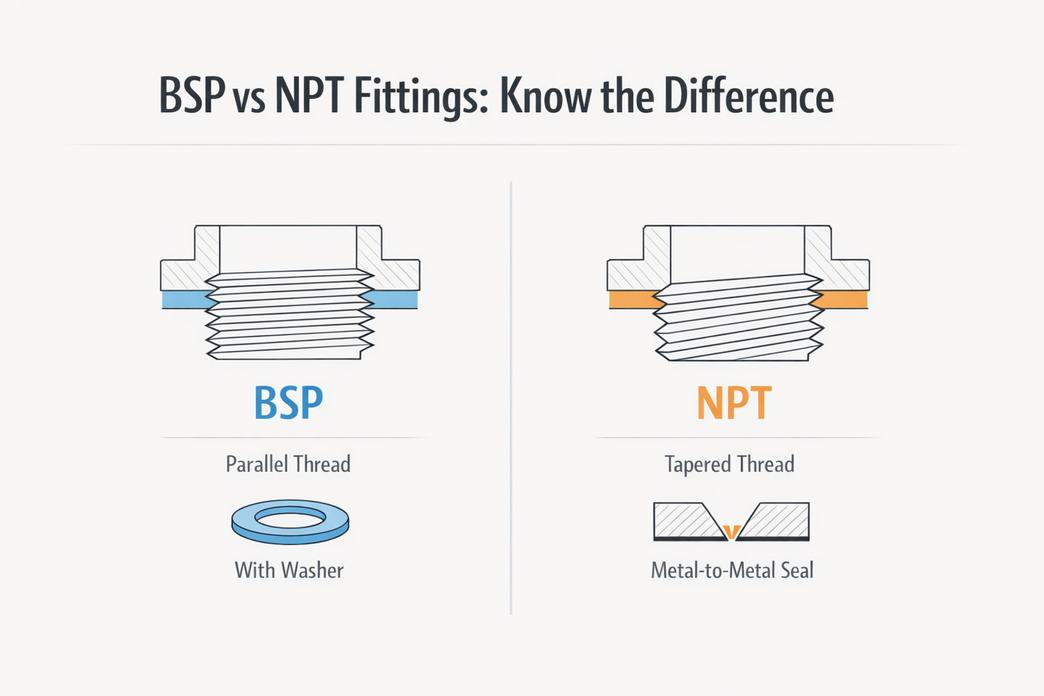
- Uses a parallel thread
- Requires a sealing washer or bonded seal
- Relies on surface compression as the main sealing method
- BSPT
- Uses a tapered thread
- Creates mechanical interference
- Seals through thread engagement
- BSPP
- Technical contrast with other systems
- Thread angle:
- BSP systems: 55°
- NPT: 60°
- Interchangeability:
- BSPT vs NPT: not directly compatible
- BSPP needs proper gasket face
- Thread angle:
In daily purchasing talk, this means one thing: pick the right pipe fitting or risk leaks. High-quality bsp threaded fittings from yuuhuan hongqian are machined to precise tolerance, helping both parallel thread and tapered thread options seat correctly without guesswork.
How BSP Threads Ensure Leak-Free Joints in Plumbing Systems
Leak control with bsp threaded fittings comes down to sealing logic and correct assembly.
- For BSPT
- Thread taper increases contact pressure.
- Sealant fills micro gaps.
- Torque locks the joint.
- For BSPP
- Flat face meets washer.
- O-ring compresses evenly.
- Pressure pushes seal tighter.
In plumbing lines carrying water or low-pressure air, this design keeps things dry and drama-free. Installers usually:
- Clean threads
- Apply tape or sealant
- Tighten to recommended torque
A well-machined pipe fitting ensures even load distribution. That’s why many contractors stick with bsp threaded fittings supplied by yuuhuan hongqian, where thread depth and surface finish are tightly controlled.
Why BSP Threaded Fittings Dominate Industrial Piping Applications
In industrial piping, consistency wins.
- Standard alignment
- EN compliance
- Wide size range
- Clear marking
- Application spread
- Oil and gas lines
- HVAC circulation systems
- Water treatment plants
Inside these systems, bsp threaded fittings simplify maintenance. No welding. No flange alignment headaches. Just unscrew, replace, and restart.
From small brass connectors to heavy-duty steel bsp threaded fittings, the flexibility of the thread standard keeps inventory simple. Many buyers choose yuuhuan hongqian because the brand balances cost, accuracy, and material strength without overcomplicating sourcing.
In short, when someone mentions bsp threaded fittings, it’s not just about threads. It’s about reliable sealing, standard compatibility, and fittings that simply get the job done.
Types Of BSP Threaded Fittings
When people talk about bsp threaded fittings, it’s really about how BSP, threaded, and fittings work together inside modern plumbing systems. From tight corners to heavy-duty plants, these parts keep leak-free joints steady under pressure. Let’s break down how each fitting type supports pipe fittings, flow control, and long-term pressure resistance.
Elbow
In bsp threaded fittings, elbows redirect flow without drama. The thread engagement inside the elbow keeps the sealing mechanism tight, even when vibration kicks in.
- Common angles:
- 45° for mild redirection
- 90° for sharp turns
- 90° street elbow for compact layouts
- Material options
1.1 Brass for water lines
1.2 Stainless steel for chemical lines
1.3 Carbon steel for industrial duty
Within plumbing systems, elbows play three clear roles:
- Flow Control
- ▪ Adjusts direction
- ▪ Maintains bore alignment
- Space Management
- ▪ Fits confined walls
- ▪ Reduces extra pipe runs
- Seal Integrity
- ▪ Deep BSP threads improve grip
- ▪ Proper torque ensures leak-free joints
For brands like yuuhuan hongqian, precision-machined pipe fittings mean smoother assembly and fewer callbacks.
Tee
A tee in bsp threaded fittings connects three lines while keeping diameter consistent. Simple idea. Big impact.
Connection layout often includes:
- Main run
- Branch outlet
- Equal or reducing port
2 key design paths:
- Equal tee – same nominal bore
- Reducing tee – smaller branch
Inside the body:
- Internal BSP threads create firm thread engagement
- Even load spread supports pressure resistance
Installers like tees because the sealing mechanism remains stable when flow splits. In HVAC and fire systems, that stability keeps downtime low.
Reducer
Reducers in bsp threaded fittings connect different bore sizes without welding. That means quicker retrofits and cleaner installs.
Performance comparison:
| Nominal Size In | Nominal Size Out | Max Pressure (Bar) | Typical Application |
|---|---|---|---|
| 2” | 1-1/2” | 25 | Water supply |
| 1-1/2” | 1” | 30 | HVAC branch |
| 1” | 3/4” | 35 | Industrial lines |
Why it matters inside plumbing systems:
- Maintains smooth flow transition
- Reduces turbulence
- Supports higher pressure resistance
The internal BSP threads ensure tight thread engagement, which directly supports leak-free joints. Good reducers protect pumps and valves from sudden stress changes.
Coupling
Couplings look basic, but in bsp threaded fittings, basics keep systems alive.
Core functions:
- Join two same-size pipes
- Simplify maintenance
- Replace damaged sections fast
Internal structure breakdown:
- Symmetrical BSP threads
- Balanced load distribution
- Consistent sealing mechanism
In daily work, couplings reduce downtime. No flange bolts. No welding sparks. Just clean pipe fittings that screw in tight and hold under pressure.
For contractors choosing yuuhuan hongqian, repeat accuracy across batches keeps field alignment smooth.
Union
Unions are the smart choice when equipment needs removal. In bsp threaded fittings, a union allows disassembly without cutting pipe.
Functional layers:
- End A with BSP threads
- End B with matching threaded fittings
- Central nut locking the joint
Step-by-flow inside plumbing systems:
- Align pipe ends
- Engage thread engagement evenly
- Tighten union nut
- Activate compression-based sealing mechanism
Recent 2025 outlook from Global Market Insights notes that industrial threaded connection demand continues rising due to maintenance-friendly designs improving lifecycle efficiency.
That trend supports the use of bsp threaded fittings in oil, gas, and water plants where fast removal matters. Reliable unions mean consistent leak-free joints, strong pressure resistance, and fewer service headaches.
4 Common BSP Fitting Materials
In industrial piping, material choice can make or break system life. From water plants to oil rigs, bsp threaded fittings keep lines tight and steady. Let’s break down how different materials shape performance, sealing strength, and long-term durability.
Brass BSP Threaded Fittings for Water Treatment
When water quality matters, bsp fittings in brass often lead the pack.
- Material traits
- Corrosion control
- Copper-zinc alloy resists scale buildup
- Smooth internal bore supports clean flow
- Compliance
- Commonly aligned with potable water approvals
- Corrosion control
- Performance inside industrial piping
- Reliable threaded connections reduce leak risks
- Stable sealing under moderate temperature swings
In treatment plants, bsp threaded fittings made of brass balance cost and durability, making maintenance crews breathe a little easier.
Stainless Steel BSP Connections in Oil and Gas
Oil and gas sites push threaded connections to the limit.
- Mechanical strength
- High tensile capacity
- Impact resistance in vibration-heavy zones
- Corrosion defense
- Handles salt spray and chemical exposure
- Supports long-cycle sealing integrity
- System integration
- Matches global standardization rules
- Fits complex industrial piping grids
Stainless variants of bsp threaded fittings bring serious versatility, especially where safety margins stay tight.
Carbon Steel BSP Joints for High-Pressure Systems
Carbon steel works where pressure climbs fast.
- High load tolerance keeps joints stable.
- Thick wall design supports aggressive media.
- Coatings extend durability in harsh plants.
Key advantages include:
- Strong sealing under surge pressure
- Compatibility with legacy bsp fittings layouts
- Easy replacement thanks to thread standardization
For hydraulic rigs and energy systems, bsp threaded fittings in carbon steel handle the grind without fuss.
PVC BSP Fittings for Low-Pressure Plumbing
PVC options suit lighter-duty jobs.
- Weight and handling
- Easy to cut and install
- Reduces labor strain
- Chemical resistance
- Works in mild acid or fertilizer lines
- Supports irrigation and drainage networks
- Cost efficiency
- Budget-friendly threaded connections
- Practical choice for expandable industrial piping setups
Though not built for extreme heat, PVC bsp threaded fittings shine where flexibility and corrosion resistance matter most.
BSP Threaded Fittings: Pressure Ratings
Pressure ratings shape how bsp threaded fittings perform in real jobs, from home plumbing to heavy industrial lines. Getting the right bsp threaded connection is not just technical talk—it keeps systems tight, safe, and stress-free. Let’s break down how different pressure classes of bsp threaded fittings actually work in daily use.
Low Pressure BSP Fittings (PN16)
When working with PN16 rated bsp threaded fittings, the focus stays on steady flow and moderate demand.
- Application scope
- Building services
- HVAC water loops
- Domestic water supply
- Light commercial piping
- Building services
- Performance features
- Designed for nominal pressure up to PN16
- Suitable for stable temperature ranges
- Easy installation with standard BSP fittings
In practical terms, low pressure threaded fittings are a go-to choice for plumbers who want clean threads, simple sealing, and fewer callbacks. Brands like yuuhuan hongqian supply bsp threaded fittings that keep sealing surfaces consistent, which really matters when installations stack up across large buildings.
Medium Pressure BSP Connections (Class 150)
Class 150 bsp threaded fittings sit in that middle ground—stronger than basic plumbing parts, yet still flexible for field adjustments.
- Common uses include Oil and Gas auxiliary lines and Fire Protection systems.
- Materials often involve Carbon Steel for strength and Stainless Steel for corrosion resistance.
- Proper torque and thread sealant selection directly affect joint integrity.
- Reliable sealing
- Solid pressure handling
- Straightforward maintenance
For contractors, this level of bsp threaded connection feels like the sweet spot. yuuhuan hongqian keeps tolerances tight, helping British Standard Pipe threaded fittings align smoothly without chewing up threads.
High Pressure BSP Threaded Fittings
High pressure bsp threaded fittings are built for serious demand, especially in Hydraulic Systems and industrial processing lines.
- Structural integrity
- Material strength
- High-grade Carbon Steel
- Precision Stainless Steel
- Reinforced thread accuracy
- Material strength
- Operational stability
- Secure sealing under vibration
- Resistance to pressure spikes
In tough environments, failure isn’t an option. That’s why many buyers turn to yuuhuan hongqian for dependable bsp threaded fittings that hold firm when pressure climbs and conditions get rough.
FAQs about Bsp Threaded Fittings
What are BSP threaded fittings and how do they differ from other thread types?
BSP threaded fittings follow British Standard Pipe forms and are widely used in plumbing systems, HVAC, and industrial piping.
- BSPP (parallel) – seals with a washer or O-ring.
- BSPT (tapered) – seals through thread interference.
Compared with:
- NPT fittings (60° thread angle) common in North America.
- NPSM or metric thread for straight mechanical connections without pressure sealing.
In real projects, the difference shows up fast—mismatched BSPT and NPT threads can cause leaks even when the pipe diameter and nominal bore look similar.
Why are BSP threaded fittings preferred in industrial piping?
Short answer: speed, serviceability, and global acceptance.
- Faster installation than weld fittings or flanged fittings.
- Easier maintenance than permanent joints.
- Compatible with common shapes—elbow, tee, reducer, coupling, union, cap, plug.
- Suitable for low pressure (PN16) up to Class 150 medium pressure, depending on material.
In oil and gas or water treatment sites, being able to disconnect a union instead of cutting pipe saves hours. That practical advantage keeps BSP threaded fittings in constant demand.
What materials and certifications should buyers consider for BSP threaded fittings?
Material choice affects pressure rating, corrosion resistance, and application life:
- Stainless steel – high pressure, oil and gas.
- Carbon steel – industrial piping, medium to high pressure.
- Brass or copper – plumbing systems, often WRAS approved.
- PVC or ductile iron – water treatment and fire protection lines.
For large projects (DN50, 2 inch, and above), buyers usually check:
- ISO 9001 for quality systems.
- ASTM standards and EN standards for dimensional control.
- WRAS approved for potable water.
- UL listed for fire protection.
The fitting may look simple, but the right material and certification decide how long that joint holds under pressure.