When sourcing custom pipe connectors for fluid power, hydraulic circuits, and high-pressure process lines, selecting precision-engineered BSP threaded fittings is the foundational engineering choice for ensuring zero-leakage system integrity. What is a BSP fitting? In fluid handling and industrial plumbing, British standard pipe fittings (commonly referred to as a BSP fitting or BSP pipe fittings) designate an internationally standardized family of threaded connectors defined by the 55-degree Whitworth thread profile. Widely deployed across European, Asian, and Commonwealth machinery systems, these robust components establish dependable fluid transmission lines across automated manufacturing lines and hydraulic power units.
At Yuhuan Hongqian Machinery Co., Ltd., situated in the specialized industrial manufacturing hub of Yuhuan, Zhejiang Province, China, we deliver high-precision OEM and ODM contract manufacturing of custom BSP pipe fittings. Our 1,500-square-meter modern production facility is equipped with 70 to 80 high-precision CNC turning and turning-milling centers, alongside 15 automated gantry loading systems that sustain a dependable monthly capacity of roughly 200,000 pieces. Mastering the engineering distinctions between parallel and tapered British standard pipe fittings—alongside their fundamental differences from American NPT threaded fittings—is crucial to avoiding flank distortion, blown O-rings, and unplanned downtime.
What Are BSP Fittings? Core Classification: BSPP vs. BSPT
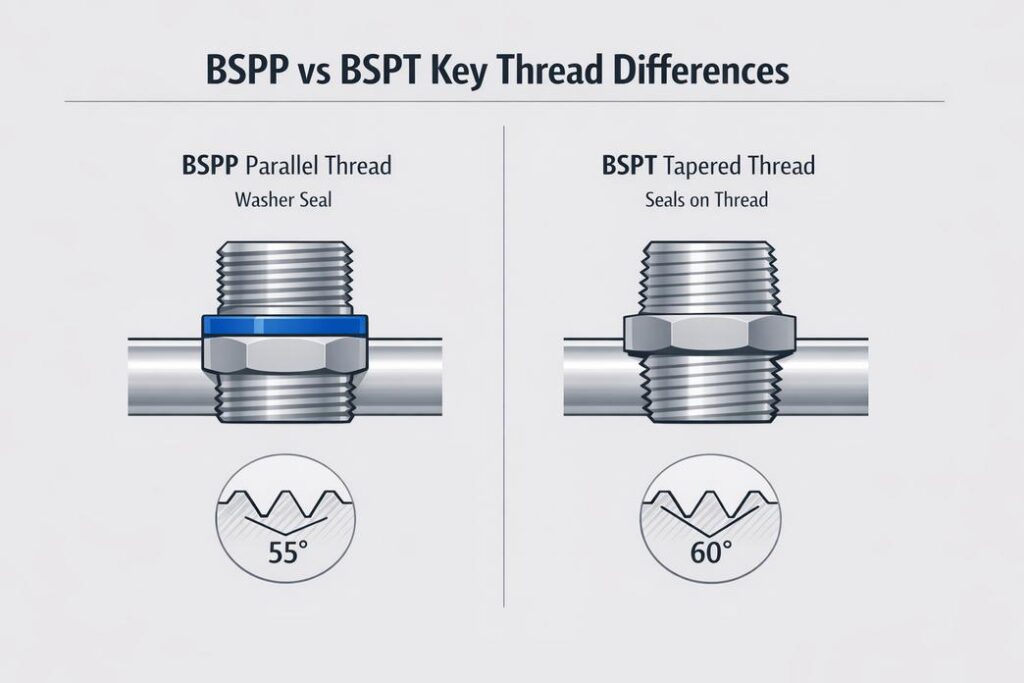
The fundamental division across BSP connection standards centers on thread geometry and designated sealing mechanics:
-
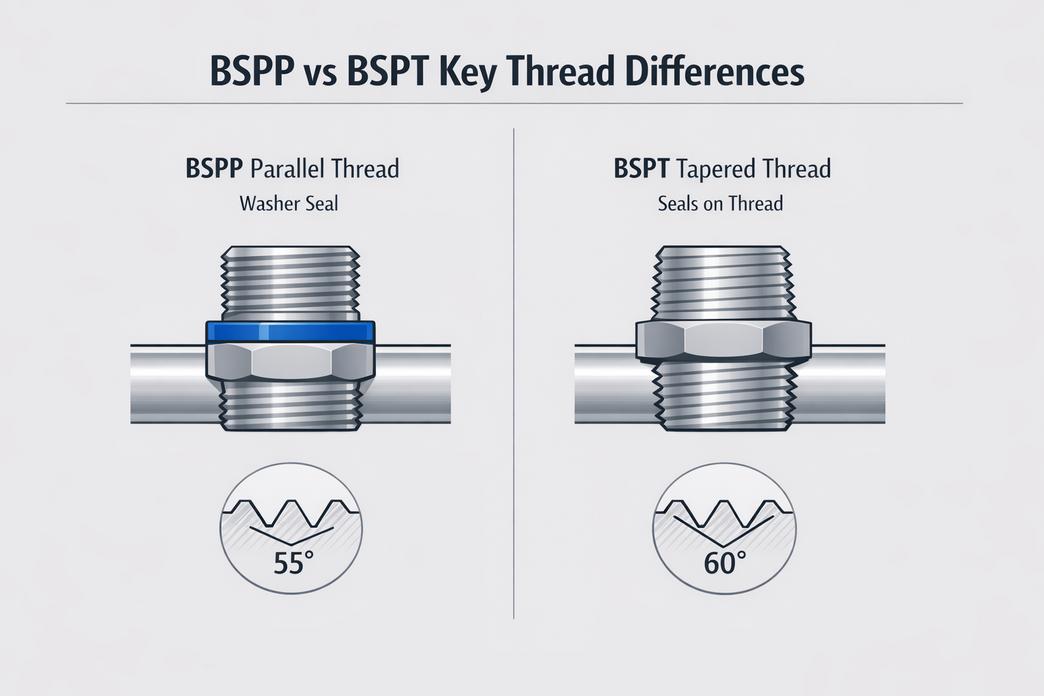
BSPP Fittings (Parallel / G Thread / ISO 228-1):
-
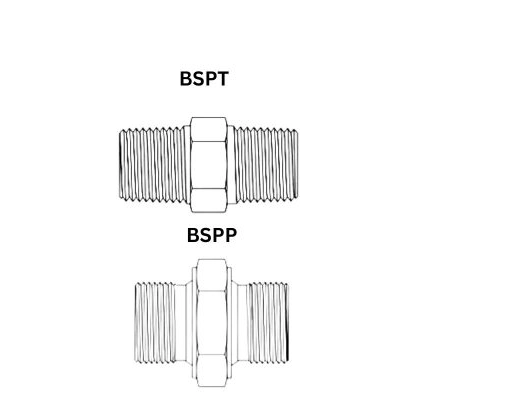
Geometry: The pitch diameter remains constant along the entire engagement axis, characterized by parallel cylindrical walls and a 55-degree Whitworth angle with radiused crests and roots.
-
Sealing Mechanism: Parallel threads do not seal along the mating flanks; their role is purely mechanical retention. Fluid sealing is achieved externally via an elastomeric O-ring, an elastomeric bonded washer (Dowty seal), or a metal-to-metal 60-degree internal cone seat.
-
-
BSPT Fittings (Tapered / R & Rc Thread / ISO 7-1):
-
Geometry: The diameter contracts or expands uniformly along the thread axis with a standard taper ratio of 1:16 (an inclination angle of 1 degree 47 minutes).
-
Sealing Mechanism: A BSPT fitting forms a seal through mechanical flank interference. As the male thread is torqued into the mating female port, the metal flanks wedge tightly against each other, typically accompanied by PTFE thread tape or liquid pipe sealant to eliminate microscopic spiral leak paths.
-
Machining Challenges: Internal vs. External Threads & CNC Tooling Strategy
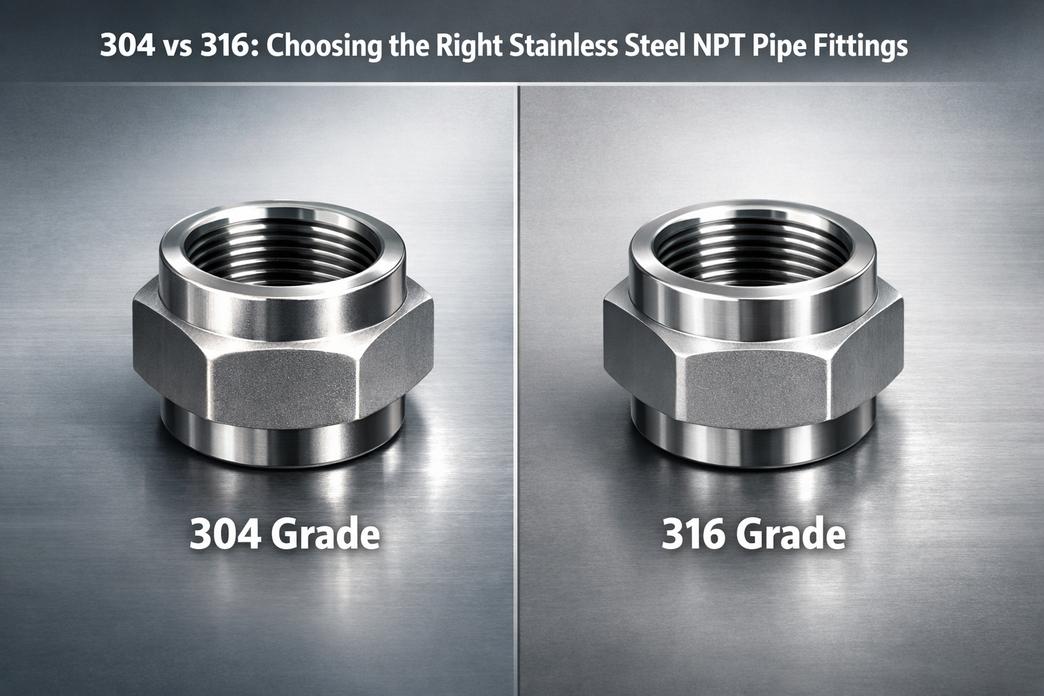
Manufacturing custom BSP threaded fittings from corrosion-resistant alloys like 304 and 316L stainless steel presents severe machining constraints:
-
Internal Threads vs. External Threads: Machining an internal female thread presents significantly higher complexity than turning an external male fitting (such as a standard BSP male thread pipe fitting). External turning benefits from thick, rigid toolholders, whereas internal threading requires boring bars with large length-to-diameter overhang ratios. This overhang introduces deflection, vibration chatter, and axial pitch errors.
-
The Chip Evacuation Bottleneck: Small-diameter internal threads produce continuous, stringy chips when cutting stainless steel. If chips fail to break, they wrap around the boring bar or pack tightly inside blind cavities, leading to abrupt insert chipping, torn flank surfaces, and scraped parts.
-
Tapping vs. CNC Single-Point Threading:
-
BSPP Profiles: Parallel internal threads can be produced via rigid tapping with specialized machine taps on high-speed lines, or single-point turned on multi-axis CNC machines.
-
BSPT Profiles: Tapered threads must be single-point turned via continuous two-axis CNC helical interpolation. Utilizing full-engagement tapered taps dramatically increases cutting contact area and torsional load, causing tap breakage, torn thread roots, and erratic gauge length engagement in stainless alloys.
-
Metrology and Inspection Protocols: How to Inspect BSP Fittings
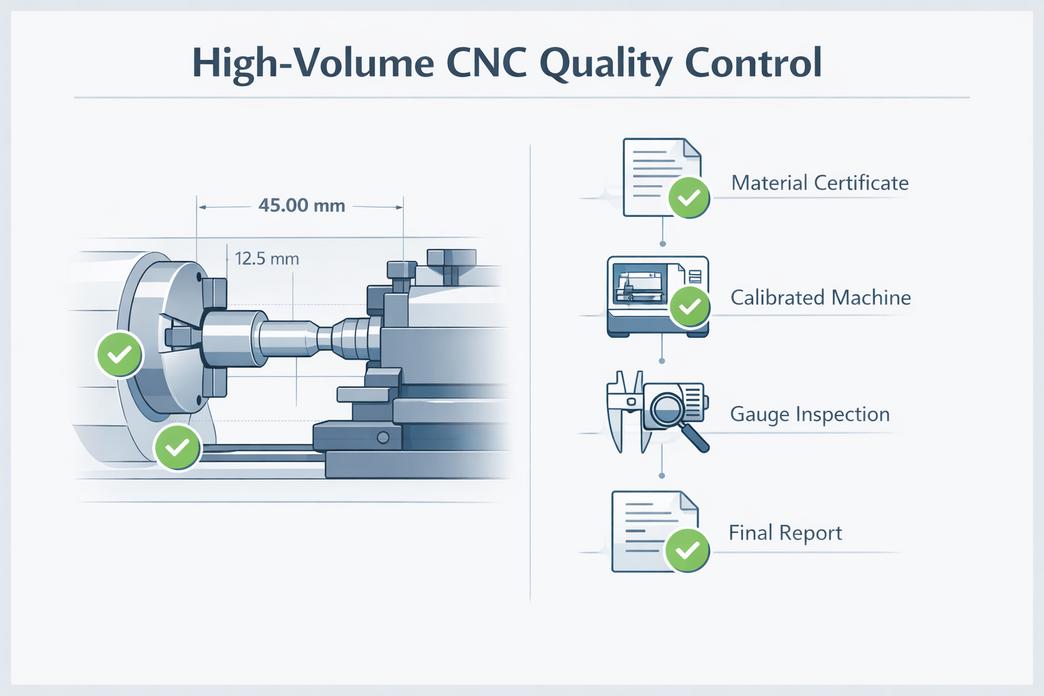
To guarantee zero-defect delivery across custom production runs, multi-tiered metrology must combine tactile shop-floor tools with optical metrology:
-
Physical Hand Measurement and Dimensional Calculation:
-
Technicians measure the major diameter of male threads or the minor bore diameter of female threads using digital calipers checked against precision gauge blocks.
-
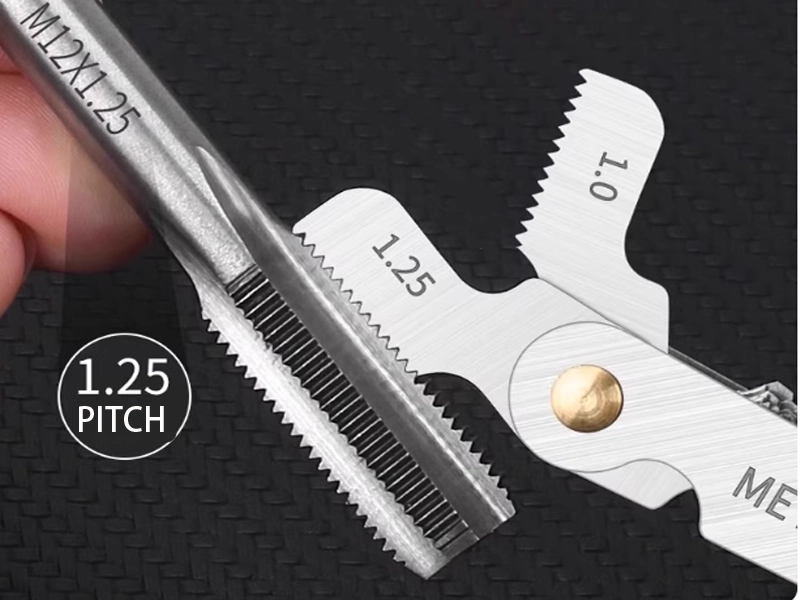
Pitch and thread profile heights are verified using hardened thread pitch leaves and micrometer blades, cross-verifying calculated pitch diameters via the three-wire method.
-
-
100% Production Gaging: Thread Plug & Ring Gauges:
-
Every external male fitting is checked with calibrated BSP thread ring gauges (Go / No-Go).
-
Internal ports are checked using matching BSP thread plug gauges. The Go gauge must spin smoothly through the complete thread depth, while the No-Go gauge must seize firmly within 1.5 turns.
-
-
Advanced Optical and Profile Metrology:
-
2.5D Optical Profile Projectors: Magnify part contours up to 50x to verify the 55-degree flank half-angle, pitch uniformity, and root/crest radii against digital overlays.
-
Toolmaker’s Microscopes: Provide high-magnification surface inspection to detect microscopic burrs, torn flank profiles, and tool scoring within thread roots.
-
Contour Measuring Instruments (Conturographs): Utilize an ultra-sensitive mechanical stylus to trace the thread profile axially, outputting exact digital graphs of pitch diameter, root radii, and effective taper runout.
-
Technical Comparison: BSP vs. NPT vs. NPTF
Selecting between British standard pipe fittings and American standard threaded fittings requires an understanding of cross-standard incompatibility:
| Engineering Parameter | BSPP Fittings | BSPT Fittings | NPT Fittings (ASME B1.20.1) | NPTF Fittings (ASME B1.20.3) |
| Thread Form Angle | 55° (Whitworth) | 55° (Whitworth) | 60° (American National) | 60° (Dryseal American) |
| Crest & Root Shape | Rounded | Rounded | Flat / Truncated | Truncated (Controlled) |
| Taper Ratio | None (Parallel) | 1:16 (Tapered) | 1:16 (Tapered) | 1:16 (Tapered) |
| Primary Sealing Method | O-Ring / 60° Cone | Flank Contact + Sealant | Flank Interference + Sealant | Dryseal Metal Crush (No Sealant) |
| Thread Engagement | Mechanical lock only | Wedge fit | Spiral gap clearance | Full metal-to-metal crush |
| Interchangeability | Strictly with BSPP/Cone | Matches BSPT ports | Matches NPT ports only | Compatible with NPT ports |
-
The Angle Conflict: A 55-degree BSP fitting cannot mate with a 60-degree NPT fitting. Threading an NPT male into a BSP port leads to cross-threading, thread galling, and high-pressure fluid leaks due to flank pitch interference.
-
NPT vs. NPTF (Standard vs. Dryseal): While both standard NPT pipe fittings and NPTF fittings share the same 60-degree taper angle, standard NPT threaded fittings leave clearance gaps between crests and roots, requiring PTFE tape to block spiral leak paths. In contrast, NPTF fittings tightly restrict truncation tolerances; during tightening, the crests crush into the mating roots to achieve a mechanical dry seal without chemical sealants.
Frequently Asked Questions (FAQ)
Q1: What is the main difference between BSP and NPT threaded fittings?
The core difference is thread angle and shape. BSP threaded fittings feature a 55-degree Whitworth profile with rounded crests and roots, whereas NPT fittings utilize a 60-degree angle with flattened crests and roots. They are mechanically incompatible and will gall or leak if forced together.
Q2: Can a BSPP male thread mate directly with a BSPT female port?
In limited low-pressure utility situations, a BSPP male fitting can thread into a parallel BSP port, but mating a parallel BSPP male into a tapered BSPT female port prevents proper flank engagement. The fitting will bind prematurely on the shallow threads without forming a uniform seal face, risking blowout under hydraulic pressure.
Q3: Why are small internal BSP threads more challenging to machine in stainless steel?
Small internal BSP ports restrict cutting tool shank thickness, inducing tool deflection and chatter during single-point turning. Furthermore, continuous stainless steel chips struggle to evacuate through tight bores, wrapping around tool posts and damaging the finished flank profile.
Q4: Can BSP plumbing fittings be interchanged with industrial hydraulic BSP pipe fittings?
No. While residential BSP plumbing fittings and industrial hydraulic BSP adapters share the same thread pitches, commercial plumbing castings possess thinner wall structures and lower burst ratings. Industrial hydraulic applications require solid-bar machined or hot-forged fittings built to withstand continuous dynamic pressure surges.
Partner with a Precision CNC Machining Facility
Whether your application demands high-volume production of standard BSP pipe fittings, custom BSPT pipe fittings, or specialized manifold blocks with cross-standard BSPP and NPT ports, Yuhuan Hongqian Machinery Co., Ltd. delivers contract manufacturing engineered to exact print tolerances.
-
Manufacturing Infrastructure: 1,500 m² workshop equipped with 70 to 80 precision CNC turning and turning-milling centers.
-
Automated Scale: 15 automated gantry loading systems supporting stable monthly production exceeding 200,000 components.
-
Verified Quality Systems: 100% thread plug and ring gaging, supported by 2.5D optical projectors, dial bore micrometers, and EN 10204 Type 3.1 material traceability.
Submit your 2D engineering drawings (PDF) and 3D CAD files (STEP) to our engineering team today for comprehensive DFM feedback and competitive factory-direct pricing within 24 to 48 hours.